Radar Rules and Performance Standards: SOLAS, IMO, STCW, COLREG
RadarThe rules behind shipborne radar: what STCW expects of a senior officer, which radars SOLAS Chapter V requires by tonnage, the IMO MSC.192(79) performance figures, the COLREG rules on radar use, and how to confirm and keep a radar in good working order.
Last reviewed 1 Nov 2026 · From a professional captain's years of study notes · Organised with AI and checked against current regulations · How we write
On this page (11)
Four rulebooks behind every shipborne radar
In short: STCW = the officer, SOLAS V = which radar, IMO MSC.192(79) = what the set must achieve, COLREG = how radar is used.
A ship’s radar sits under four layers of rules, each answering a different question:
| Instrument | Question it answers |
|---|---|
| STCW (Code, Table A-II/2) | What must the officer know and be able to do with radar? |
| SOLAS Chapter V | Which ships must carry which radars, and how are they installed, approved and maintained? |
| IMO performance standards — today MSC.192(79) | What must the equipment itself achieve: detection, accuracy, discrimination, start-up time, fallback? |
| COLREG | How must radar be used to keep a look-out and avoid collision? |
Exam tip: resolution numbers and the detailed values in the standards are what port State control, flag inspectors and surveyors quote. Know that they exist and what each covers, and keep the headline figures (carriage thresholds, range and bearing accuracy) at your fingertips — those do get asked.
STCW — what a senior officer must be able to do with radar
In short: STCW A-II/2 expects a Master or chief mate to plan and fix (and judge the fix), coordinate SAR, organise the watch and use equipment data for command decisions.
Table A-II/2 of the STCW Code sets the knowledge, understanding and proficiency (KUP) for masters and chief mates. For radar navigation it expects you to:
- Plan a voyage and conduct the navigation.
- Fix the position — and judge how accurate that fix is — by any means available.
- Coordinate search and rescue operations.
- Set up watchkeeping arrangements and procedures.
- Keep the ship safe by using the information from the bridge equipment to support command decisions.
STCW also defines how each competence is to be demonstrated and the criteria used to evaluate it.
Building blocks: management-level radar training (IMO model course 1.08) assumes you already hold radar/ARPA at operational level (IMO model course 1.07) and an OOW qualification (model course 7.03 or the yacht equivalent).
SOLAS Chapter V — which ships carry which radar
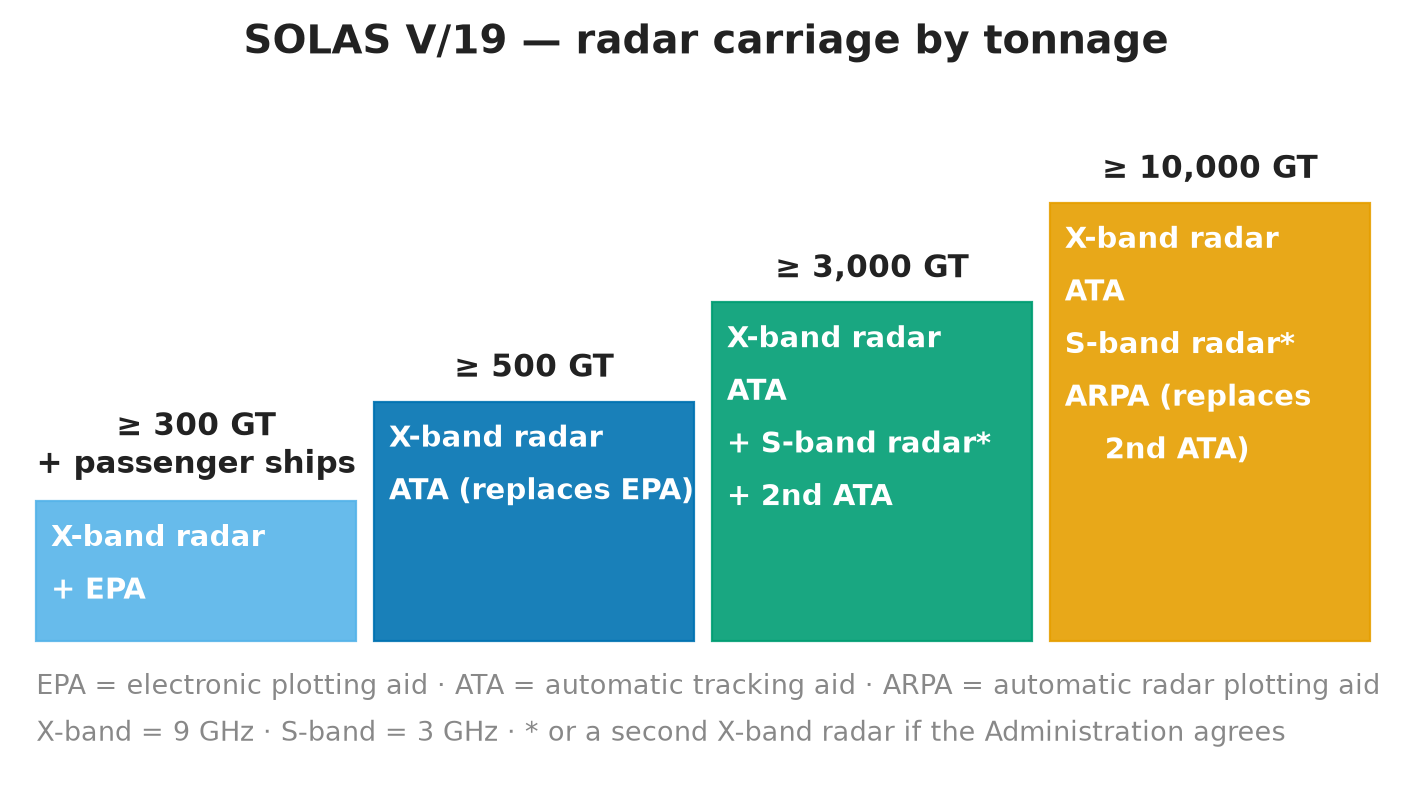
In short: SOLAS V/19 sets radar carriage by size — 300 GT X-band, 500 GT + ATA, 3,000 GT + S-band and a 2nd ATA, 10,000 GT an ARPA in place of the 2nd ATA; SOLAS V/16.2 lets you sail on with a defect.
Who Chapter V applies to
SOLAS Chapter V — Safety of Navigation applies to all ships on all voyages. Exceptions: warships and government ships on non-commercial service, and ships trading only on the North American Great Lakes (west of Quebec).
The flag State may decide how far the chapter applies to:
- ships under 150 GT on any voyage;
- ships under 500 GT not on international voyages;
- fishing vessels;
- ships operating landward of the baselines.
The regulations that matter for radar, ARPA and AIS
| Regulation | Subject |
|---|---|
| V/15 | Principles of bridge design and arrangement |
| V/16 | Maintenance of equipment |
| V/17 | Electromagnetic compatibility |
| V/18 | Approval, surveys and performance standards |
| V/19 | Carriage requirements |
- Reg. 18 — equipment installed on or after 1 July 2002 must be type-approved and meet the IMO performance standard in force when it was installed: MSC.64(67) for radars (A.823(19) for ARPA) from 1 July 2002, and IMO MSC.192(79) for radars installed on or after 1 July 2008 (the date in the IMO text).
- Reg. 16.2 — a breakdown of navigational equipment does not by itself make the ship unseaworthy; the voyage may continue, taking the defect into account, until it can be repaired.
Regulation 19 — radar carriage by size
| Ship | Radar equipment required |
|---|---|
| 300 GT and over, and every passenger ship whatever its size | One 9 GHz (X-band) radar + an electronic plotting aid (EPA) — SOLAS V/19.2.3 |
| 500 GT and over | Add an automatic tracking aid (ATA), which replaces the EPA — SOLAS V/19.2.5 |
| 3,000 GT and over | Add a 3 GHz (S-band) radar — or a second 9 GHz set if the Administration agrees — plus a second ATA — SOLAS V/19.2.7 |
| 10,000 GT and over | An automatic radar plotting aid (ARPA: at least 20 targets, connected to the speed log, trial manoeuvre) in place of the second ATA, plus a heading or track control system — SOLAS V/19.2.8 |
Memory hook: 300 see → 500 track → 3,000 double → 10,000 ARPA.
Exam tip: a 2,000 GT ship needs a 9 GHz radar + ATA; a 12,000 GT ship needs X-band + S-band (or a second X-band) + ATA + ARPA. This carriage question comes up regularly — learn the thresholds.
Regulation wording vs bridge memo. SOLAS V/19 speaks of an ATA from 500 GT and an ARPA from 10,000 GT (V/19.2.8, in place of the second ATA). A practical memo used by experienced Masters (partly reconstructed) puts ARPA earlier: 300–500 GT → X-band · 500–3,000 GT → X-band + ARPA · 3,000–10,000 GT → X + S, with ARPA on each · 10,000 GT and over → X + S + ARPA. In practice almost every modern radar has ARPA (target tracking) built in. For the exam, answer with the regulation: ATA from 500 GT, ARPA from 10,000 GT.
X-band and S-band compared
| X-band | S-band | |
|---|---|---|
| Frequency / wavelength | 9 GHz / 3 cm | 3 GHz / 10 cm |
| Typical output | under 10 kW | about 20–30 kW |
| Strength | Sharper, more detailed picture — shorter wavelength, short pulse, more pulses per second → better on small targets, ideal coastal | Longer propagation, much less loss in heavy rain and thick fog → offshore and bad weather |
The two are linked by v = f · λ (speed of radio waves = frequency × wavelength).
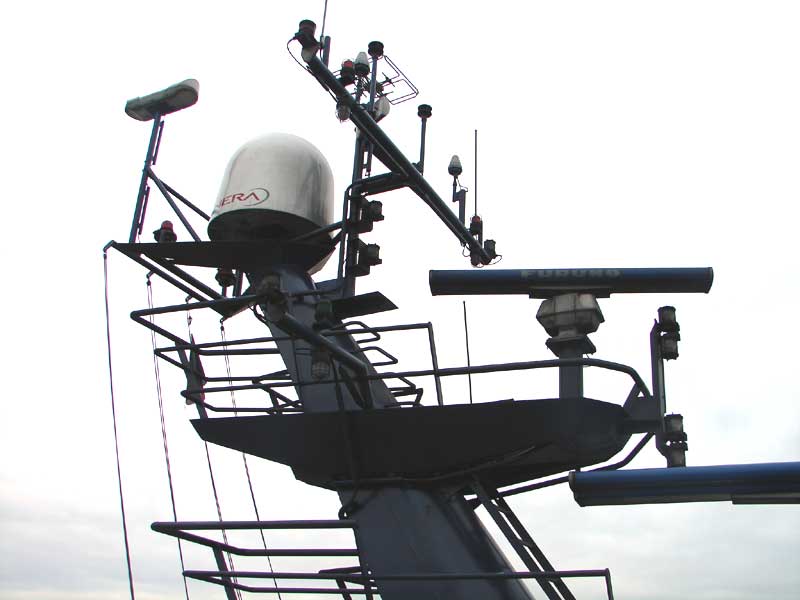
On deck you can tell them apart: an S-band scanner is visibly larger than an X-band one. A quick on-board check: a radar SART only answers X-band, so if a SART shows on both displays, both sets are X-band — the S-band set has been replaced or is missing. Thorough familiarisation catches this kind of surprise.
IMO performance standards — what the radar itself must achieve
In short: IMO MSC.192(79) fixes what the set must achieve: range 30 m or 1 %, bearing 1°, minimum detection ranges, 4 min start-up, automatic fallback.
Which standard applies
- The standard a radar must meet depends on the year the ship was built or the set was installed. It fixes detection range, discrimination, accuracy, anti-clutter and tracking performance.
- The current standard, MSC.192(79), merged the radar and ARPA standards: ARPA is now called the target tracking (TT) function of the radar system.
- Older standards still met on board: A.477(XII) (older radars) and A.823(19) (ARPA).
Minimum detection ranges
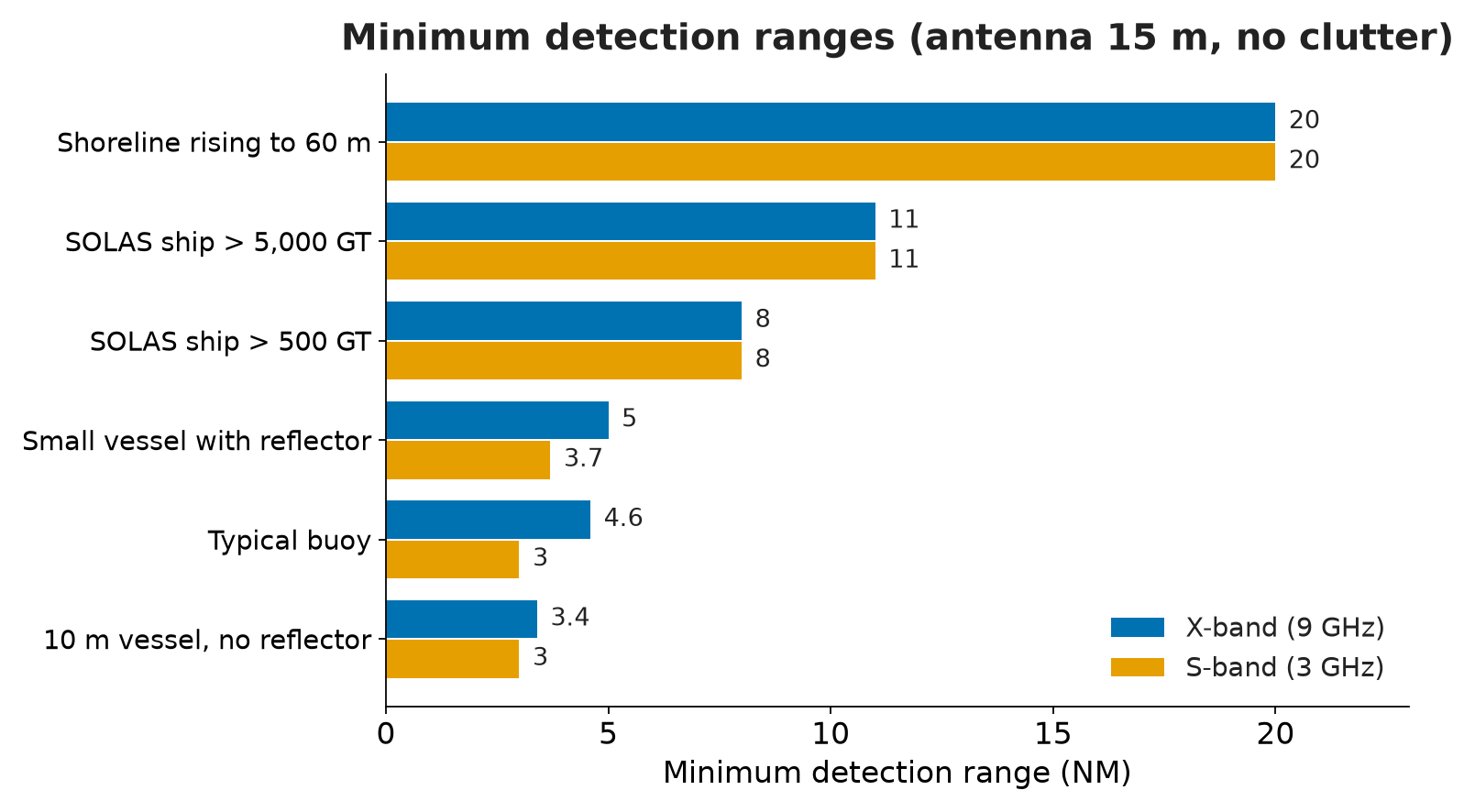
Conditions: no clutter, antenna 15 m above the sea, target detected on 8 scans out of 10. The heights below are the height of the target above sea level, not of the antenna.
| Target | X-band | S-band |
|---|---|---|
| Shoreline rising to 60 m | 20 NM | 20 NM |
| Shoreline rising to 6 m | 8 NM | 8 NM |
| Shoreline rising to 3 m | 6 NM | 6 NM |
| SOLAS ship over 5,000 GT (10 m) | 11 NM | 11 NM |
| SOLAS ship over 500 GT (5 m) | 8 NM | 8 NM |
| Small vessel with radar reflector (4 m) | 5.0 NM | 3.7 NM |
| Typical navigation buoy | 4.6 NM | 3.0 NM |
| 10 m vessel without reflector (3.5 m) | 3.4 NM | 3.0 NM |
These are minimums, just like the minimum visibility ranges of navigation lights. If your S-band picks up a small vessel with a reflector only at 2 NM (less than 3.7 NM), the radar is not performing and needs attention.
Key performance figures
| Item | Requirement |
|---|---|
| Short range | Targets clearly shown from 50 m out to 1 NM (a buoy detectable from 40 m) without touching any control except the range scale |
| Range accuracy | Within 30 m or 1 % of the range scale in use, whichever is greater (older A.477(XII): 70 m or 1.5 %) |
| Bearing accuracy | Within 1° |
| Range discrimination | 40 m |
| Bearing discrimination | 2.5° |
| Discrimination conditions | Calm sea, range scale 1.5 NM or less, targets between 50 % and 100 % of the scale |
| Roll and pitch | Detection not seriously degraded up to ±10° |
| Start-up | Fully working within 4 min from cold, and within 5 s from standby |
What the figures mean in practice:
- Bearing check alongside: compare the radar bearing of a lighthouse at the harbour entrance with the chart or ECDIS — no more than 1° difference (the same idea as finding the compass error alongside).
- Range check: compare the radar range of a charted fixed object with the charted distance. A fixed echo at 1.5 NM on radar that the chart puts at 1.55 NM points to a range accuracy problem — not a bearing, gyro or synchronisation issue.
- Why discrimination matters: a tanker with a launch alongside (or two ships in a ship-to-ship transfer) can merge into one blob. When the launch pulls away, the tracker may show the “250 m tanker” suddenly doing 25 kn towards you.
- Roll and pitch: the beam has a vertical width, so a target is held while the ship rolls.
- Warm-up: many sets show a countdown (around 2 min on some models, always within the 4 min limit) and will not transmit until it ends. The standby screen also shows the running hours — useful for the maintenance plan and for magnetron life.
- Radar bearings are always less accurate than ranges (beam width widens echoes — take the centre of the echo; check heading marker and gyro alignment): a radar is a precise ruler but a mediocre compass.
Fallback arrangements
The standard requires the radar to keep its basic functions when part of the system fails — inputs for heading, speed through the water, COG/SOG, position, the radar video, AIS and the network.
The key case: if azimuth stabilisation (heading input) fails, the radar must switch automatically to unstabilised head-up within 1 minute, and any automatic anti-clutter processing that relies on stabilisation switches itself off.
On the display this shows as a red alert with an exclamation mark; with no north or course reference, head-up is the only mode left, so the picture turns with every alteration of course.
COLREG — the rules that bring radar into collision avoidance
In short: COLREG Rules 5, 6, 7, 8 and 19 bring radar into look-out, safe speed, risk of collision and restricted visibility — never judge on scanty radar information.
Rules that require radar
| Rule | What it asks of radar users |
|---|---|
| Rule 5 — Look-out | Keep a proper look-out by all available means — radar included |
| Rule 6 — Safe speed | Lists radar-specific factors to weigh when setting a safe speed |
| Rule 7 — Risk of collision | Use radar properly: long-range scanning for early warning and radar plotting or equivalent systematic observation |
| Rule 8 — Action to avoid collision | Action must be early, substantial and in line with good seamanship |
| Rule 19 — Restricted visibility | Conduct when vessels are not in sight of one another, including action on radar contact alone |
Also know Rule 2 (responsibility) and Rule 3 (definitions).
The radar factors in Rule 6(b): the characteristics, efficiency and limitations of the set · the range scale in use · the effect of sea state, weather and interference · the risk that small vessels, ice and other floating objects are not detected at an adequate range · the number, location and movement of vessels detected · the more exact assessment of visibility that radar ranges allow.
Scanty radar information
Rule 7(c): no assumptions may be made on the basis of scanty information, especially scanty radar information.
At management level you must judge both the integrity of radar collision-avoidance data (how it was processed) and its reliability (how accurate it is).
Exam tip: if the examiner shows a single plotted position and asks what the target is doing, the answer is “scanty information” — ask for more plots, because the next ones may show it is actually moving away.
Applying Rules 2, 8 and 19 with radar
- Rule 8: an alteration must be readily apparent to the other ship — not 1–2°, but no need for 90° or 180° either. Show your intention clearly, especially as the give-way vessel.
- Rule 2: if you are the stand-on vessel and the other ship does nothing, remember the general duty of good seamanship too.
- Rule 19: in restricted visibility there is no stand-on vessel — both ships must act.
- Learn the Rules up to 19 by heart for the exam, but understand them rather than reciting them. For lights and shapes, know the meaning, not the rule number.
Exam tip: dense fog, narrow channel, a container ship 2.5 NM ahead, CPA 0.8 NM, no answer on VHF → reduce speed and prepare to take avoiding action. In a developing collision situation the safe first answer is always to reduce speed. Wrong options to eliminate: keep course and speed; increase speed and overtake to starboard; the word “head-on” in an option only tells you the target is ahead.
Confirming that the radar is working normally
In short: Run the performance monitor at least monthly and compare the picture with what the set should show; spotting a fault is the chief officer’s job.
A radar is in normal operation when it delivers everything it is meant to:
- a clear picture of land in coastal and harbour waters;
- an enhanced traffic picture;
- ship-to-ship collision avoidance;
- detection of small floating and fixed hazards;
- detection of aids to navigation.
The standard detection table assumes a 15 m antenna and no clutter. Real conditions are different, so judging whether the set is performing comes down to experience and knowledge.
Built-in checks:
- Performance monitor — an internal self-test of the transmitter and receiver that sends nothing out, much like a VHF showing “TX OK / RX OK”. Run it at least monthly (or as company policy sets).
- Pulse power monitors.
- Tracking function tests.
Who is expected to notice: a Master may forgive a second officer for missing a radar fault, but not a chief officer. Report any failure to the Master immediately — the only reasonable delay is a short one on a quiet night ocean crossing with no traffic and excellent visibility.
Equipment factors — magnetron, antenna and sensor failures
In short: Magnetrons fade without an alarm, a dirty or iced antenna weakens echoes, and each sensor failure (gyro, log, GNSS) removes specific radar functions.
Magnetron and solid-state transceivers
- Magnetron life: reference figure 4,000–20,000 hours; experienced Masters report 10,000–30,000 hours, and some failing under 10,000. The higher the output power, the shorter the life.
- A magnetron ages gradually and gives no alarm: at the same berth, with nothing touched, the picture simply gets weaker day after day — then it is time to replace it. Track the running hours so the replacement can be planned.
- The designated officer (second officer or ETO) maintains the set according to the manufacturer’s manual and records the work in the radar logbook.
- Solid-state transceivers give better detection with far lower power, need less maintenance and last longer.
Antenna
- Salt, ice and dirt on the antenna’s radiating window degrade the echoes → clean it regularly (arranged by the chief officer).
- Ice on the scanner: from the bridge you can slow down (less spray) and alter 10–20° away from the sea. Ice high up is also a stability risk (top weight).
What each sensor failure does to the radar
| Failure | Effect on the radar |
|---|---|
| Heading (THD/gyro) | Only unstabilised head-up is possible · no target tracking, no AIS functions, no ECDIS/chart overlay · echo averaging, echo expansion, sweep correlation and automatic anti-clutter limited or switched off |
| Speed log (SDME) | Speed must be entered manually → a large, unavoidable error; current makes a manual speed wrong all the time |
| GNSS (radar running on speed through the water) | Target tracking keeps working, but AIS target functions are lost: no range, bearing, CPA, TCPA, BCR or BCT for reported targets |
Response: under the fallback section of MSC.192(79) (§9) the system raises alerts and the OOW acts as the manual directs. The management response: extra look-outs, reduce speed, Master takes the con.
Operation and settings — keeping the radar in good working order
In short: Check the data feeding the radar, use gain, tuning and clutter together, and know every control before you need it.
Check the data feeding the radar
- Verify the integrity of the primary data: time, position, course and speed.
- GNSS feeds the radar five basics: date, time, position, SOG and COG. GNSS integrity drives AIS accuracy.
- Check the association of TT and AIS targets and the accuracy of the ECDIS–radar overlay.
Get the best picture
- A high-quality image comes from using gain, tuning and clutter suppression together. Both the operator and the set are judged by the quality of the echoes.
- Switch between speed through the water (STW) and speed over the ground (SOG) at the right time for the task, and know the limits of each speed sensor.
The team leader’s role
- Avoidance decisions are built from trails + manual plot + target tracking + AIS association.
- The team leader must know every control without thinking — no time can be lost operating the set while a decision is needed.
- A Master arriving on the bridge brings calm: takes the con, looks out of the window first, then at the radar (12 NM, then 6 NM…). The higher the rank, the greater the responsibility — a likely theme in the orals.
- Familiarisation checklists (within 24 hours, then 7, 14 and 30 days) are a real check of the equipment, not a tick-box exercise.
⚡ Flashcards
Test yourself, one card at a timeQ1Four rulebooks: who answers what?
AnswerSTCW = the officer · SOLAS V = carriage, installation, maintenance · MSC.192(79) = what the set must achieve · COLREG = how radar is used.
Q2STCW A-II/2: five radar-related competences at management level?
AnswerVoyage planning & navigation · position and accuracy of the fix · coordinate SAR · watchkeeping arrangements · equipment info for command decisions.
Q3SOLAS V/19 radar carriage ladder?
Answer300 GT + all passenger ships → X-band + EPA · 500 → ATA · 3,000 → + S-band (or 2nd X-band) + 2nd ATA · 10,000 → ARPA in place of the 2nd ATA (SOLAS V/19.2.8). 2,000 GT = X-band + ATA.
Q4S-band fails at sea, X-band works: action?
AnswerCarry on with X-band, log it, tell Master and company, extra caution, repair soon. SOLAS V/16.2: a breakdown does not make the ship unseaworthy.
Q5X-band vs S-band?
AnswerX: 9 GHz / 3 cm, sharper, small targets, coastal. S: 3 GHz / 10 cm, longer range, less loss in rain and fog. A radar SART answers X-band only.
Q6MSC.192(79) range and bearing accuracy?
AnswerRange 30 m or 1 % of the scale in use (whichever greater) · bearing 1° · discrimination 40 m / 2.5° · ready in 4 min from cold, 5 s from standby.
Q7Minimum detection: ship > 5,000 GT, buoy, small vessel with reflector?
Answer11 NM · buoy X 4.6 / S 3.0 NM · small vessel X 5.0 / S 3.7 NM. These are minimums: less = radar not performing.
Q8Heading (azimuth stabilisation) input fails?
AnswerRadar drops to unstabilised head-up within 1 min; stabilisation-based anti-clutter switches off; no tracking, AIS functions or chart overlay.
Q9COLREG rules that involve radar?
AnswerRules 5, 6, 7, 8 and 19 (plus 2 and 3).
Common trapOne plot = scanty information, ask for more (Rule 7(c)). Rule 19: no stand-on vessel, both act.
Q10Performance monitor: what and how often?
AnswerInternal test of transmitter and receiver, nothing transmitted. At least monthly. Spotting a radar fault is the chief officer’s job.
Q11Magnetron: life and warning signs?
AnswerAbout 4,000–20,000 h (field reports 10,000–30,000 h). No alarm: the picture just weakens day by day → track running hours.
Q12Five data GNSS feeds the radar?
AnswerDate, time, position, SOG and COG.
📚 Resources
Videos
- COLREG Rule 7 explained — Sea Nomad
- Rule 19 - Conduct of vessels in Restricted visibility | Rules of the road | Merchant navy | COLREGS — Merchant Navy Knowledge
Books
- Radar and ARPA Manual: Radar, AIS and Target Tracking for Marine Radar Users — Alan Bole, Alan Wall, Andy Norris, 3rd edition (Butterworth-Heinemann, 2014)
Regulations
- IMO Resolution MSC.192(79) — Revised performance standards for radar equipment
- SOLAS Chapter V, Regulations 15–19 (bridge design, maintenance incl. V/16.2, EMC, approval and performance standards, carriage); COLREG Rules 2, 3, 5, 6, 7, 8 and 19; STCW Code Table A-II/2
- MGN 610 (M+F) Amendment 1 — SOLAS Chapter V guidance on the Merchant Shipping (Safety of Navigation) Regulations 2020 — MCA
Exam focus — Malta
Typical questions • “Radar carriage for a 2,000 GT ship under SOLAS V/19?” → 9 GHz (X-band) radar + ATA. Know the ladder: 300 GT X-band · 500 GT + ATA · 3,000 GT + S-band (or 2nd X-band) + 2nd ATA · 10,000 GT ARPA in place of the 2nd ATA (SOLAS V/19.2.8). • “A fixed echo shows 1.5 NM on radar, 1.55 NM on the chart — what error?” → range accuracy (IMO MSC.192(79): 30 m or 1 % of the scale in use). Bearing, gyro and antenna synchronisation are distractors. • “The 10 cm radar fails, the 3 cm still works — action?” → continue on X-band, log and report, extra caution, repair soon (SOLAS V/16.2). • “Fog, narrow channel, ship 2.5 NM ahead, CPA 0.8 NM, no VHF reply?” → reduce speed and prepare to take avoiding action (COLREG Rule 19: no stand-on vessel). • “One plotted point — what is the target doing?” → scanty information, ask for more plots (COLREG Rule 7(c)). What examiners look for: the right instrument for each question (STCW = people, SOLAS = carriage, MSC.192(79) = equipment, COLREG = use); headline figures rather than resolution numbers; and reasoning, not recitation. In multiple choice, eliminate the wrong options first, then read for the keywords — the wording can be tricky.