Radar Plotting: the OAW Triangle, CPA and TCPA
RadarHow to work a manual radar plot: the O-A-W triangle, CPA, TCPA, bow crossing range and time, the target's true course, speed and aspect, and how a course or speed change moves the relative line. It is your backup when ARPA fails and a standard paper exercise in the Malta radar exam.
Last reviewed 1 Nov 2026 · From a professional captain's years of study notes · Organised with AI and checked against current regulations · How we write
On this page (14)
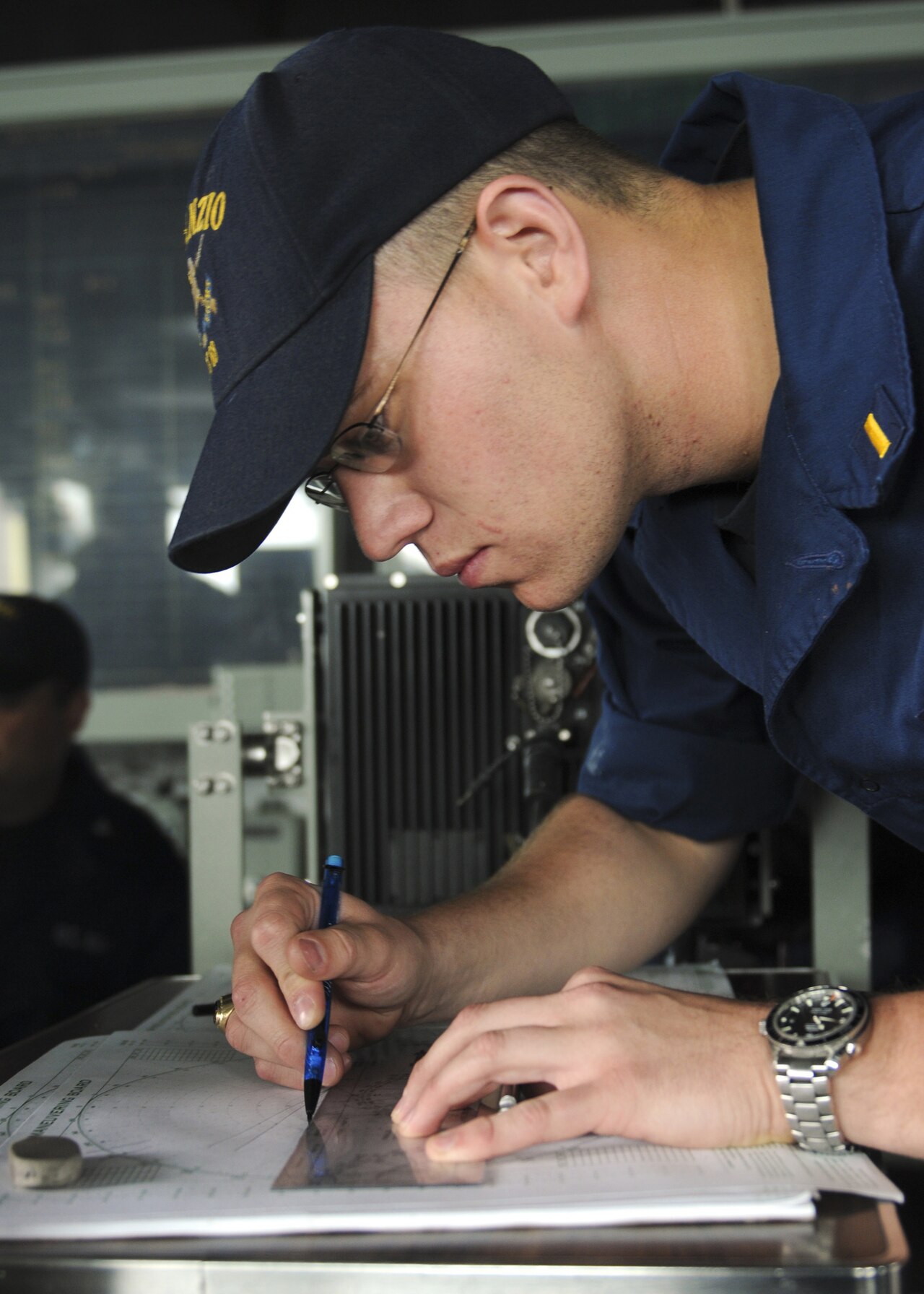
Why plot by hand?
In short: ARPA plots for you, but a senior officer keeps manual plotting alive — as a backup and as a way to understand the picture.
- At management level, advise your OOWs not to give up manual plotting, and make sure they practise it regularly.
- It is your backup if ARPA fails.
- It builds situational awareness: you see how your own course and speed changes affect each encounter.
- ARPA is simply an automated O-A-W plot — the same triangle, done by the computer.
Manual plot or ARPA?
| Manual plot | ARPA (TT) | |
|---|---|---|
| Time to first answer | 6 min or more — 3 positions plus drawing | About 1 min for first data; steady tracking after about 3 min |
| Workload | One target at a time | About 4 targets in 3 min, and many more |
| Accuracy | Lower — drawing and reading errors | Higher |
- Manual plotting is slow and less accurate. With many targets or high speeds it cannot keep up.
- That is why manual plotting is not one of the three key sources in heavy traffic — those are radar TT (ARPA), AIS and TT–AIS association.
On the bridge
- Your first manual plot can take a very long time. With practice it takes minutes — practise until the triangle is automatic.
- Keep a plotting sheet ready on the bridge.
What the plot can and cannot trust
In short: the relative plot comes straight from the radar echoes. The target’s true motion also needs your own heading and speed — feed in wrong data and the true answers are wrong.
- CPA, TCPA, BCR and BCT come from the relative plot only → they are independent of own course and speed.
- The target’s true course, speed and aspect need own course and speed through the water → GIGO (garbage in, garbage out). Wrong heading or speed input → wrong target data, by hand and by ARPA.
- GIGO applies to radar, ECDIS and AIS alike. The one part of the system that can catch bad input is the watchkeeper.
- If any input fails, ARPA still gives you at least CPA and TCPA.
Why, on the triangle
- OA is measured from the radar echoes themselves.
- WO is built from the gyro (heading) and the log (speed).
- Gyro error → WO points the wrong way → W is in the wrong place → WA is wrong.
- Log error → WO has the wrong length → W is in the wrong place → WA is wrong too.
- OA does not change, so CPA and TCPA stay right.
Why sea-stabilised for collision avoidance
- A sea-stabilised display uses gyro heading and log speed through the water.
- The target’s true vector then shows its heading through the water, which gives you its aspect — the key to which COLREG rule applies.
Plotting maths
In short: three formulas, one proportion and a scale. Work one step at a time: time → NM → cm.
Speed, distance and time
- D = S × t ÷ 60 (D in NM, S in kn, t in min). The 60 is always there: knots are per hour, the plot works in minutes.
- Speed: S = D × 60 ÷ t · Time: t = D × 60 ÷ S.
- Read the interval first. If O→A covers 12 min, own run = 2 × the 6-min distance.
| Interval | Distance run = speed ÷ | At 28 kn |
|---|---|---|
| 3 min | 20 | 1.4 NM |
| 6 min | 10 | 2.8 NM |
| 10 min | 6 | 4.67 NM |
| 12 min | 5 | 5.6 NM |
| 15 min | 4 | 7 NM |
| 20 min | 3 | 9.33 NM |
| 30 min | 2 | 14 NM |
The rule of sixes
- 6 min = 0.1 h, so just move the decimal point: 12.5 kn → 1.25 NM in 6 min → 2.5 NM in 12 min (double it).
- It is the old UK method from before calculators. British practice is to plot at 6-min intervals; American practice sometimes uses 15 min, depending on distance and speed.
- Some UK oral examiners still ask you to plot without a calculator — so learn it. A calculator has been allowed in the Malta assessment, but check on the day.
Proportions — for TCPA and BCT
- At constant relative speed, distance and time are proportional.
- d₁ : t₁ = d₂ : x → x = d₂ × t₁ ÷ d₁.
- Example: the target ran 3.1 NM in 12 min; 6.2 NM are left to CPA → x = 6.2 × 12 ÷ 3.1 = 24 min.
- Another: 2 : 12 = 3 : x → x = 3 × 12 ÷ 2 = 18.
- Sanity check: double the distance → double the time.
- Simple proportions are easier than formula triangles. If rearranging is the problem, make x the subject and move the terms across. Round numbers make interpolation easy.
- The same proportion gives TCPA and BCT: time is proportional to distance along the relative line.
NM to cm on the sheet
| Sheet | Range 12 NM | Range 6 NM |
|---|---|---|
| A3 (radius 12 cm) | 1 NM = 1 cm | 1 NM = 2 cm |
| A4 (radius 6 cm) | NM ÷ 2 = cm | 1 NM = 1 cm |
- Other sheets: measure the radius first → 1 NM = radius ÷ range.
The O-A-W triangle
In short: three points, three vectors. OA is what the radar shows, WO is what you are doing, WA is what the target is really doing.
- O = first plotted position of the target · A = last position.
- OA = relative approach (arrow O→A).
- WO = own ship’s run in the interval (“way of own”).
- WA = the target’s run in the interval (“way of another”) = its true vector.
Set up the sheet
- Write own course and speed at the top of the sheet (the exam sheet gives them) and read the interval.
- Pick the scale from the biggest distance on the sheet. Cover or cut off the part of the scale you do not use, so you cannot read it by mistake.
- Draw a small reference triangle in a corner: O · A · W, with every arrow direction marked. Add O1 = alteration of course and O2 = reduction of speed (O3 if you like). It is your reference whatever the plot looks like.
- Do not draw extra lines — the plot only gets messy.
Plot it step by step
- Plot the target at fixed intervals (usually 6 min). First position = O, last = A.
- Relative speed = OA × 60 ÷ interval.
- From O, lay own ship’s run in the interval along the reciprocal of own course → that point is W. WO = own vector.
- WA = target’s true vector: target course = direction W→A · target speed = WA × 60 ÷ interval.
- Extend O→A past own ship → relative motion line (RML). From it you get CPA, TCPA, BCR and BCT.
Why three observations
- One or two dots cannot show you whether the target is holding its track. With three you can see if the track stays consistent or changes.
- Plots not perfectly in line? Do not take the middle. Draw the line through the most dangerous one (the closest CPA). When in doubt, assume the worst case.
CPA and TCPA
In short: CPA is the shortest distance between own ship and the relative motion line; TCPA is how long the target takes to get there.
- CPA (closest point of approach) = perpendicular (90°) from own position to the RML. Mark that point X.
- The CPA is not the length of O–A.
- TCPA (time to CPA) = distance A→X × 60 ÷ relative speed. Add it to the time of A for the clock time.
- Or by proportion: (time O→A) : (distance O→A) = TCPA : (distance A→X).
- Example answers on a typical exam sheet: CPA 1.2–1.5 NM · TCPA ≈ 25 min · BCR 2.4 NM · BCT ≈ 23 min.
Worked example
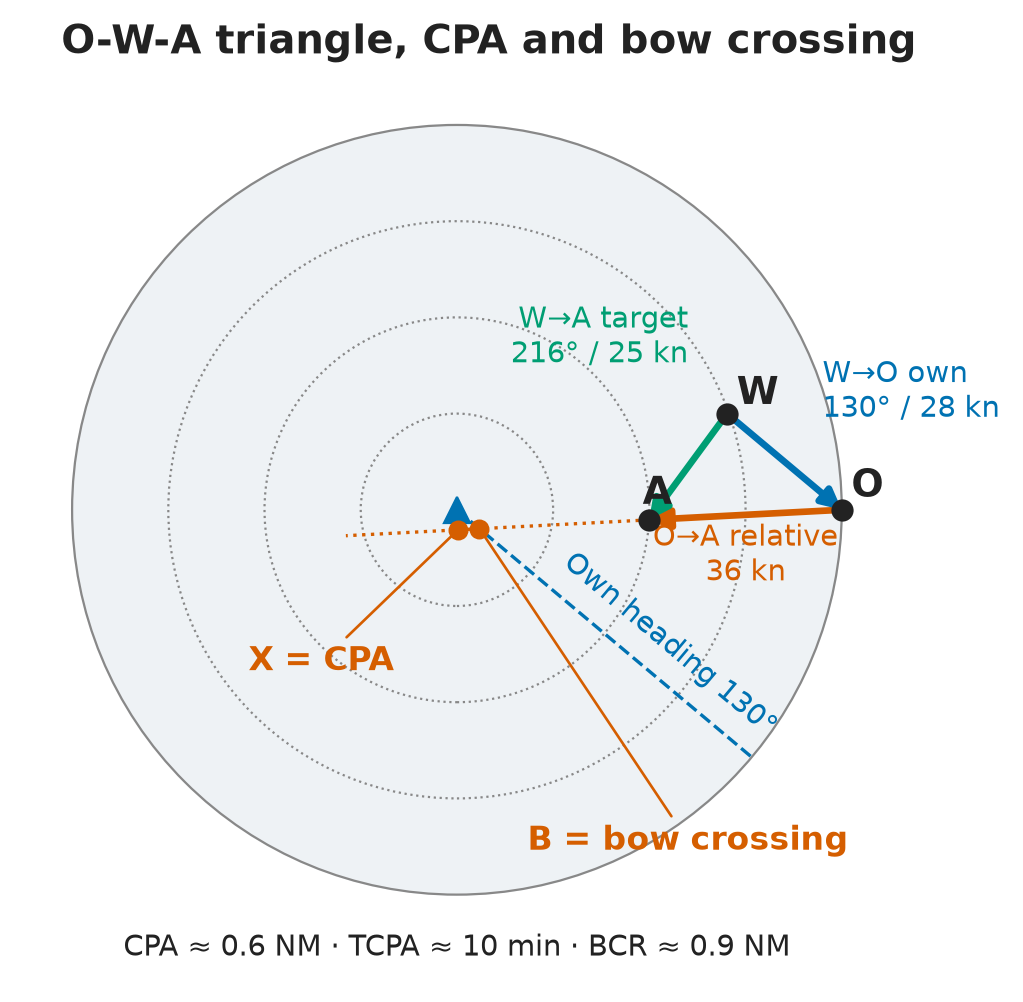
- Own ship 130° / 28 kn, range scale 12 NM.
- Target at 1500: 090° / 12 NM → at 1510: 093° / 6 NM (interval 10 min).
- Own run in 10 min: 28 ÷ 6 = 4.67 NM.
- OA ≈ 6 NM in 10 min → relative speed 36 kn.
- CPA ≈ 0.6 NM · TCPA ≈ 10 min after 1510 → about 1520.
- Target’s true course and speed ≈ 216° / 25 kn.
- COLREG: the target is crossing from port, so it is the give-way vessel (COLREG Rule 15). Own ship stands on but keeps watching and is ready to act (COLREG Rule 17).
BCR and BCT
In short: where and when the target crosses ahead of you.
- B = the point where the relative motion line cuts own heading line.
- BCR (bow crossing range) = how far ahead of you the target crosses your bow (own ship to B).
- BCT (bow crossing time) = when it gets there — by proportion along the relative line, like TCPA.
- ARPA also gives bow crossing range and time, alongside range, bearing, course, speed, CPA and TCPA.
- The examiner may point at the plot and ask: “What is X? What is B? How do you calculate it?”
True vectors to relative vectors
In short: a standard paper exercise — you are shown true vectors and must draw what the relative vectors would look like.
- The task: own ship in the centre · relative motion, north-up, true vectors of 12 min shown → “If you changed the vectors to RELATIVE, draw the new vector for each target.”
- The rule: relative = target true − own true.
- The drawing: at the tip of the target’s true vector, draw own vector reversed (same length, opposite direction). Join the target echo to that point → relative vector.
Shortcuts
| Target | Relative vector |
|---|---|
| Stationary (no true vector) | Own vector reversed |
| Same course and speed as you | Zero — the echo stands still |
| Same course, slower | Short, pointing astern |
| Relative vector pointing at own ship | Collision course (CPA 0) |
A practice sheet
Own ship 000°, about 10 kn (approximate values):
- Stationary echo ahead → comes straight at you.
- Target to the east, heading west → collision course.
- Target to the ESE, heading north at your speed → zero relative vector.
- Target to the SSW, heading north, slower → short, pointing astern.
- Target to the NW, heading SE → passes west of you at about 4.5 NM.
- Target to the west, heading east → passes astern at about 1.8 NM.
Constant bearing, constant range
Exam-style scenario: own ship 000° / 13 kn, relative vectors.
- Target B keeps a constant relative bearing of 045° and a constant range of 4 NM over 6 min → it is on the same course and speed as you. It is not stopped.
- Target A ahead keeps a steady bearing with decreasing range → collision course (CPA ≈ 0) → risk of collision (COLREG Rule 7) → early, substantial, seamanlike action (COLREG Rule 8).
- A target crossing on your starboard bow makes you the give-way vessel (COLREG Rule 15). Take early and substantial action (COLREG Rules 16 and 8) and do not cross ahead → alter to starboard and pass astern.
- To find the true motion of a target, build the O-A-W triangle: lay own vector W→O, then W→A is the target’s true course and speed.
Avoiding action on the plot
In short: decide the CPA you want, draw the new relative line, then read the new course or speed off the triangle.
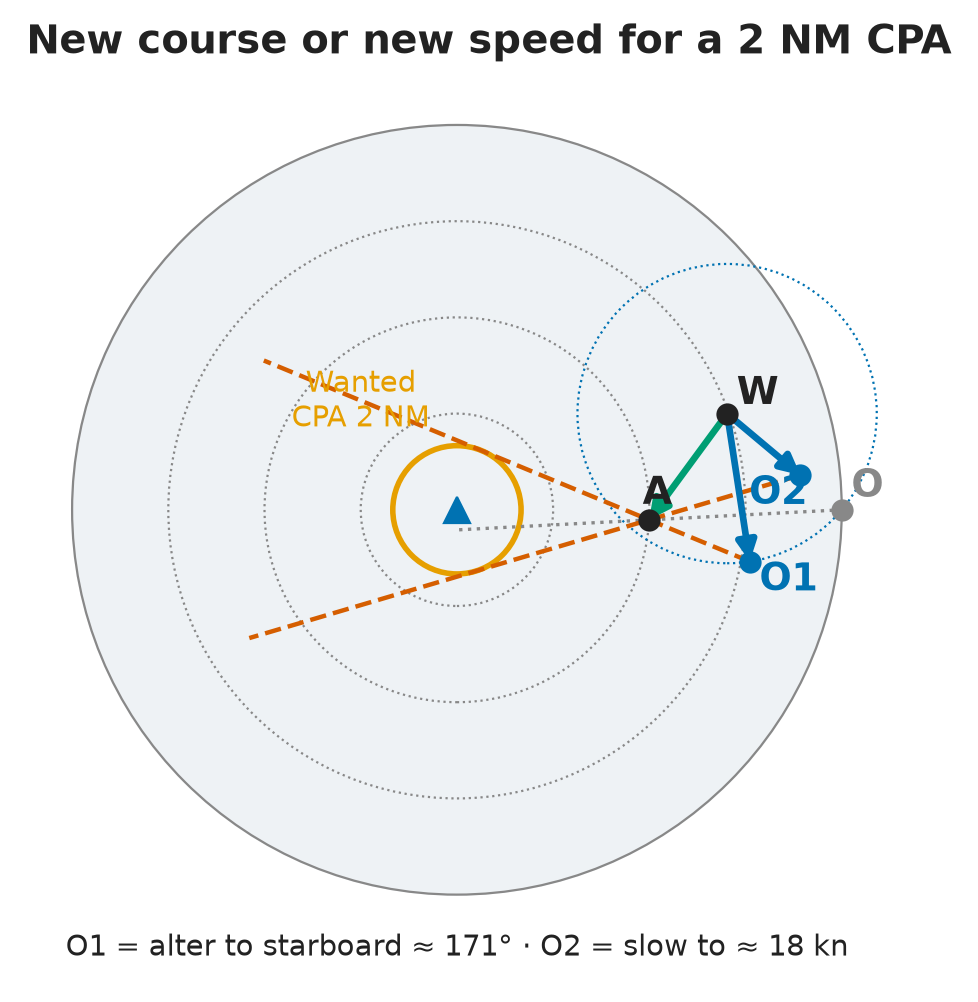
- Typical question: “The Master wants to pass at least 2 (or 3) NM off — find the new course, or the speed reduction.”
Method
- Draw a circle of the wanted CPA round own ship, like a radar range ring.
- From A, draw the tangent to that circle and extend it → the new relative line.
- Transfer it to the triangle: O1 = new course (alteration) · O2 = reduced speed on the same course.
- Measure the new direction or length. Work out the speed by proportion.
Things to watch
- Choose the side first: starboard and port give different results. In restricted visibility check COLREG Rule 19(d).
- Course, speed, or half and half can give the same CPA. Whatever you choose, the alteration must be large enough to be apparent to the other ship, visually or by radar (COLREG Rule 8).
- Stuck on orientation? Rotate the sheet so your course points up.
- In the exam you may not need a full alteration plot, but you may be asked what happens if you reduce speed or alter course, and where the new relative line goes. Know the triangle.
- Do not learn fixed recipes. Understand what is happening, then choose what is easier to compute.
Why only your vector changes the picture
- Relative motion needs two bodies, and you can only change your own vector.
- If the other ship stops, only your motion remains → its relative vector = your vector reversed. In true motion its vector disappears.
Aspect and overtaking
In short: aspect tells you whether you are overtaking, being overtaken or crossing — and so which rule applies (COLREG Rules 13, 15, 19).
- COLREG Rule 13: overtaking = coming up from more than 22.5° abaft the beam. In doubt, assume you are overtaking (COLREG Rule 13(c)).
- At night, seeing the stern light together with a sidelight (white + green or red) puts you at the edge of the sector → you are in doubt.
- Light arcs: sidelights 112.5° each, stern light 135° (112.5 + 112.5 + 135 = 360).
- By day, use all available means: the other ship’s heading and bearing, the chart, AIS and radar. Press TRUE and compare true and relative vectors.
- ARPA can combine relative vectors with true trails, or the reverse.
Aspect by calculation
- Aspect = (bearing ± 180°) − target true course → Red or Green angle from his bow.
- Example: target bears 030° (reciprocal 210°), target course 280° → 210° − 280° = −70° → Red 70.
- More than 112.5° Red or Green → you are abaft his beam, inside his overtaking sector.
- The examiner’s first question is often “How do you know it is overtaking?” — he gives you the bearing and the course. Work it out by numbers, not by eye.
No lights at all
- The vessel may be drifting: its true vector is small and points the way of the current.
Rule 19 on the plot — restricted visibility
In short: with no visual contact you are at your most vulnerable. Ask yourself: “Where can I go to create distance?”
- First question: is a close-quarters situation developing? In restricted visibility there is no stand-on vessel — both ships must act.
- COLREG Rule 19(d) (target detected by radar alone): avoid an alteration to port for a vessel forward of the beam (except one being overtaken), and avoid an alteration towards a vessel abeam or abaft the beam.
- Options: alter to starboard, reduce speed, stop or reverse the engines (COLREG Rule 8(e)), or a mix. In any situation: slow down.
- COLREG Rule 19(e): with a target forward of the beam and close quarters possible, reduce to the minimum speed to keep steerage; take all way off if needed.
- COLREG Rule 19(b): have the engines ready for immediate manoeuvre — tell the engine room as soon as visibility drops (ships on heavy fuel may need to change over to diesel).
- COLREG Rule 19(c): apply the Section I rules with due regard to the visibility. You cannot take visual compass bearings in fog → use systematic radar observation.
- ARPA data may be used for collision avoidance in restricted visibility, as long as you verify them by other means.
Two readings of “abaft the beam”
- One reading: under Rule 19, treat any target abaft the beam as the abaft-the-beam case — not the 22.5° arc of Rule 13.
- The other: use the Rule 13 definition of overtaking (more than 22.5° abaft the beam).
- The point is debated — read COLREG Rule 19 itself and be ready to justify your answer.
Exam-style case
- Dense fog, narrow channel. A container ship 2.5 NM ahead, CPA 0.8 NM, no reply on VHF.
- ✅ Reduce speed and prepare to take avoiding action. In collision situations, the safe answer always includes reduce speed.
- ❌ “Head-on” in the option is irrelevant (it only tells you the target is forward of the beam) · maintain course and speed · increase speed and overtake to starboard (you are not overtaking).
Exam technique and typical errors
In short: the logic matters more than perfect numbers — but the classic slips cost marks.
Typical errors
- Taking the O–A length as the CPA.
- Using the wrong scale on the ruler.
- Taking the middle of a scatter of plots instead of the most dangerous one.
- Not marking arrow directions.
- While learning, do not stress about exact numbers — get the logic first.
What not to say
- Never give “I’ll call him on VHF” as your collision-avoidance answer. It is not in COLREG, and MCA guidance warns about its dangers: misunderstandings, and pulling the OOW’s attention off the lookout and the plot (MGN 324 (M+F)). In practice many ships do call, but early action makes it unnecessary.
- Do not base collision avoidance on AIS. ARPA builds the triangle from your own sensors; AIS repeats the other ship’s GPS, with possible installation errors. AIS is still useful for fast data and for the ship’s name to call.
How to prepare
- Rules-of-the-road questions often decide an oral. Being able to prove whether you are overtaking is a classic.
- Read the COLREG text itself, not only flashcards or apps — you pick up the links between rules, and an app can carry its author’s mistakes.
- Practise plotting sheets until the triangle is automatic.
⚡ Flashcards
Test yourself, one card at a timeQ1ARPA is working. Why keep plotting by hand?
AnswerIt is your backup if ARPA fails, and it shows how your own actions change each encounter (situational awareness).
Common trapTrap: it is slow — 6 min or more for 3 positions plus drawing. Weak with many targets or high speeds.
Q2Gyro or log input is wrong. Which plot results can you still trust?
AnswerCPA, TCPA, BCR and BCT — they come from the relative plot (OA) alone.
Common trapTrap: the target’s true course, speed and aspect are wrong — garbage in, garbage out, by hand or by ARPA.
Q3How far do you run in 6 min at 12.5 kn?
Answer1.25 NM — rule of sixes: 6 min = 0.1 h, so move the decimal point. In 12 min: 2.5 NM.
Common trapTrap: forgetting the 60 in D = S × t ÷ 60 (knots are per hour, the plot works in minutes).
Q4On the plot, what are O, A and W?
AnswerO = first target position · A = last · W = start of own run, laid back from O. OA = relative track · WO = own vector · WA = target’s true vector.
Common trapTrap: unmarked arrows — always draw and follow the arrow directions.
Q5How do you find CPA and TCPA?
AnswerExtend OA past own ship. CPA = perpendicular from own ship to that line (point X). TCPA = distance A→X × 60 ÷ relative speed.
Common trapTrap: taking the length of OA as the CPA.
Q6What are BCR and BCT?
AnswerBow crossing range and bow crossing time: where (point B) and when the relative line cuts your heading line. BCT by proportion, like TCPA.
Q7How do you turn a target's true vector into a relative vector?
AnswerRelative = target true − own true: at the tip of the target’s true vector, draw own vector reversed, then join the echo to that point.
Common trapTrap: a relative vector pointing at own ship = collision course (CPA 0).
Q8A target keeps a constant bearing and a constant range. What is it doing?
AnswerIt is on the same course and speed as you — it is not stopped. Its relative vector is zero.
Common trapTrap: steady bearing with decreasing range is the dangerous one — risk of collision (COLREG Rule 7).
Q9The Master wants a CPA of at least 2 NM. How do you find the new course or speed?
AnswerDraw a 2 NM circle round own ship. From A, draw the tangent → new relative line. Transfer it to the triangle: O1 = new course, O2 = reduced speed.
Common trapTrap: an alteration too small for the other ship to notice (COLREG Rule 8).
Q10How do you prove you are overtaking?
AnswerAspect = (bearing ± 180°) − target true course. More than 112.5° Red/Green → you are more than 22.5° abaft his beam = overtaking (COLREG Rule 13). In doubt, assume you are.
Common trapTrap: eyeballing the plot — work it out from the bearing and course the examiner gives you.
Q11Fog. Target ahead, CPA 0.8 NM, no reply on VHF. What do you do?
AnswerReduce speed and prepare to take avoiding action. In restricted visibility there is no stand-on vessel (COLREG Rule 19).
Common trapTrap: altering to port for a vessel forward of the beam (Rule 19(d)), or answering “I’ll call him on VHF”.
Q12Name four classic plotting errors.
AnswerTaking OA as the CPA · wrong scale on the ruler · taking the middle of scattered plots instead of the most dangerous one · arrow directions not marked.
📚 Resources
Books
- Radar and ARPA Manual: Radar, AIS and Target Tracking for Marine Radar Users, Alan Bole, Alan Wall, Andy Norris — 3rd edition (Butterworth-Heinemann, 2014)
- Radar Observer’s Handbook for Merchant Navy Officers, W. Burger — 8th edition (Brown, Son & Ferguson, 1993)
Regulations
- COLREG Rules 7, 8, 13, 15, 17 and 19 — risk of collision, action to avoid collision, overtaking, crossing, stand-on vessel, restricted visibility
- IMO MSC.192(79) — revised performance standards for radar equipment, including target tracking (CPA, TCPA, true and relative vectors)
- MGN 324 (M+F) Amendment 2 — Use of VHF radio and AIS — MCA guidance on why VHF and AIS are no substitute for collision-avoidance action
Official sites
- IMO — Convention on the International Regulations for Preventing Collisions at Sea, 1972 (COLREGs) — the convention behind the steering and sailing rules
Videos
- Radar Plotting (Example 1) - Deriving Aspect, Target Course & Speed, CPA, TCPA, and Range. — Steering Mariners
- Radar Plotting _PART 1 — SAILORSTUBE
Exam focus — Malta
Format: online multiple-choice theory test (about 20 questions, bring a laptop or tablet, not a phone), an individual simulator exercise, and a paper exercise: true vectors → relative vectors. Eliminate the wrong options first, then look for the keywords. Typical questions: (1) Given true vectors on a relative-motion, north-up display, draw the relative vectors → relative = target true − own true; stationary target = own vector reversed; same course and speed = zero. (2) Describe how you find CPA and TCPA → extend OA, perpendicular from own ship = CPA (point X); TCPA by proportion — and say what X and B (bow crossing) are. (3) A target keeps constant bearing and constant range → same course and speed as you, not stopped. (4) How do you know you are overtaking? → aspect by calculation, more than 22.5° abaft his beam (COLREG Rule 13). (5) Fog, target ahead, CPA 0.8 NM → reduce speed and prepare to act; no stand-on vessel (COLREG Rule 19). A radar screenshot may also show an error such as trails relative instead of true. What examiners want to hear: a clean O-A-W triangle with arrows marked; CPA and TCPA come from the relative plot and survive gyro or log errors, true vectors do not; the plot is the backup when ARPA fails; slow down and create distance — never “I’ll call him on VHF”.