Patient Assessment: History Taking and Examination
MedicalOn board there is no doctor to hand the patient over to. The officer in charge of medical care must collect a structured history and perform a systematic examination, then pass a clear picture to the Radio Medical Advice service. This article covers the method: what to ask, in what order, how to examine, and what to record.
Last reviewed 1 Nov 2026 · From a professional captain's years of study notes · Organised with AI and checked against current regulations · How we write
On this page (12)
Where history taking fits
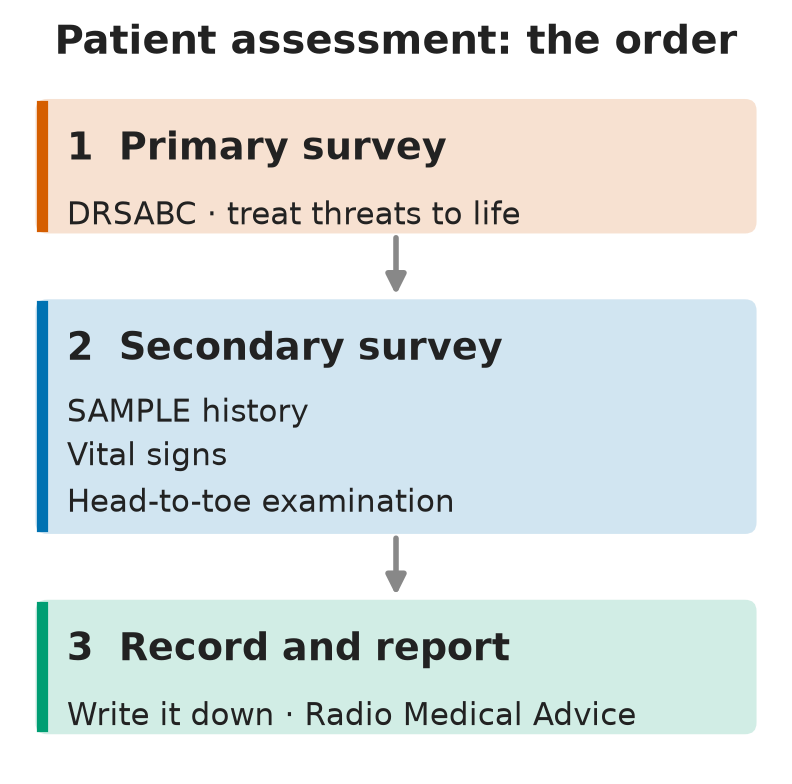
In short: treat threats to life first (primary survey). Take the history only once the casualty is stable, in the secondary survey.
Read first: nothing — this is the first topic of the Medical Care area. Next: Emergency Response and Radio Medical Advice.
- Primary survey first (DRSABC): any threat to life is treated before anything else. History taking belongs to the secondary survey, once the casualty is stable.
- The secondary survey combines three things: SAMPLE history, vital signs, and a head-to-toe / system examination.
- SAMPLE = Signs & symptoms · Allergies · Medications · Past medical history · Last oral intake · Events leading up.
- Rule of record keeping: what is not written was not done. Note times, findings and treatment as you go.
The history-taking flow
In short: open question, SOCRATES for the main symptom, every other symptom, systemic review, background — always in this order.
- Open question — “What brings you here today?” Let the patient talk; summarise the presenting complaint in one line.
- SOCRATES — characterise the main symptom (usually pain).
- Exhaust every symptom — repeat for each other symptom the patient reports.
- Systemic review — screen every body system for symptoms the patient did not mention.
- Background — past medical and surgical history, current medications, allergies.
SOCRATES
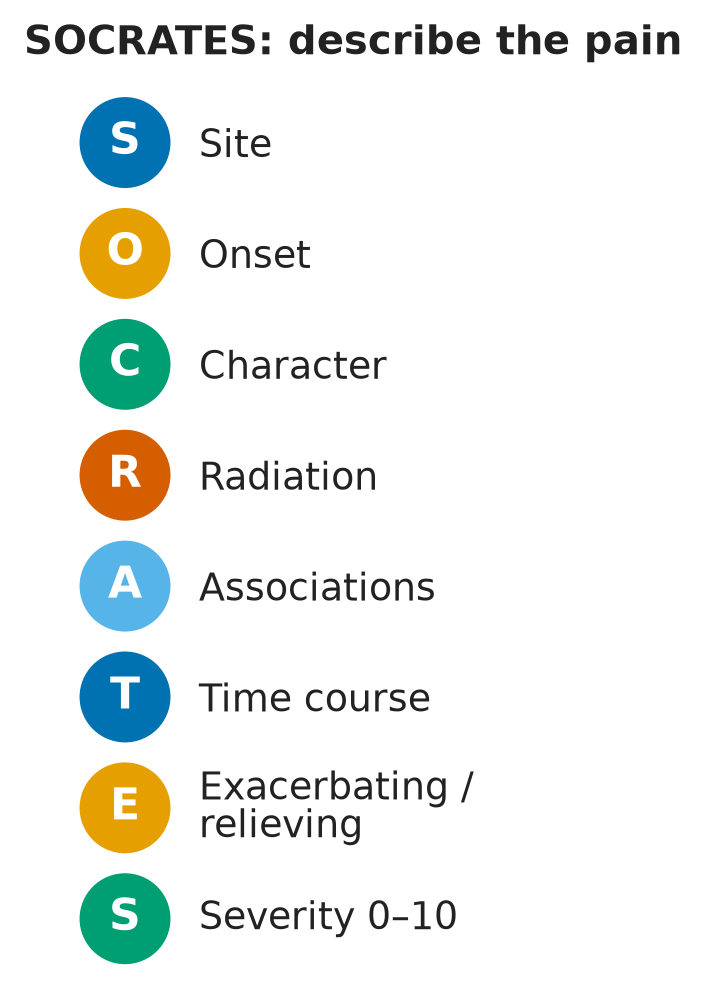
In short: eight questions that describe any pain. Ask them in order and score the severity 0–10.
- Site — where exactly? Ask the patient to point with one finger.
- Onset — sudden or gradual? What were they doing?
- Character — sharp, dull, burning, crushing, colicky?
- Radiation — does it spread anywhere?
- Associations — nausea, vomiting, sweating, fever, breathlessness?
- Time course — constant or coming in waves? Getting better or worse?
- Exacerbating / relieving factors — movement, breathing, food, position, painkillers?
- Severity — score 0–10, and compare with earlier scores.
Systemic review
In short: short closed questions, one body system at a time, to catch symptoms the patient did not mention.
Ask short closed questions system by system:
- Cardiovascular — chest pain, palpitations, ankle swelling, breathlessness lying flat.
- Respiratory — cough, sputum (colour, blood), wheeze, shortness of breath.
- Gastrointestinal — appetite, nausea/vomiting, bowel habit, blood in stool, abdominal pain.
- Genitourinary — pain or burning on passing urine, frequency, blood in urine.
- Neurological — headache, dizziness, weakness, numbness, visual changes, fits.
- Gynaecological (female crew) — last menstrual period, possibility of pregnancy.
Background history
In short: past illnesses, operations, medications and allergies — and what reaction the allergy caused.
- Past medical history — chronic conditions (diabetes, asthma, epilepsy, heart disease).
- Past surgical history — previous operations and dates.
- Medications — including over-the-counter and supplements.
- Allergies — drug, food, latex; and what reaction occurred.
Examination principles
In short: WIPER before you start, then look → feel → percuss → listen, comparing left with right.
- WIPER before you start:
- Wash your hands
- Introduce yourself
- Permission (consent) — and a chaperone where appropriate
- Expose the area needed, respecting dignity
- Reposition the patient (comfortable, usually half-sitting or lying)
- Order of each system: look → feel → percuss → listen.
- Compare sides — left against right is your built-in reference.
- Watch the face, not your hand — the expression tells you where it hurts.
- Finish by thanking the patient and explaining what happens next.
Airway and breathing
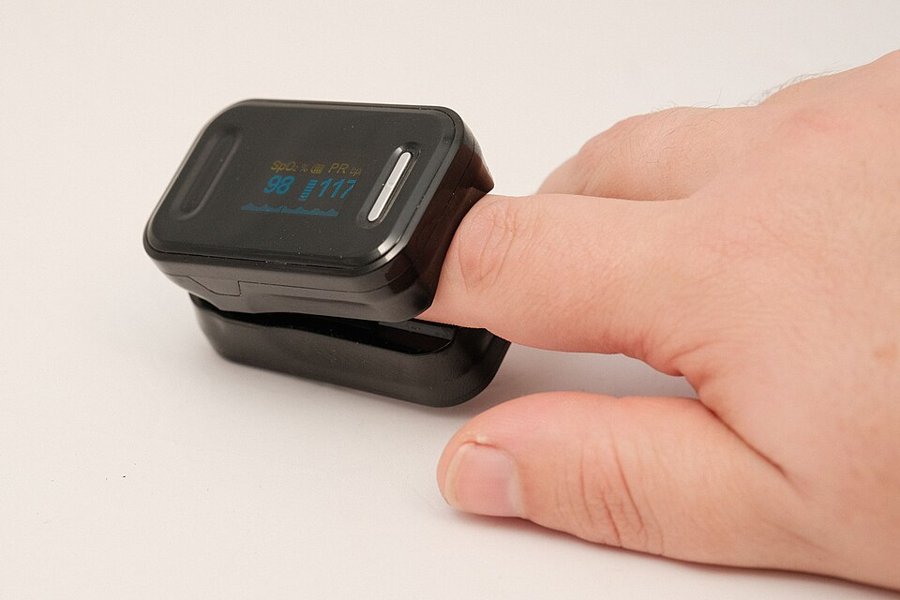
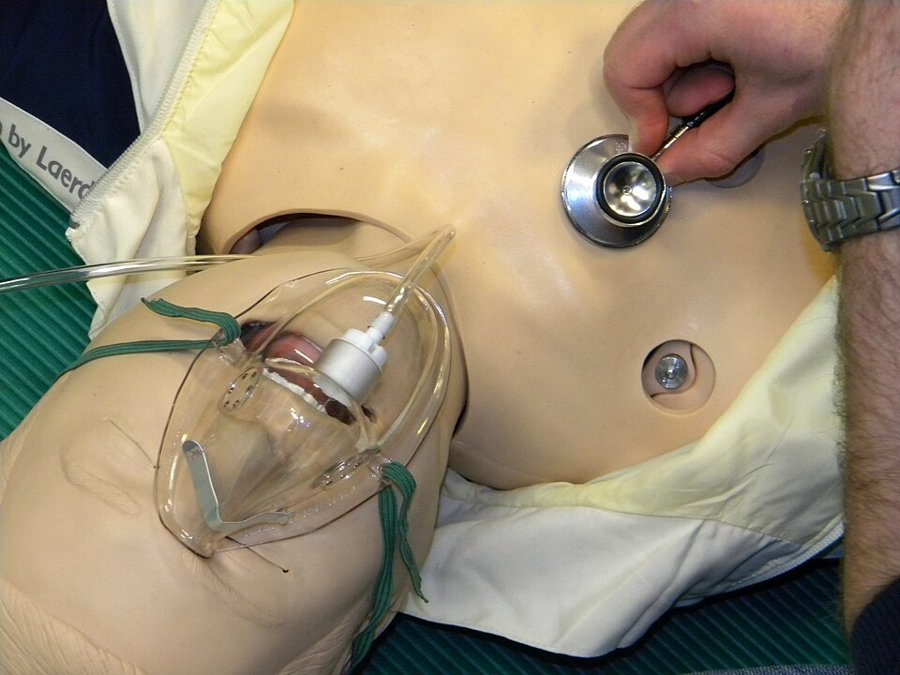
In short: pulse oximeter first (SpO₂ ≥ 95%), then airway, then look, feel, percuss and listen to the chest. Stridor is an emergency.
- Pulse oximeter — SpO₂ (normal ≥ 95%) and pulse rate.
- Airway — look in the mouth (swelling at the back of the throat?); feel that the trachea is central; listen to the voice (normal, hoarse, wheezy).
- Look — chest expansion equal and symmetrical? Paradoxical movement? Scars, bruising, tripod position or use of accessory muscles = respiratory distress.
- Feel — chest tenderness; equal expansion both sides.
- Percuss — more resonant = extra air (pneumothorax); dull = fluid or mass (effusion).
- Listen with the stethoscope:
- Vesicular — normal breath sounds.
- Crackles (coarse or fine) — fluid or secretions in the airways.
- Expiratory wheeze — narrowed lower airways (asthma).
- Stridor — upper-airway obstruction: emergency.
- Pleural rub — inflamed pleura.
- Useful signs: cherry-red lips suggest carbon monoxide poisoning; a flapping tremor of the hands suggests CO₂ retention.
Abdomen
In short: map the abdomen into quadrants, palpate the painful area last, and look for tenderness, guarding and rebound tenderness.
- Position — stand on the side of your dominant hand; patient lying flat, relaxed.
- Start at the mouth — tongue, cracks at the corners of the lips.
- Look — distension, rashes, bruising, visible veins. If distended, think of the 5 F’s: Fat, Fluid, Fetus, Flatus, Faeces.
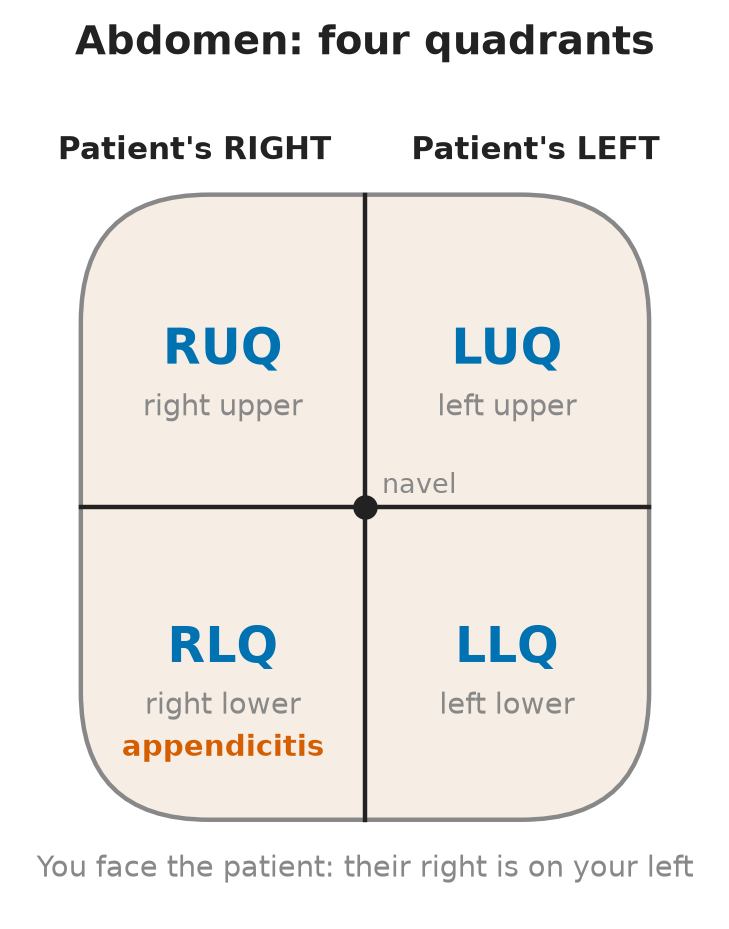
- Map the abdomen into 4 quadrants (RUQ, LUQ, RLQ, LLQ) or 9 regions, and record findings by location.
- Palpate:
- Start away from the painful area and finish there.
- Hand flat, fingers together; press with the finger pads, flexing at the knuckles. Light first, then deep.
- Note tenderness (pain on pressing) and guarding (involuntary muscle tension = peritoneal irritation).
- Rebound tenderness — pain on release rather than on pressure; in the right lower quadrant it suggests appendicitis.
- Deep two-handed palpation above the umbilicus: a wide, expansile pulsation can suggest an aortic aneurysm.
- Percuss — tympanic (hollow) = gas; dull = fluid or solid organ.
- Listen — absent bowel sounds suggest ileus; hyperactive sounds suggest obstruction.
Vital signs and recording
In short: record a full set of observations, repeat them, and send them on the medical report form. The trend matters more than one value.
- Record pulse, respiratory rate, blood pressure, temperature, SpO₂, level of consciousness (AVPU), pupils and capillary refill (normal < 2 s).
- Repeat observations at regular intervals: the trend matters more than a single value.
- Use the ship’s medical report form so that history, findings and observations reach the Radio Medical Advice doctor in a structured order.
⚡ Flashcards
Test yourself, one card at a timeQ1Where does history taking fit in patient assessment?
AnswerIn the secondary survey, after the primary survey (DRSABC) has dealt with threats to life. Secondary survey = SAMPLE history + vital signs + examination.
Common trapStarting the history before airway, breathing and bleeding are under control.
Q2What does SAMPLE stand for?
AnswerSigns & symptoms · Allergies · Medications · Past medical history · Last oral intake · Events leading up.
Q3In what order do you take a history?
AnswerOpen question (presenting complaint) → SOCRATES → every other symptom → systemic review → background.
Common trapFiring closed questions before letting the patient talk.
Q4Expand SOCRATES.
AnswerSite · Onset · Character · Radiation · Associations · Time course · Exacerbating/relieving factors · Severity (0–10).
Common trapTime course is not the moment it started — that is Onset.
Q5What is the systemic review for?
AnswerShort closed questions system by system — cardiovascular, respiratory, GI, GU, neurological, gynaecological — to find symptoms the patient did not mention.
Common trapForgetting last menstrual period and possible pregnancy in female crew.
Q6A patient says they are allergic. What else must you record?
AnswerThe reaction it caused. Ask about drug, food and latex allergies, and about over-the-counter medicines and supplements.
Q7What does WIPER stand for?
AnswerWash hands · Introduce yourself · Permission (consent, chaperone) · Expose with dignity · Reposition. Then each system: look → feel → percuss → listen.
Q8Chest percussion: what do 'more resonant' and 'dull' mean?
AnswerMore resonant = extra air (pneumothorax). Dull = fluid or mass (effusion).
Q9Stridor or wheeze — which one is the emergency?
AnswerStridor: upper-airway obstruction. Expiratory wheeze = narrowed lower airways (asthma).
Common trapTreating stridor as ‘just a wheeze’.
Q10Abdomen: tenderness, guarding, rebound tenderness?
AnswerTenderness = pain on pressing. Guarding = involuntary muscle tension (peritoneal irritation). Rebound = pain on release; in the right lower quadrant it suggests appendicitis.
Common trapStarting on the painful area — start away from it, finish there.
Q11A distended abdomen: what are the 5 F's?
AnswerFat, Fluid, Fetus, Flatus, Faeces.
Q12Which observations do you record, and why repeat them?
AnswerPulse, respiratory rate, BP, temperature, SpO₂, AVPU, pupils, capillary refill (< 2 s). Repeat them: the trend matters more than a single value.
Common trapNot writing it down — what is not written was not done.
📚 Resources
Videos
- Using SOCRATES in History Taking | OSCE | Communication Skills — Geeky Medics
- Respiratory Examination | OSCE Guide — Geeky Medics
- Abdominal Examination - OSCE Guide (Latest) — Geeky Medics
Books
- The Ship Captain’s Medical Guide, 24th edition (MCA, TSO, 2024) · MIN 718 (M+F)
- International Medical Guide for Ships, 3rd edition (WHO, on behalf of ILO, IMO and WHO, 2007)
Regulations
- STCW A-VI/4 — Table A-VI/4-2, medical care on board
Exam focus — MCA
Expect to explain the sequence (primary survey → secondary survey → SAMPLE → examination), to expand SOCRATES and WIPER, and to describe what you would report to Radio Medical Advice for a given scenario. Examiners look for a systematic approach and for written records, not for a diagnosis.