Head Injury and Brain Disorders
MedicalHow to recognise and manage head injuries on board (brain bleeds, skull-base fracture, compression, concussion) and the main brain disorders: headache red flags, seizures, stroke and TIA, and meningitis. With no doctor on board, spotting deterioration early and calling radio medical advice fast protects the brain, and it is core MCA medical care exam material.
Last reviewed 1 Nov 2026 · From a professional captain's years of study notes · Organised with AI and checked against current regulations · How we write
On this page (11)
Head Trauma: Bleeds, Skull Fractures and Risk Factors
In short: a severe head injury means bleeding inside the skull, signs of a fracture, or one of the complications below. The skull cannot stretch, so a bleed squeezes the brain. Watch the GCS: a falling score is your alarm.
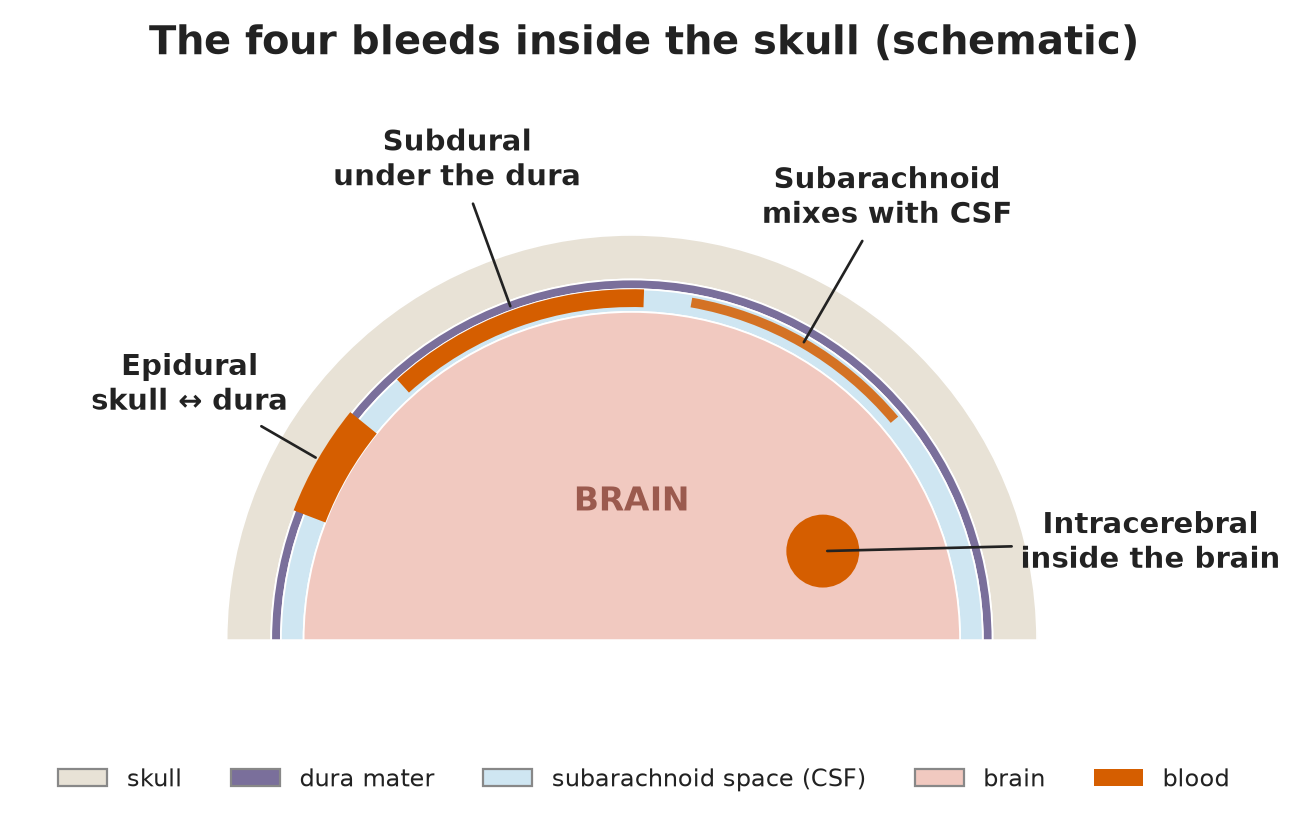
The four bleeds inside the skull
They are named by where the blood collects in relation to the meninges (the brain’s covering layers):
| Bleed | Where the blood collects |
|---|---|
| Epidural | Between the skull and the dura mater (outermost layer) |
| Subdural | Under the dura, between the dura and the brain surface |
| Subarachnoid | In the subarachnoid space, mixing with the cerebrospinal fluid (CSF) |
| Intracerebral | Inside the brain tissue itself |
The skull is a closed box. Any bleed raises the pressure inside it and compresses the brain.
Base-of-skull (basilar) fracture
- Raccoon eyes — bruising around both eyes (the eyelid edge is spared).
- Battle’s sign — bruising behind the ear, over the mastoid.
- Haemotympanum — blood behind the eardrum.
- CSF rhinorrhoea / otorrhoea — clear fluid from the nose or ear.
- A bump — swelling where the head was hit.
- You find these in the secondary survey: bruising behind the ears and round both eyes, plus clear fluid from the nose, ear or mouth = base-of-skull fracture.
- Halo test: let the fluid drip onto gauze or a sheet. Blood mixed with CSF separates into a dark centre with a thin pinkish or yellowish ring = CSF leak.
What can go wrong after a head injury
- Post-traumatic seizure
- Low blood glucose
- Poor oxygen supply to the brain
- Raised intracranial pressure (ICP)
- Focal or diffuse neurological deficit (one limb weak, or general confusion)
- Vomiting
- Infection
Who is at higher risk
The same blow is more dangerous — and your threshold for radio medical advice lower — when the casualty:
- takes blood thinners: aspirin, warfarin, a NOAC;
- has a history of bleeding or easy bruising;
- is over 65;
- has a blood disease;
- is hypothermic or has been drinking alcohol — both slow down clotting.
On the bridge: a 70-year-old charter guest on warfarin slips on the companionway and bumps their head. They seem fine — but they are high-risk. Start observations and call radio medical advice early.
Compression and Rising Intracranial Pressure
In short: a bleed or swelling inside the closed skull pushes the brain down onto the brainstem. The brainstem runs breathing and heart rate, so the casualty can stop breathing even with a clear airway.
What happens
- Pressure rises and pushes the brain downwards — the only way out is the foramen magnum, the opening at the base of the skull (brain herniation).
- What gets squeezed is the brainstem: the control centre for breathing and heart rate.
- It does not block the airway. It shuts down the breathing centre, so breathing stops. Think of a deck wash: the hose isn’t kinked — the pump has been switched off.
What you see
- Face red and flushed.
- Breathing slow and noisy, like snoring.
- Rising-ICP vital signs: BP shoots up, pulse slows, breathing slows. Compare with your first set of observations (the baseline).
| Shock | Compression | |
|---|---|---|
| Skin | Pale | Red, flushed |
| Breathing | Fast, shallow | Slow, noisy (snoring) |
| Pulse | Fast | Slow |
| BP | Falls | Rises |
Concussion
In short: concussion is a shaken brain. You only call it concussion once you have ruled out the dangerous problems above — then rest, pain relief and regular checks.
What it is
- The impact shakes the brain inside the skull. The brain floats in CSF: it hits the skull, then bounces back and hits the opposite side → bruising on both sides (coup–contrecoup).
- The brain tissue is injured together with the skull.
- Diagnosis of exclusion — only after the more serious problems (bleeds, fracture, compression) are ruled out.
Symptoms and care
- Symptoms: headache (may last for months) · dizziness · lethargy · low mood (depression) · poor concentration.
- Treatment: put to bed, rest for 48 h · pain relief · watch for deterioration · may need a doctor’s review in port.
- Wake-up checks: wake and check every 30 min–1 h for the first hours, then every 1–2 h for 48 h. Symptoms can still appear after 48 h.
- Paracetamol ceiling: 4 g in 24 h (8 × 500 mg tablets).
Managing a Head Injury on Board
In short: you cannot stop a bleed inside the skull, but you can protect the brain: oxygen, enough blood pressure, low pressure in the head, control of fits and good wound care — and radio medical advice every time.
A, B and C — protect the brain’s supply
- Airway and breathing: keep the airway open and give good oxygenation. If you ventilate, keep breaths slow and gentle — fast, forceful breaths raise the ICP.
- Circulation: aim for a systolic BP of about 100 mmHg for good brain blood flow. Do not pour in IV fluids.
D — disability
- Treat seizures with diazepam 10 mg PR (rectal). A post-traumatic fit uses the same drug and dose as any other fit.
- Lower the ICP where you can: tilt the head up 30° · avoid a cervical collar if possible (it presses on the neck veins and raises the ICP) · keep the blood glucose normal.
- Avoid sedating drugs if possible — they hide deterioration. Check the GCS regularly and record every change.
- Check the blood glucose early, then every 30 min in a serious head injury.
E — exposure and wound care
- Keep a normal body temperature and prevent infection:
- cut the hair back 5 cm around the wound;
- clean with sterile swabs and boiled, cooled water;
- cover any open skull wound with a wet sterile dressing;
- suspected skull fracture or brain wound → consider a prophylactic antibiotic.
- Open skull fracture: do NOT poke the wound · do NOT press on it · do NOT remove fragments.
- Radio medical advice — always for a head injury.
The usual neck-injury reflex (collar on) clashes with a severe head injury: the collar raises the pressure in the skull. Protect the neck by hand or with blocks instead — see Fractures, Splints and Spinal Injuries.
Headache: Types, Red Flags and Pain Relief
In short: most headaches are harmless. Your job is a good history and examination to catch the few that are life-threatening.
Primary and secondary headache
- Primary: the headache is the problem.
- Cluster — pain in and around one eye. Painkillers don’t work; high-flow oxygen helps (recent evidence).
- Tension — like a tight band round the head.
- Migraine — pain + nausea + visual changes (classic form). Triggers include cheese, dairy, chocolate. It can mimic a stroke; a normal neurological exam tells them apart.
- Secondary: the headache is a symptom of something else:
- head injury / concussion;
- vascular disorder — spontaneous bleed, stroke, venous thrombosis;
- substance use or withdrawal — alcohol, caffeine, carbon monoxide (CO), some painkillers;
- dehydration;
- sinusitis or other viral infection — tapping over the sinuses makes the pain worse, often with a post-nasal drip;
- mental illness;
- cranial neuralgia (nerve pain).
On board: a headache in several engine-room crew at once → think CO before you hand out paracetamol.
Red flags — treat as serious, call radio medical advice
- New headache, or a change in a known one, in someone over 60.
- Thunderclap headache — “the worst ever”, peaking suddenly. Sources differ on the speed: one gives within seconds, another within 5 min. Think subarachnoid haemorrhage.
- Focal neurological symptoms (e.g. limb weakness) or non-focal ones (e.g. acute confusion).
- Abnormal neurological examination.
- Headache becoming more frequent, more severe or constant.
- Headache that changes with posture.
- Headache in pregnancy — possible pre-eclampsia.
Pain-relief ladder
- Paracetamol 500 mg × 2 tablets every 6–8 h (ceiling 4 g in 24 h).
- NSAID + codeine.
- Still in pain → consider morphine.
- Reassess often — watch for deterioration or new red flags → radio medical advice.
- Codeine: maximum 7 days (risk of addiction).
- NSAIDs: avoid in asthma (can trigger a severe attack) and with an ulcer history; give them as a course, not a single dose.
Seizures and Epilepsy
In short: a fit is a symptom. Time it, protect the casualty, give diazepam if it goes on, and look for the cause (SCMG p.16).
Causes — not only epilepsy
- Low blood sugar (hypoglycaemia) · low oxygen (hypoxia)
- Arrhythmias (abnormal heart conduction) · heart disease · syncope (fainting)
- Meningitis / encephalitis
- Ecstasy (body temperature 44–45 °C) · alcohol withdrawal · tumours · fever in children
- Head injury (post-traumatic seizure) and stroke can both trigger fits.
Managing a fit
- Time the fit. A normal fit lasts under about 1.5 min.
- At 3 min send for diazepam; give it at 5 min: diazepam 10 mg PR, repeat every 15 min, maximum 4 doses.
- A fit lasting over 5 min = status epilepticus.
- After the fit: head-tilt/chin-lift to open the airway, and check for injuries.
- Give oxygen 4–6 L/min until SpO2 is 95% or more, then stop.
- First-ever fit → radio medical advice at once, and put in an IV line.
- A known epileptic fitting in their usual pattern is not an alarm. Worry if the fits are repeated or unusual.
- A fit after a head injury → run the head-injury procedure as well.
Stroke (CVA) and TIA
In short: a stroke starves part of the brain of blood. Treatment happens ashore and depends on speed: “time is brain”. Your job is to recognise it fast, call for help and nurse the casualty safely.
Two types
- Ischaemic — a clot blocks blood flow to part of the brain (a blocked pipe).
- Haemorrhagic — a weak vessel wall bursts and bleeds in or around the brain (a burst pipe).
- Same result: part of the brain loses its blood supply. Only a CT scan ashore can tell them apart.
Recognition — FAST
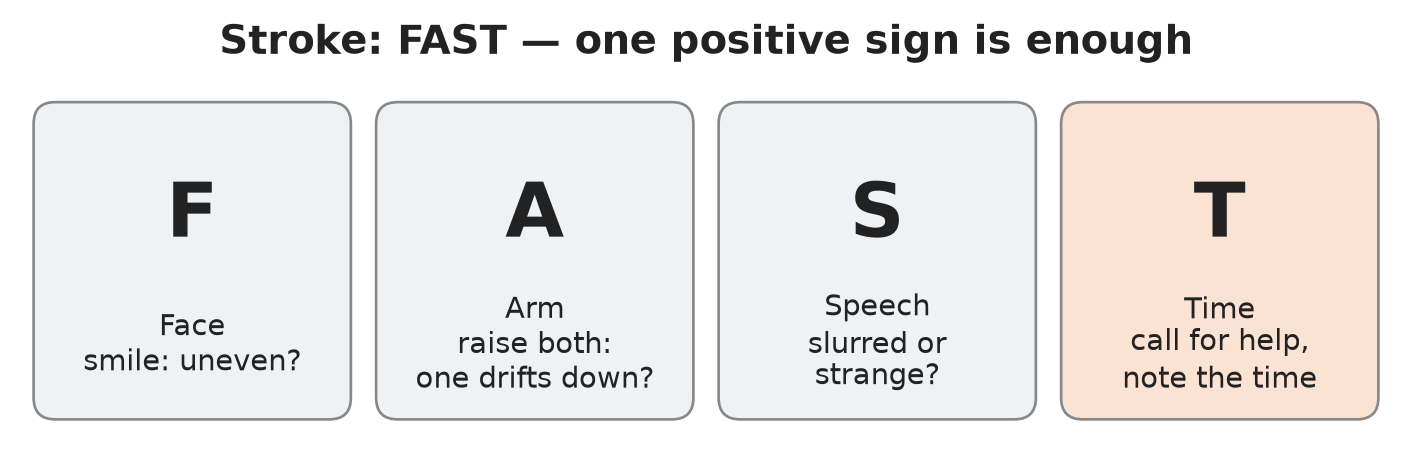
One positive sign is enough — act at once:
- F — Face: ask them to smile. Is it uneven?
- A — Arm: ask them to raise both arms. Does one drift down?
- S — Speech: ask them to repeat a phrase. Is it slurred or strange?
- T — Time: call for help now (ashore 112/911, at sea radio medical advice) and note the time of onset.
- Extra check: the tongue points to one side when stuck out.
| Clot stroke | Cerebral haemorrhage |
|---|---|
| History of headache | History of headache |
| Sudden collapse | Sudden collapse |
| Usually deeply unconscious | Noisy, snoring breathing |
| Probable paralysis | Possible paralysis |
| Very shocked — can look like shock | Slow, strong pulse · red face (same picture as compression) |
Management on board
- FAST positive → radio medical advice immediately; record the time of onset.
- Ashore, a clot stroke treated early can recover fully: thrombolysis (clot-busting drug) and/or thrombectomy (clot removed by a procedure), usually successful within 4–6 h of onset. A stricter working rule: after about 4 h the damage is permanent. Plan the evacuation around these times.
- Pain relief: NO aspirin, NO NSAIDs — it could be a bleed.
- Turn the casualty often to prevent pressure sores.
- Swallowing may be affected: test with 50 ml of clear water. If they manage it, they may eat and drink — with someone beside them.
- Reduced consciousness → recovery position with supports, and the ABCDE approach.
TIA — transient ischaemic attack
- A temporary blockage: stroke-like signs that clear completely within 24 h, usually within minutes.
- A warning shot: high risk of a full stroke in the following days. Never ignore it → radio medical advice.
- Untreated, most people have a major stroke within a year.
Meningitis
In short: an infection of the brain’s coverings. It starts like flu or migraine, spreads by droplets, and bacterial meningitis kills fast — isolate, give antibiotics early and protect the crew.
Warning signs
- Early (within 8 h of infection): cold hands and feet · leg pain · unusually pale or mottled skin.
- Classic (take 13–22 h to develop): purple, non-blanching rash · photophobia (light hurts) · severe headache · fever · stiff neck and joints · drowsiness or coma.
- Glass (tumbler) test: press the side of a clear glass on the rash. If it does NOT fade → get medical help at once (meningococcal septicaemia).
- Hallmark signs:
- Neck stiffness — cannot bring the chin to the chest.
- Kernig’s sign — lying down, raising the leg causes head or neck pain (the inflamed meninges are stretched).
- Knee-straightening test — hip bent, pain or resistance when you straighten the knee (SCMG 22nd ed.).
It looks like migraine plus flu, so it is easy to dismiss early. The hallmark signs set it apart — don’t wait for the rash.
Management on board
- Isolate at once — one person only cares for the casualty.
- PPE including a mask — droplet spread, highly infectious.
- Treat sepsis if present.
- Antibiotics as soon as possible: SCMG 22nd ed. gives benzylpenicillin 3 g IM at once, then 2.4 g every 6 h until you have radio medical advice. The IV route is preferred where possible.
- Radio medical advice — keep the casualty isolated; meningitis is a notifiable disease.
- Prophylaxis for everyone exposed (TMAS): ciprofloxacin 250 mg by mouth, one single dose. On a ship, close contacts can mean the whole crew.
- Nursing: observations every 6 h · waste in sealed bags · tepid sponging + paracetamol for fever.
⚡ Flashcards
Test yourself, one card at a timeQ1Name the four types of bleeding inside the skull. Why is any of them dangerous?
AnswerEpidural (skull–dura) · subdural (under the dura) · subarachnoid (in the CSF space) · intracerebral (in the brain itself). The skull is a closed box: any bleed raises the pressure and squeezes the brain.
Common trapTrap: a casualty who talks after the blow can still be bleeding — check the GCS regularly, deterioration is the alarm.
Q2Which signs point to a fracture of the base of the skull?
AnswerRaccoon eyes (bruising round both eyes) · Battle’s sign (bruising behind the ear) · blood behind the eardrum · clear fluid (CSF) from the nose or ear · a bump at the impact site.
Common trapTrap: clear fluid is not a runny nose — do the halo test (dark centre + pale pink/yellow ring = CSF).
Q3Which casualties are at higher risk after the same head injury?
AnswerOn blood thinners (aspirin, warfarin, NOAC) · history of bleeding or easy bruising · over 65 · blood disease · hypothermia or alcohol (both slow clotting).
Common trapTrap: a “small bump” in an elderly guest on warfarin is not small — lower your threshold for radio medical advice.
Q4Brain compression: what do you see, and how is it different from shock?
AnswerRed, flushed face · slow, noisy, snoring breathing · BP shoots up with a slow pulse. Shock is the opposite: pale, fast shallow breathing.
Common trapTrap: compression doesn’t block the airway — it switches off the breathing centre in the brainstem.
Q5What is concussion, and how do you look after the casualty?
AnswerThe brain is shaken inside the skull. Bed rest 48 h, pain relief, wake and check every 30 min–1 h at first, then every 1–2 h for 48 h; review in port.
Common trapTrap: it is a diagnosis of exclusion — rule out bleeds first; symptoms can still appear after 48 h.
Q6Severe head injury on board: what are your ABCDE targets?
AnswerSlow, gentle ventilations · systolic BP about 100 mmHg · fits → diazepam 10 mg PR · head up 30° · glucose every 30 min · GCS regularly · radio medical advice always.
Common trapTrap: no flood of IV fluid, no cervical collar if avoidable, no sedatives — and never poke, press or pick fragments from an open skull wound.
Q7Which headaches are red flags?
AnswerNew or changed headache over 60 · thunderclap (“worst ever”, peaks within seconds) · focal signs (limb weakness) or acute confusion · abnormal neuro exam · getting worse/constant · changes with posture · pregnancy.
Common trapTrap: thunderclap = think subarachnoid haemorrhage, not migraine.
Q8What is the pain-relief ladder for headache?
AnswerParacetamol 2 × 500 mg every 6–8 h (max 4 g/24 h) → NSAID + codeine → morphine. Reassess often.
Common trapTrap: no NSAIDs in asthma or ulcer history; codeine max 7 days; cluster headache doesn’t respond to painkillers — high-flow oxygen helps.
Q9A crew member is fitting. When do you give diazepam, and how?
AnswerTime it: normal fit under about 1.5 min. At 3 min send for diazepam, give at 5 min: 10 mg PR, repeat every 15 min, max 4 doses. Over 5 min = status epilepticus.
Common trapTrap: a fit is a symptom, not always epilepsy — first-ever fit = radio medical advice at once.
Q10How do you recognise a stroke, and what is your job on board?
AnswerFAST: Face uneven · Arm drifts · Speech slurred · Time — radio medical advice now, note the time of onset. One sign is enough. Clot treatment works within 4–6 h.
Common trapTrap: no aspirin, no NSAIDs — it may be a bleed.
Q11What is a TIA, and why does it matter?
AnswerA temporary blockage: stroke signs that clear fully within 24 h (usually minutes). It is a warning shot → radio medical advice.
Common trapTrap: “it’s gone, so it’s fine” — untreated, most have a major stroke within a year.
Q12Suspected meningitis on board: what do you look for and do?
AnswerEarly (within 8 h): cold hands/feet, leg pain, pale/mottled skin. Later (13–22 h): non-blanching purple rash, light sensitivity, severe headache, fever, stiff neck. Isolate, one carer with mask, antibiotics at once, prophylaxis for contacts, radio medical advice.
Common trapTrap: it looks like migraine + flu — don’t wait for the rash.
📚 Resources
Video
- What To Do If Someone Has A Stroke, Signs & Symptoms - First Aid Training - St John Ambulance — St John Ambulance
Books
- The Ship Captain’s Medical Guide — Maritime and Coastguard Agency, 24th edition (2024): head injury, fits, stroke and meningitis
- International Medical Guide for Ships — World Health Organization, 3rd edition
Regulations
- MIN 718 (M+F) The ship captain’s medical guide 24th edition — MCA notice introducing the current SCMG
Official sites
- Head injury and concussion — NHS
- Symptoms of a stroke — NHS (FAST)
- Meningitis — NHS (rash and glass test)
- Seizure first aid — St John Ambulance
Exam focus — MCA
Typical questions: “A deckhand is hit on the head by a swinging block and is now drowsy — talk me through it.” · “How do you tell compression from shock?” · “Which signs suggest a base-of-skull fracture?” · “A guest collapses with a slurred voice and a drooping face — what do you do, and what must you not give?” · “A crew member has a fit lasting 6 minutes — manage it.” · “You suspect meningitis mid-passage — what about the rest of the crew?”
What examiners want: ABCDE with GCS trends and radio medical advice every time; the four bleeds and the closed-box idea; base-of-skull signs and the halo test; compression = red face, slow snoring breathing, BP up, pulse down (opposite of shock); head-injury targets — slow gentle ventilation, systolic about 100 mmHg, head up 30°, no collar if avoidable, no sedatives, glucose every 30 min, diazepam 10 mg PR; never touch an open skull fracture; concussion as a diagnosis of exclusion with wake-up checks for 48 h; headache red flags and the pain ladder; the 3-min / 5-min diazepam rule and first-ever fit = advice at once; FAST, time of onset, the 4–6 h window, no aspirin or NSAIDs; TIA as a warning; meningitis — isolate, mask, antibiotics early, prophylaxis for contacts, notifiable.