Airway, Breathing and Oxygen Therapy
MedicalHow to keep an unconscious casualty's airway open and give oxygen safely on board: Guedel and nasal airways, flow rates and SpO2 targets, cylinder safety, GCS and the recovery position. Core hands-on skills for the MCA medical care exam, where there is no doctor on board.
Last reviewed 1 Nov 2026 · From a professional captain's years of study notes · Organised with AI and checked against current regulations · How we write
On this page (9)
Oxygen Therapy: When and How Much
In short: give oxygen to correct low oxygen levels, aim for a target SpO2, and set the flow for the job.
When to give it
- Give oxygen for hypoxia (SpO2 below 94%): cardiac arrest/resuscitation, respiratory distress, severe asthma, anaphylaxis, shock, major trauma, drowning.
- Always 100%, whatever the oximeter says:
- CO poisoning / smoke inhalation — the pulse oximeter counts carboxyhaemoglobin as oxygen, so it gives a falsely normal reading.
- Decompression illness (divers).
Target SpO2 — two rules you will hear
- Oxygen-therapy rule (BTS oxygen guideline): titrate to 94–98%. Known COPD or CO2-retaining patients: 88–92% — too much oxygen can depress their breathing, so turn the flow down to target.
- Bedside rule of thumb used when taking vital signs: normal SpO2 is 95% or more; below 95% after an injury → act; around 90% → give oxygen. Exception: chronic heart or lung patients who normally sit at 85–90%.
- The two rules agree in practice: below the mid-90s, look for a cause and be ready with oxygen; with COPD, aim lower.
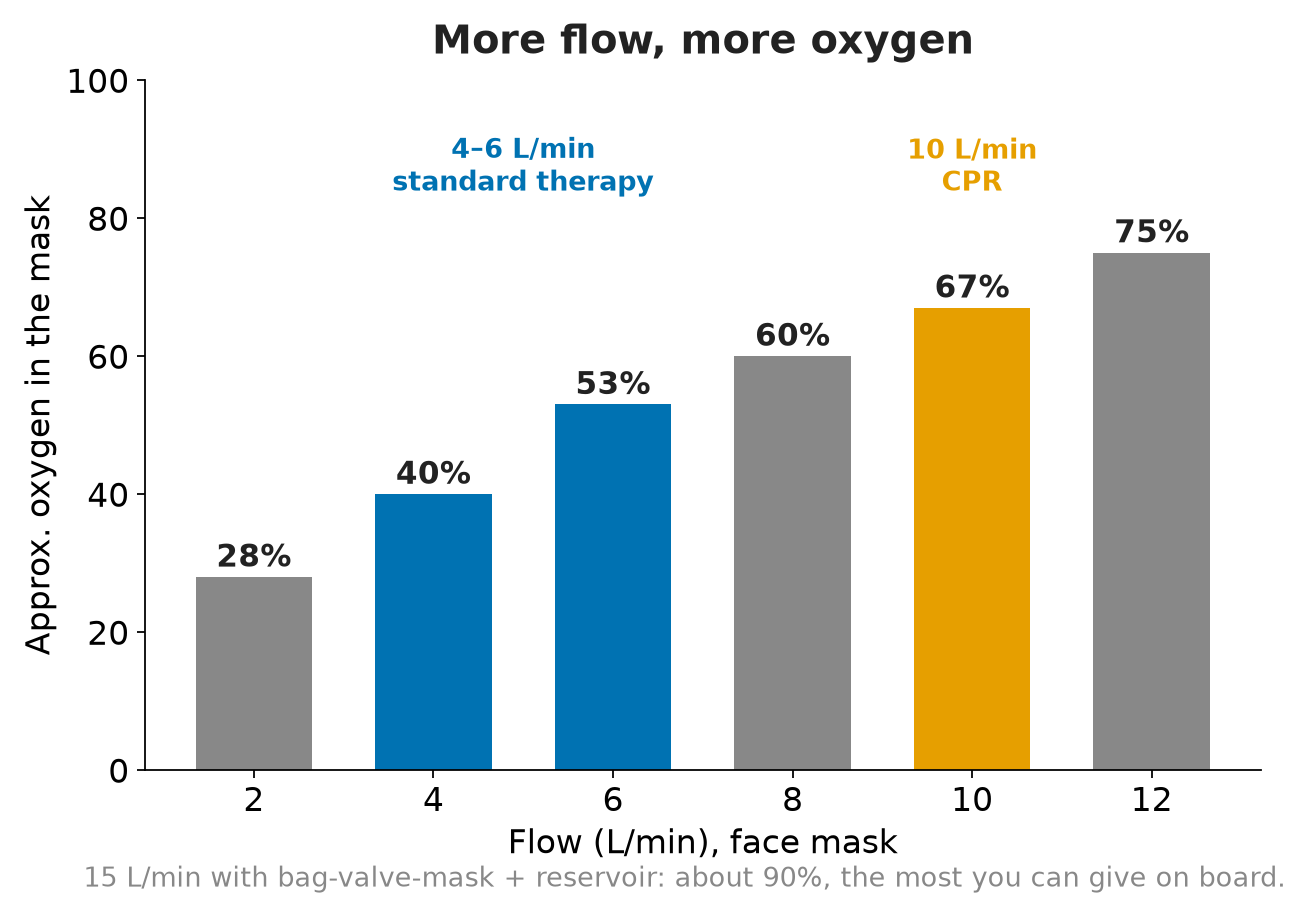
Flow rate and oxygen concentration (face mask)
| Flow | Approx. O2 in the mask | Typical use |
|---|---|---|
| 2 L/min | 28% | |
| 4 L/min | 40% | Standard therapy (4–6 L/min) |
| 6 L/min | 53% | Breathing patient with low O2 |
| 8 L/min | 60% | |
| 10 L/min | 67% | CPR |
| 12 L/min | 75% | |
| 15 L/min | approaching 100% | Resuscitation with BVM + reservoir |
- Standard therapy: 4–6 L/min by mask.
- Resuscitation: 15 L/min through a bag-valve-mask (BVM, “AMBU”) with reservoir — about 90% O2, the most you can deliver on board.
- Nasal prongs: for non-critical patients, or when the patient will not tolerate a mask (or hold the mask just off the face).
Pocket mask
- Kept in the AED pouch with 2 sets of gloves, scissors, a shaver and a swab.
- Has a one-way valve. It only works with a complete seal: press it down and tilt the head back.
- During CPR, leave it on the face between compressions (see CPR, AED and Choking).
Oxygen Equipment, Cylinders and Hazards
In short: know your cylinder, set it up cleanly, respect the fire risk and know how long your oxygen will last.
Kit and maintenance
- Typical yacht/ship kit: an oxygen D cylinder with a multiflow regulator. Medical stores rules: MSN 1905 (M+F).
- Monthly onboard checks · hydraulic test every 5 years · service every 3 years · oxygen refilled every year.
- Pin Index system (older cylinders): the cylinder valve has gas-specific pin holes and the regulator yoke has two matching pins, so the wrong regulator physically cannot fit. A Bodok seal (sealing washer) sits between valve and yoke. Keep about 6 spare Bodok washers.
Giving oxygen — step by step
- Confirm the indication (SpO2 below 94%, or always 100% for CO/smoke and decompression illness).
- Identify the cylinder: medical oxygen is black with white shoulders. Use no other colour. Don’t trust colours abroad — the US and India use different codes.
- Crack (flush) the valve briefly before fitting the regulator to blow out dirt. Check for dents, rust and leaks.
- Fit the regulator hand-tight only — no spanners.
- Set the flow: 4–6 L/min standard · 15 L/min with BVM + reservoir for resuscitation · nasal prongs for mild cases.
- Titrate to target: SpO2 94–98% (COPD 88–92%).
- Watch the hazards (below).
- Defective cylinder: empty it slowly outdoors, never refill it, and store empties apart from full ones.
The four hazards
- 🔥 Fire: oxygen feeds combustion. No oil or grease on fittings, no naked flames, ventilate the space.
- ⏳ Limited supply: work out endurance = cylinder pressure × water volume ÷ flow. Example: a 2.3 L cylinder at 137 bar holds about 315 L → about 21 min at 15 L/min or about 52 min at 6 L/min. Read the figures on your own cylinder label.
- 💨 Dry gas: long use dries the mouth and airway → humidify.
- ❗ Oxygen is not ventilation: if the patient is not breathing, you must breathe for them with a BVM; a mask alone does nothing.
Airway Adjuncts: Guedel (OPA) and Nasal Airway (NPA)
In short: adjuncts hold the tongue away from the back of the throat. They keep the airway open, but they do not protect it from vomit.
What adjuncts do — and don’t do
- They keep the airway patent only. No oxygen connects to them; if they block, suction through them.
- Neither OPA nor NPA prevents aspiration of vomit → an unconscious breathing patient goes in the recovery position with continuous monitoring.
- Supraglottic airways (i-gel type) also exist; some yachts carry them.
Guedel / oropharyngeal airway (OPA)
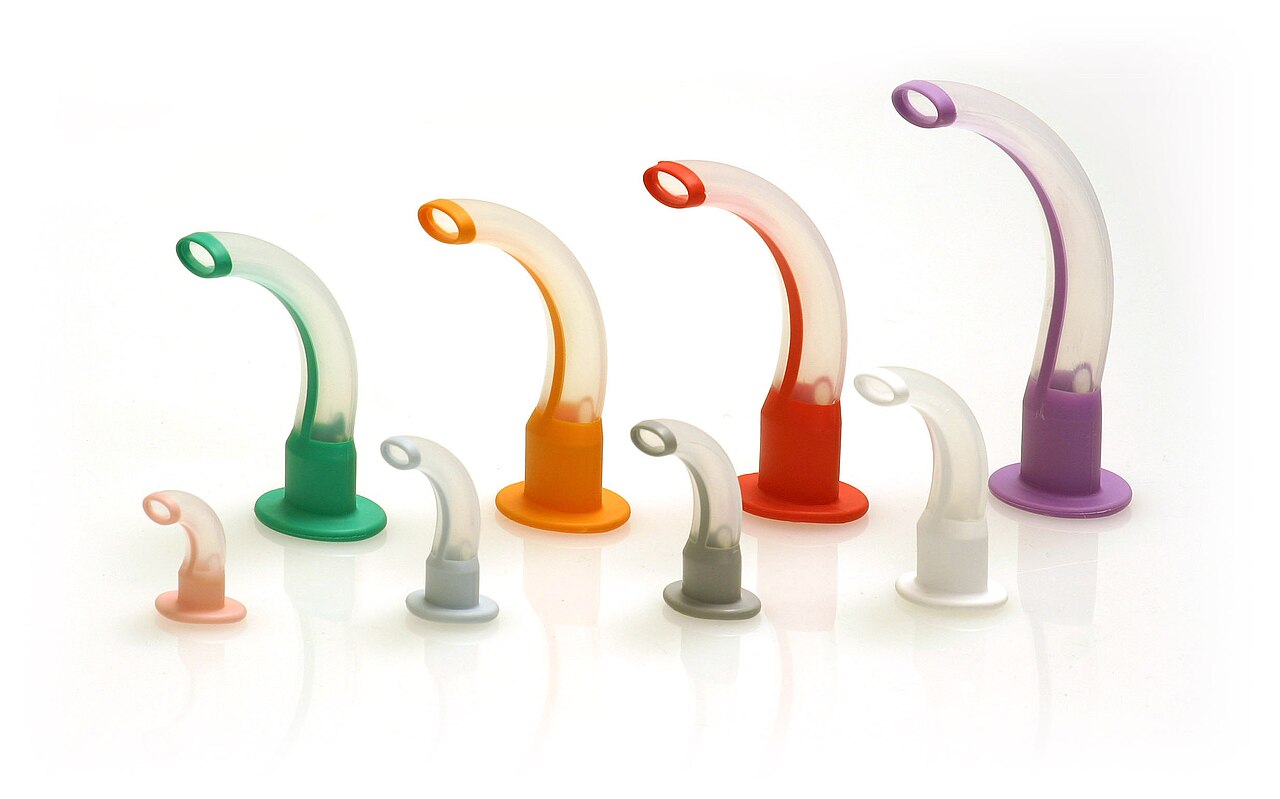
- A rigid, curved tube in the mouth that keeps the tongue off the back of the throat.
- Only for a completely unconscious patient with no gag reflex.
- If they gag, cough or react → remove it immediately (risk of vomiting, laryngospasm, aspiration). Gagging means they are not fully unconscious; spitting it out means they are waking up.
- On board: usually only 2 sizes — 6 (red) and 7 (yellow), the commonest adult sizes — not the full set.
Insertion
- Confirm: completely unconscious, no gag reflex.
- Size it against the cheek: corner of the mouth to the angle of the jaw.
- Wrong size makes things worse: too short pushes the tongue back; too long can trigger laryngospasm.
- Insert upside down (curve towards the palate), then rotate 180° as it reaches the soft palate.
- Children: insert it the right way up straight away, using a tongue depressor — their palate is delicate.
- Push until the flange rests on the teeth; secure with ribbon tied loosely.
- Gag or cough → out at once.
- Recovery position + continuous monitoring.
Nasopharyngeal airway (NPA)
- A soft, flexible tube passed through the nostril to the back of the throat, behind the tongue.
- Big advantage: tolerated by semi-conscious patients who still have a gag reflex — also useful with a clenched jaw (trismus) or mouth injuries, when an OPA cannot go in.
- Choose it when airway swelling is coming — e.g. facial burns or blast injury can swell dramatically within about 10 min.
- Contraindication: suspected basal skull fracture — head injury with CSF or blood from nose or ears, raccoon eyes, Battle’s sign (bruising behind the ear). The tube could enter the skull.
- Caution: nasal fractures, bleeding disorders.
Insertion
- Rule out a basal skull fracture.
- Size it: length nostril to ear tragus; width about the patient’s little finger. Average adult male ≈ size 7.
- Lubricate well (it comes with its own lubricant).
- Right nostril first, bevel towards the septum. Advance gently with a slight twist, straight back along the floor of the nose — not upwards.
- Resistance → try the other nostril (they are rarely equal). Never force it. Nosebleed is the commonest complication; too long a tube can cause gagging or vomiting.
- The flange (or a safety pin through it) stops it sliding into the nose.
- No aspiration protection → recovery position + continuous monitoring.
The Unconscious Patient: Looking for the Cause
In short: run DRSABC, then a full ABCDE, and at every step look for clues to why the patient lost consciousness (LOC).
Airway and breathing clues — look in the mouth
- Cyanosis → low SpO2? (dark skin: check the inside of the lips / gums)
- Swelling → anaphylaxis?
- Injury → major trauma?
- Froth or bitten tongue → seizure?
- Soot (carbon) in the mouth → smoke inhalation.
- Sweet smell → diabetic emergency (ketones smell like nail-polish remover).
- Almond smell → cyanide (from burning plastics and foams in a fire).
Circulation clues
- Hands and feet cold, clammy and sweaty → hypovolaemic shock? · Warm and red → anaphylaxis / sepsis?
- Pulse: fast? irregular? weak? · Low BP → shock?
- Tender abdomen: peritonitis? bruising? trauma? pelvis?
- Anatomy pointers: right-side pain → liver / gallbladder; the stomach fundus is on the left (reflux eases lying on the left); abdominal pain in a man around 50+ → think of an aortic rupture too.
Exposure clues
- Urticarial rash (hives) → anaphylaxis? · Non-blanching, blood-coloured rash → meningitis?
- Temperature: signs of sepsis or heat stroke.
- Surroundings: possible trauma · injection marks (drug use) · a hot environment.
Common causes of unconsciousness
- Anaphylaxis / asthma / pneumonia
- Peritonitis
- Sepsis / infectious disease
- Heat exhaustion / heat stroke / dehydration
- Drugs / alcohol
- Diabetic collapse
- Faints (low blood pressure)
- Fits (seizures)
- Toxic gases (lack of oxygen)
- Trauma / head injury / external or internal bleeding
Enclosed spaces: H2S smells of rotten eggs at low levels but knocks out your sense of smell at high levels; it is heavier than air, flammable and kills in minutes. Rotting cargo also gives off CO2, and the air may be short of oxygen. Only trained crew go in: space ventilated, atmosphere tested, a person outside in constant contact with a spare BA set ready. Confined spaces still kill about 2 people a day across industry.
Finishing the examination
- Low GCS → recovery position and secure the airway.
- Write down your findings in the patient’s notes.
- Explain them to the patient and say what happens next: treatment, radio medical advice, reassessment.
- Keep reassessing — patients deteriorate.
- Chart the observations, e.g. a NEWS-style chart: respirations, SpO2, air or oxygen, blood pressure over time, with red/orange bands for abnormal values so a decline jumps out.
GCS and Vital Signs Monitoring
In short: score consciousness with AVPU, then GCS for serious head injury; repeat vital signs often enough to stay one step ahead.
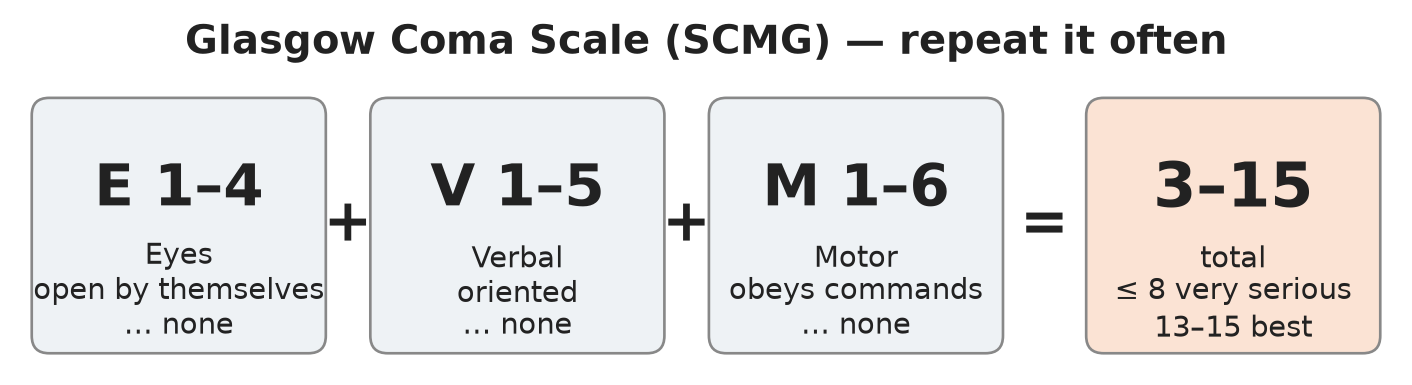
Glasgow Coma Scale (SCMG)
- AVPU first (Alert, Voice, Pain, Unresponsive). Use GCS for serious head injuries and repeat it often to track deterioration.
- Eyes (1–4): open spontaneously › to command › to pain › none. Eyes swollen shut cannot be scored.
- Motor (1–6): obeys commands › localises pain (pushes your hand away) › withdraws from pain without localising › decorticate (stiff, arms bent inwards) › decerebrate (arms straight, hands turned outwards — worse, brain damage) › none.
- Verbal (1–5): oriented (date, place, name) › confused › inappropriate words › incomprehensible sounds › none.
- Total 3–15. 8 or less = very serious; 13–15 = best.
- Every unconscious patient gets a blood glucose test — glucose swings after trauma, and the body cannot heal without it.
Vital signs — practical tips
- Blood pressure: a manual cuff is the most accurate. Electronic units need yearly calibration, and a drop can ruin them. Cuff 2 fingers above the elbow crease.
- Beware the white-coat effect: one high reading is not hypertension. Re-check morning and evening for a week, and take more than one reading before you trust a number.
- How often: critical or chest injury → every 15 min, cuff left on. Once stable → every 30 min, then hourly.
- SpO2: normal 95% or more. Cold hands read falsely low → warm them. Slumped posture lowers the reading → sit them up, take a few breaths, measure again.
- Respirations: adult range 12–20/min (a resting ideal is often quoted as 10–12). 25/min is out of range → think shock or low oxygen.
Recovery Position and the Face-Down Casualty
In short: an unconscious patient who is breathing normally goes on their side to keep the airway clear. Choose the side with care.
Recovery position
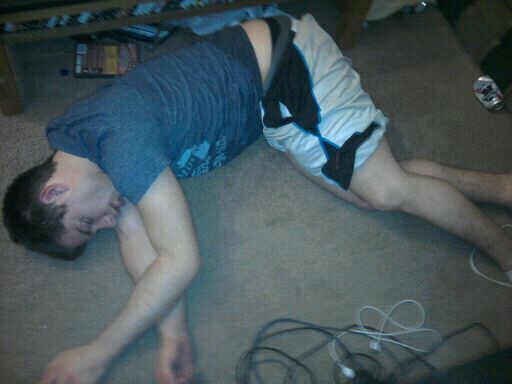
- Casualty breathing normally (depending on signs and symptoms) → recovery position.
- Loosen tight clothing at the neck and waist first.
- Roll them on their side: head tilted back, airway open, top knee bent to stop them rolling; place the arm so they cannot roll over.
- Keep the airway secure and monitor continuously.
Which side?
- Pregnant → LEFT: the womb does not press on the vena cava (same reason as the CPR tilt in late pregnancy).
- Seasick → LEFT: the stomach outlet (pylorus) points right, so lying left slows emptying into the gut and reduces reflux and vomiting.
- Swallowed poison → LEFT: the poison stays in the deepest part of the stomach — less vomiting and inhalation, and less passes on to the small intestine, where most is absorbed.
- Bleeding from the mouth or a head wound → bleeding side DOWN, so blood drains out (blood kept inside raises pressure on the brain). If injuries conflict, the head/brain wins.
- Broken femur: never lie them on it.
- Chest injury (exception): sit them up, leaning towards the INJURED side — the good lung can expand and leaning on the sore side eases the pain.
Memory hook — “LEFT is best”: pregnancy, seasickness and swallowed poison all go on the left.
Face-down casualty
- Don’t roll them straight away. Check breathing from behind (the back rises); the mouth drains on its own; slide your hands underneath to feel for bleeding.
- Turn them only if you cannot confirm breathing (CPR needed) — roll them towards the side opposite the way the face is pointing.
- Examine the back when you log-roll them onto the stretcher — don’t roll them back and forth.
⚡ Flashcards
Test yourself, one card at a timeQ1When do you give oxygen, and what SpO2 are you aiming for?
AnswerLow oxygen (SpO2 below 94%): arrest, respiratory distress, severe asthma, anaphylaxis, shock, major trauma, drowning. Target 94–98%; known COPD 88–92%.
Common trapTrap: CO poisoning / smoke inhalation and diving decompression illness always get 100% — the oximeter reads falsely normal in CO poisoning.
Q2What flow do you set for standard therapy and for resuscitation?
AnswerStandard 4–6 L/min by mask · resuscitation 15 L/min with BVM + reservoir (about 90% O2, the highest you can give).
Common trapTrap: oxygen is not ventilation — a patient who is not breathing needs a bag-valve-mask, not just an oxygen mask.
Q3How do you recognise a medical oxygen cylinder, and what are the four oxygen hazards?
AnswerBlack body, white shoulders. Hazards: fire · limited supply (pressure × volume ÷ flow) · dry gas (humidify) · O2 ≠ ventilation.
Common trapTrap: cylinder colours differ abroad (e.g. US, India) — never trust colour alone; never use oil or grease on fittings.
Q4How is an oxygen cylinder maintained on board?
AnswerChecks monthly · hydraulic test every 5 years · service every 3 years · oxygen refilled annually.
Common trapTrap: a defective cylinder is never refilled — empty it slowly outdoors and keep it apart from the others.
Q5Who can have a Guedel (OPA), and how do you size and insert it?
AnswerOnly a completely unconscious patient with no gag reflex. Size: corner of mouth → angle of jaw. Insert upside down, rotate 180° at the soft palate.
Common trapTrap: if they gag or cough, remove it at once — and it does not stop them inhaling vomit.
Q6When do you choose an NPA instead, and when must you not use one?
AnswerSemi-conscious patient with a gag reflex, clenched jaw or mouth injury, or airway swelling expected (facial burns). Size: nostril → ear tragus, width ≈ little finger.
Common trapTrap: never with a suspected basal skull fracture (CSF/blood from nose or ears, raccoon eyes, Battle’s sign).
Q7An unconscious casualty smells of nail-polish remover. What do you suspect, and what are the other mouth clues?
AnswerKetones → diabetic emergency. Also: cyanosis → low O2 · swelling → anaphylaxis · froth/bitten tongue → seizure · soot → smoke · almond smell → cyanide.
Common trapTrap: in dark skin, look for cyanosis inside the lips, not on the skin.
Q8What GCS score is "very serious", and what test does every unconscious patient also need?
AnswerGCS 8 or less = very serious (13–15 best). Always do a blood glucose test.
Common trapTrap: use AVPU first; GCS is for serious head injury and must be repeated to spot deterioration.
Q9Which casualties go on their LEFT side in the recovery position?
Answer“LEFT is best”: pregnancy · seasickness · swallowed poison. Bleeding from mouth or head → bleeding side down.
Common trapTrap: chest injury is the exception — sit them up, leaning towards the injured side.
Q10You find a casualty face down. What do you do first?
AnswerDon’t roll them straight away: watch the back rise, let the mouth drain, feel underneath for bleeding.
Common trapTrap: only turn if you cannot confirm breathing (CPR needed) — roll away from the way the face points.
📚 Resources
Video
- OPA Insertion — EM CapeTown
- Simple guide on Oropharyngeal Airway (OPA) utilisation — Lufy Ismail
Books
- The Ship Captain’s Medical Guide — Maritime and Coastguard Agency, 24th edition (2024)
- International Medical Guide for Ships — World Health Organization, 3rd edition
Regulations
- MSN 1905 (M+F) Amendment 5 — ships’ medical stores — minimum medical stores and first-aid kits for UK ships
Official sites
- BTS Guideline for oxygen use in healthcare and emergency settings — British Thoracic Society, source of the 94–98% and 88–92% targets
Exam focus — MCA
Typical questions: “A crew member is unconscious but breathing — what do you do?” · “When would you use an NPA instead of a Guedel, and when never?” · “How do you set up and give oxygen from the ship’s cylinder, and how long will it last?” · “What SpO2 do you aim for, and what changes for COPD or CO poisoning?” · “Which side do you put a pregnant or seasick casualty on?”
What examiners want: a calm DRSABC → ABCDE sequence; adjuncts only with the right level of consciousness (OPA: no gag reflex; NPA: not with a basal skull fracture) and always the recovery position + monitoring afterwards; the right flow for the job (4–6 L/min vs 15 L/min with BVM + reservoir) and the fire hazard; O2 is not ventilation; GCS 8 or less = very serious; and the “LEFT is best” rule with the chest-injury exception.