Burns: Assessment, First Aid and Dressing
MedicalHow to assess a burn on board (depth, size by the rule of nines, chemical, electrical and inhalation burns), stop the burning and cool it, dress it, and replace lost fluid with the Parkland formula. With no doctor on board, these steps limit shock, infection and scarring, and they are core MCA medical care exam material.
Last reviewed 1 Nov 2026 · From a professional captain's years of study notes · Organised with AI and checked against current regulations · How we write
On this page (11)
Why Burns Are Dangerous
In short: the skin is an organ. Burn it and you lose its protection, its fluid and its heat control — the burn keeps harming the casualty long after the flames are out.
What the skin does
- Protection — a barrier against germs and fluid loss.
- Thermoregulation — keeps body heat in.
- Excretion and sensation.
- Lose a large area and all four fail at once.
Complications to expect
- Infection — the burn destroys the skin barrier.
- Blisters → fluid loss. Large burns lose a lot of fluid → risk of shock and dehydration.
- Fluid loss is massive even without blisters — a 3rd-degree burn has no blisters but leaks heavily.
- Loss of skin, pain and swelling.
- Hypothermia — with no skin to hold heat, cooling a big area can chill the whole casualty. Cool extensive areas with care.
- Compartment syndrome — swelling under tight burnt skin squeezes muscles and vessels. Watch for it in burns and fractures.
Pain is a good sign: the nerves still work. A burn that does not hurt is deeper and worse.
Classifying Burn Depth
In short: the deeper the burn, the less it hurts and the longer it takes to heal. Depth decides first aid, dressing and whether the casualty needs a hospital.
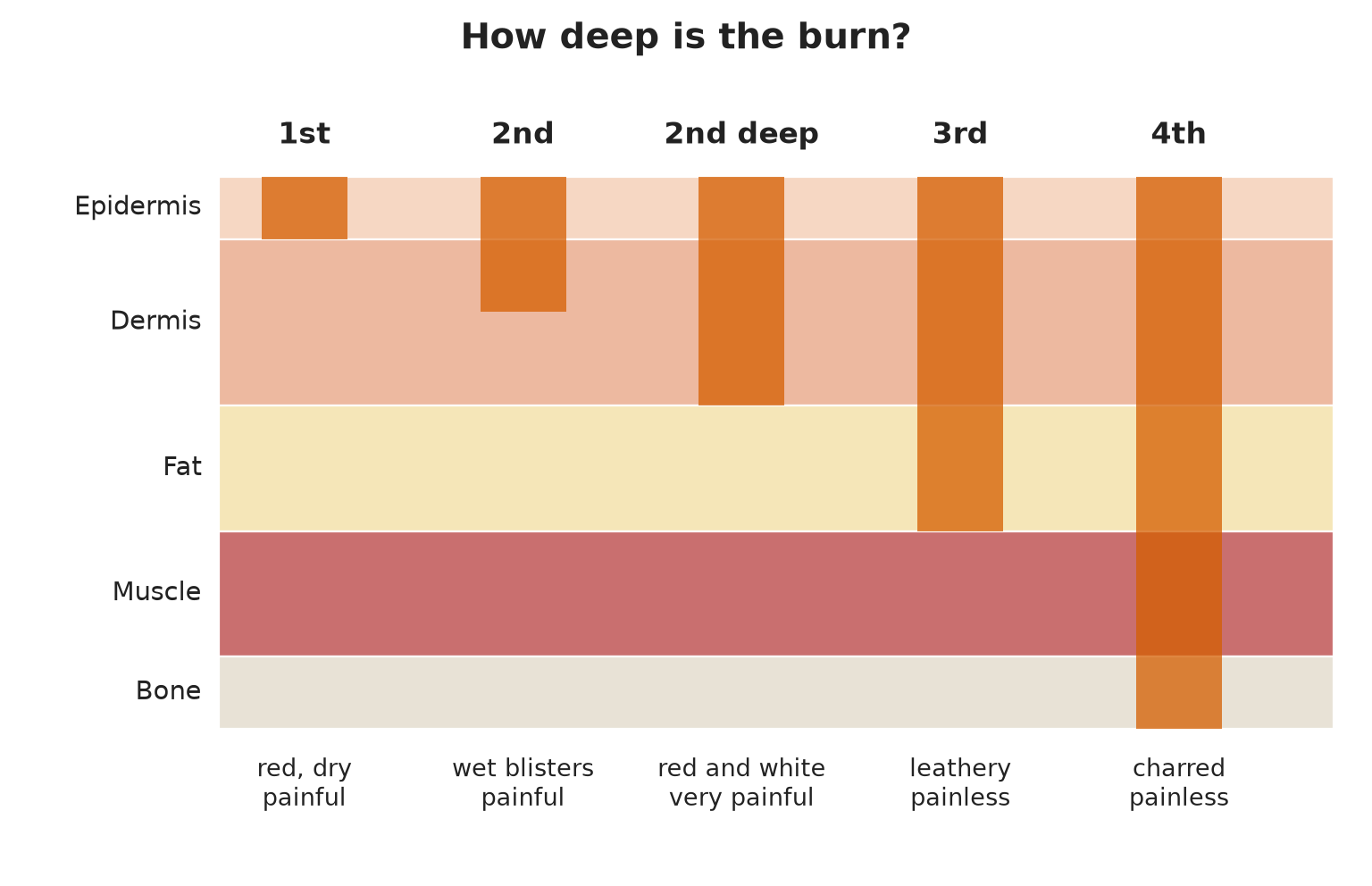
The four degrees
| Degree | Layers | What you see | Pain | Action | Risk |
|---|---|---|---|---|---|
| 1st — superficial | Outer layer only | Red, swollen, no blisters, dry | Painful | Cool running water or a cold compress | Repeated sunburn → skin cancer |
| 2nd — superficial partial thickness | 1st + 2nd layer | Blotchy red, wet blisters, moist, glistening | Painful | Cool water, loose sterile gauze, don’t pop blisters | Local infection, cellulitis |
| 2nd — deep partial thickness | Both layers burnt through | Red and white, bloody blisters | Extremely painful | Immediate medical attention | Scarring, skin graft |
| 3rd — full thickness | All skin layers | White and brown, stiff, dry, leathery | Painless (nerves destroyed) | Immediate medical attention | Contractures, amputation |
| 4th degree | Skin, tissue below, muscle and bone | Black, charred, dead tissue | Painless | Immediate medical attention | Amputation, gangrene, death |
- A typical 2nd-degree burn of the hand: red, moist, shiny surface with several blisters — and it hurts.
- A deep burn (3rd–4th degree): black, leathery tissue; the deepest parts feel nothing.
Healing times (SCMG 22nd ed.)
- Superficial 2nd degree: 7–10 days.
- Deep 2nd degree: about 3 weeks.
Estimating the Burnt Area
In short: the size of a burn is given as a percentage of body surface area (% BSA). It drives fluid replacement and the evacuation decision.
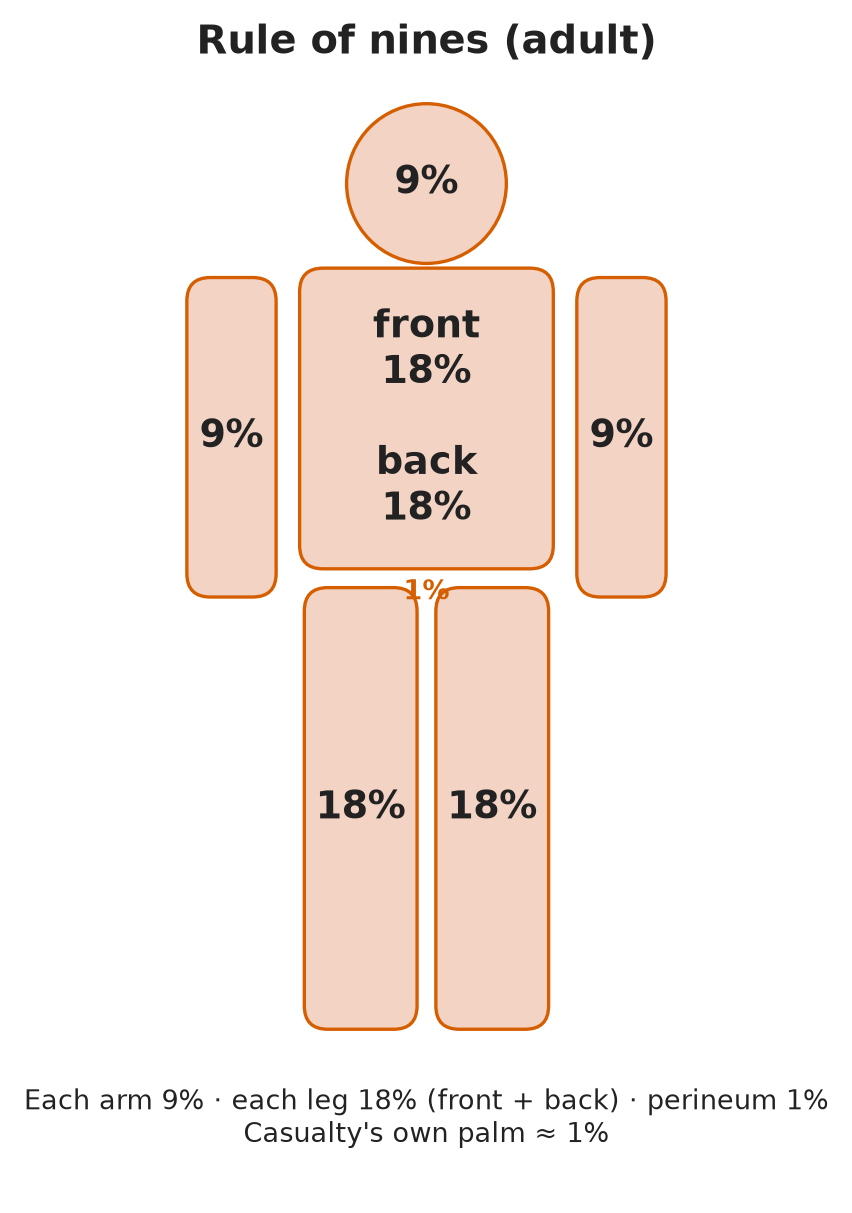
Rule of nines (adults)
| Body part | % BSA |
|---|---|
| Head | 9% |
| Each arm (front and back) | 9% |
| Each leg (front and back) | 18% |
| Front of trunk | 18% |
| Back of trunk | 18% |
| Perineum | 1% |
- Palm method: the casualty’s own palm is about 1% of their body surface — handy for scattered or small burns.
- Count only 2nd degree or deeper (burns into the epidermis or beyond). A 1st-degree burn keeps the waterproof layers intact, so it loses very little fluid.
Children and the Lund & Browder chart
- Children have a bigger head and smaller legs than adults:
- Infant / toddler: head 18%, each leg 13.5%.
- Child: head 12%, each leg 16.5%.
- The Lund & Browder chart adjusts for age and is more accurate than the rule of nines. Use a burn chart if one is on board.
First Aid: Stop the Burning and Cool
In short: make the scene safe, stop the burning, then cool with running water for at least 20 min. Keep the rest of the casualty warm.
Approach
- Use the usual casualty routine: DR BBCFS → ABC → % — Danger, Response, Breathing, Bleeding/Burns, Consciousness, Fractures, Shock; then airway, breathing, circulation; then estimate the % BSA.
- Your own safety first.
- Keep assessing the casualty while the burn cools.
Clothing on fire (EFA manual V1.3)
- A dry-powder extinguisher is by far the best way to put out burning clothing.
- No extinguisher: lay the person down and smother the flames — wrap them in any material, or use a bucket of water or a hose.
- Make sure all smouldering clothing is out.
- Powder in the eyes does little or no harm — wash it out after the fire is out, while you cool the burns.
Cooling a thermal burn
- Stop the burning process before anything else: remove the source and start cooling.
- Cool water, about 15°C: run or pour it over the burn, or submerge the part and change the water every few minutes.
- How long: current guidance is at least 20 min under running water. Figures you will meet: older guidance said at least 10 min; some sources say 30 min, and chemical burns need longer (see below).
- Cooling still helps up to 3 h after the burn. Protected by a burn bag or medical cling film, cooling can go on for 30 min to 3 h — it improves healing time.
- No suitable water? Use towels or cloths soaked in water or normal saline, changed every 2–3 min.
- Burn-gel wraps only cool — they are not a dressing. For long soaking of a hand, put it in a plastic bag of water.
No ice, ice packs or refrigerated water — they cause more damage. Do not cool extensive burns over 15% BSA (SCMG 22nd ed.): hypothermia risk. Skin loss over 10% already carries a hypothermia risk from cooling — keep the rest of the casualty warm.
While you cool
- Remove rings, watches, belts and anything tight before the swelling starts.
- Remove clothing that is not stuck to the burn. Stuck clothing stays on — unless it is a chemical burn.
- When cooled: pat dry gently with a clean towel and cover with cling film.
- Elevate the burnt part and treat for shock.
Chemical, Electrical and Inhalation Burns
In short: each special burn has one extra rule — get the chemical off, find the exit wound, watch the airway.
Chemical burns on the skin
- Liquid chemical: remove all wet, contaminated clothing before cooling.
- Powder or solid chemical: brush it off downwind before removing clothing. Wear gloves — there is an inhalation risk.
- Wash time: alkali → 2 h (alkali soaks deeper, so about double the acid time) · acid → 1 h — or until the burning pain stops.
- Don’t wash the chemical over unaffected skin or into the other eye; don’t let water collect in the shoes.
- Look up the chemical in the MFAG and the IMDG Code, and check its MSDS. The dangerous-goods data sheet goes to hospital with the casualty.
Chemical in the eye
- Approach: DR BBCFS → ABC → TMAS.
- Spray, splashes or fumes cause redness and irritation.
- At the eye-wash station: flush with at least 1 litre of water for 20 min, burnt eye down so the water does not run into the other eye or onto the skin.
- Get medical help — some chemicals leave permanent damage. Always check the MSDS.
Electrical burns
- Current passes through the body: always look for both an entry and an exit wound (e.g. entry on the hand, exit on the foot).
- The damage along the internal path can be much worse than the skin suggests.
- Adapted routine:
- Danger — is it safe? Is the power off?
- Response — radio medical advice, casualty, AVPU.
- Breathing — be ready for cardiac arrest.
- Bleeding / Burns — treat.
- Consciousness — AVPU.
- Fractures — treat.
- Shock — W.A.T.E.R.
The on-board rule given for electrical burns: do not cool or apply water.
Inhalation injury
- Burns to the airway cause swelling that can block the air flowing into the lungs.
- Suspect it after a fire in an enclosed space, with soot round the nose or mouth, singed nasal hairs or a hoarse voice.
Circumferential burns
- A burn that goes all the way round a limb, the chest or the neck.
- The burnt tissue tightens like a tourniquet: it can cut off circulation below (limb) or restrict breathing (chest).
- Monitor pulse, colour and sensation below the burn.
- Chest → escharotomy: surgical cuts through the rigid burnt tissue to let the chest move — a hospital procedure.
Dressing Burns on Board
In short: pain relief first, then a light, sterile, non-stick dressing agreed with TMAS. Protect the airway and genitals first and keep fingers apart.
Burns dressing kit
- Gloves (non-sterile nitrile) · sterile dressings · paraffin gauze (non-adherent) · burn gel · Biafine emulsion · saline for irrigation · bandages or net.
- Paraffin gauze brands: Paranet (10 × 10 cm, sterile, petroleum-jelly gauze) · Jelonet · Bactigras (antiseptic). Store flat below 25°C; external use only.
- Large burn → have an IV giving set ready for fluid replacement.
Never use Inadine (povidone-iodine non-adherent dressing) on burns. Prefer a dressing with diluted real honey or Vaseline.
Step by step
- Pain relief before cleaning or dressing — tramadol or low-dose morphine, on radio medical advice.
- Grease burns: clean first with mild soap and warm water.
- Choose the dressing with TMAS: medical cling film, or honey, or petroleum (paraffin) gauze in strips + a sterile non-adherent pad.
- Add absorbent padding and bandage lightly. The dressing must be light, sterile and non-fluffy — non-stick (silver-based types exist).
- Priority, even in total-body burns: face (airway) and genitals first, then fingers and toes separately — burnt fingers and toes fuse together.
- Dress large areas in small strips, or dressings cut in half side by side: each piece comes off on its own, with less pain.
- Superficial burns can be left uncovered.
- Elevate the part. Swelling rises for days — re-check the tightness of every dressing.
Products and when to change
- Alginate dressing with active honey (e.g. Algivon) — a honey option.
- Hydrocolloid dressings for closed 1st/2nd-degree burns: waterproof, stay on up to 7 days, never on an infected wound.
- Silver sulfadiazine cream for 2nd–3rd-degree burns — keep it in the fridge.
- Changing: sources differ. SCMG 22nd ed.: leave dressings undisturbed for 1 week. On-board practice: change daily for the first 2 days if the pads are soaked. Wash honey off with warm sterile water.
- At a change, dead tissue can be removed with tweezers until it bleeds slightly; salt-water baths of 2–3 min help.
Blisters
- Leave them intact. Remove only if:
- the blister is over a joint;
- the casualty cannot avoid lying on it;
- the fluid is cloudy or bloody.
- Use sterile scissors.
Fluid Replacement: the Parkland Formula
In short: a big burn leaks fluid fast. Work out the 24-hour need with Parkland, give half in the first 8 h, and agree the route with TMAS.
The formula
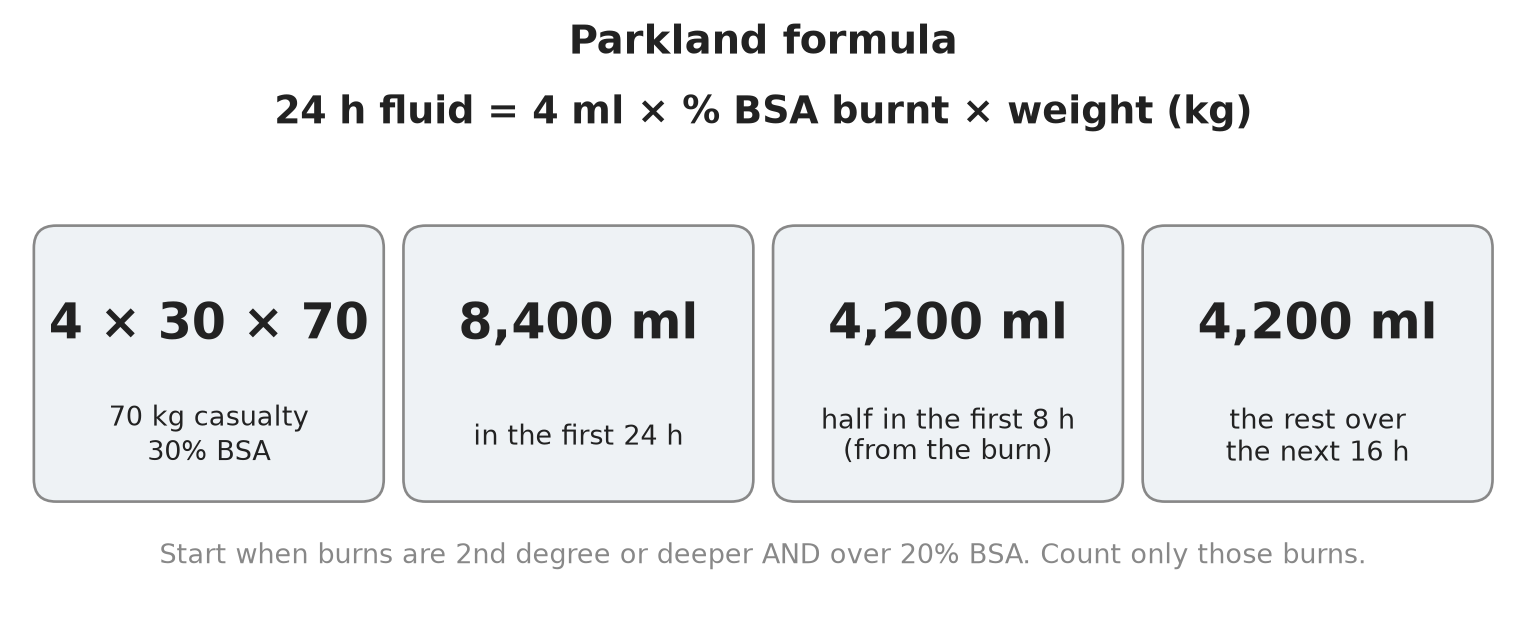
Fluid in the first 24 h = 4 ml × % BSA burnt × weight (kg)
- Give half in the first 8 h (counted from the time of the burn), the rest over the next 16 h.
- Start it when the burn is 2nd degree or deeper AND over 20% BSA.
- Count only 2nd-degree or deeper burns in the % BSA.
| Example | Sum | Result |
|---|---|---|
| 70 kg casualty, 30% BSA | 4 × 30 × 70 | 8,400 ml in 24 h |
| First 8 h | 8,400 ÷ 2 | 4,200 ml |
| Drip rate, 20-drop set | 4,200 × 20 ÷ 480 min | 175 drops/min ≈ 44 per 15 s |
Which fluid, which route
- Oral fluids are acceptable if the casualty can drink — keep a strict fluid in/out chart.
- Never plain water. Use water + salt + sugar, or oral rehydration salts, with whatever is on board.
- Polase (potassium + magnesium) is a useful add-on but has no sodium — don’t use it alone.
- IV: the clinical standard is Ringer’s lactate / Hartmann’s.
- Large area → IV or rectal infusion may be needed. IV access impossible (burnt skin, collapsed veins) → intraosseous (IO) route: a needle into the bone marrow, usually the upper tibia or the humerus; it delivers fluids and drugs like an IV.
- Whatever the route: treat for shock and give analgesics.
Infection and Evacuation
In short: serious burns need a hospital within hours; every burn needs watching for infection for days.
Hospital within 6 hours (SCMG 22nd ed.)
- 3rd-degree burns — especially those encircling the chest or a limb.
- Burns to the face, genitals or joints.
- Burns over 18% BSA in an adult or 10% in a child.
- Any burn to a risk area of the body → seek medical help at once.
Recognising an infected burn
- Fever · more pain · redness · swelling · enlarged lymph nodes · bad smell.
- Never ignore it: high risk of septicaemia → radio medical advice immediately.
- Treatment: antibiotics by mouth or injection (systemic), remove dead tissue, clean dressing changed every 2 days.
⚡ Flashcards
Test yourself, one card at a timeQ1Why is a large burn dangerous, even after the fire is out?
AnswerIt breaks the skin barrier → infection, fluid loss → shock, hypothermia, pain, swelling and compartment syndrome.
Common trapTrap: no blisters does not mean little fluid loss — a 3rd-degree burn loses massive fluid.
Q2How do you tell a superficial burn from a full-thickness one?
Answer1st: red, dry, no blisters, painful · 2nd: wet or bloody blisters, very painful · 3rd: white/brown, leathery, painless · 4th: charred, into muscle and bone.
Common trapTrap: pain is a good sign (nerves intact) — no pain over a burn is worse.
Q3How do you estimate the burnt area of an adult?
AnswerRule of 9s: head 9% · each arm 9% · each leg 18% · front trunk 18% · back trunk 18% · perineum 1%. Casualty’s palm ≈ 1%.
Common trapTrap: count only 2nd degree or deeper; children have a bigger head (infant 18%) — use Lund & Browder if you have it.
Q4A crew member's clothing is on fire. What do you do?
AnswerA dry-powder extinguisher is by far the best tool. None → lay them down and smother the flames; check nothing is still smouldering (EFA manual V1.3).
Common trapTrap: don’t worry about powder in the eyes — wash it out after, while cooling the burns.
Q5How long, and with what, do you cool a thermal burn?
AnswerStop the burning, then cool running water about 15°C for at least 20 min; it still helps up to 3 h after the burn.
Common trapTrap: no ice or iced water; don’t cool extensive burns over 15% BSA (hypothermia — SCMG 22nd ed.).
Q6Chemical burn: what comes first, and how long do you wash?
AnswerPowder → brush off downwind, then remove clothing; liquid → remove wet clothing before cooling. Wash alkali 2 h, acid 1 h (or until the pain stops).
Common trapTrap: don’t wash the chemical over healthy skin or the other eye; send the data sheet with the casualty.
Q7Electrical burn: what must you check for?
AnswerPower off first. Look for both an entry and an exit wound; be ready for cardiac arrest.
Common trapTrap: the skin hides the damage — the injury along the current’s path can be far worse.
Q8When do you suspect an airway (inhalation) burn?
AnswerFire in an enclosed space, soot round the nose and mouth, singed nasal hairs, hoarse voice.
Common trapTrap: the airway can swell shut later — keep watching breathing, call TMAS early.
Q9What do you dress a burn with, and what must you never use?
AnswerAfter cooling: cling film, honey or paraffin gauze + non-adherent pad, padding, light bandage. Face and genitals first, fingers and toes separately.
Common trapTrap: never Inadine (povidone-iodine) on a burn; never fluffy cotton.
Q10When may you remove a burn blister?
AnswerOnly if it is over a joint, the casualty cannot avoid lying on it, or the fluid is cloudy or bloody — with sterile scissors.
Common trapTrap: otherwise never pop blisters — the roof protects against infection.
Q11What is the Parkland formula, and when do you start it?
Answer4 ml × % BSA × weight (kg) in 24 h: half in the first 8 h, the rest over the next 16 h. Start with 2nd degree or deeper over 20% BSA.
Common trapTrap: never plain water by mouth — add salt and sugar (or oral rehydration salts).
Q12Which burns must reach hospital within 6 hours, and how does an infected burn show?
Answer3rd degree (esp. round chest or limb), face, genitals, joints, over 18% adult / 10% child (SCMG 22nd ed.). Infection: fever, more pain, redness, swelling, big lymph nodes, bad smell.
Common trapTrap: an infected burn can lead to septicaemia — get radio medical advice at once.
📚 Resources
Video
- What to do if Your Baby has a Burn or Scald - First Aid Training - St John Ambulance — St John Ambulance
Books
- The Ship Captain’s Medical Guide — Maritime and Coastguard Agency, 24th edition (2024); the burns chapter is on page 196 of the 23rd edition
Regulations
- MSN 1905 (M+F) Amendment 5 — ships’ medical stores — the minimum medical stores and first-aid kits UK ships must carry
- Medical First Aid Guide (MFAG) and IMDG Code — first aid and data for chemical burns
Official sites
- Burns and scalds — NHS
- Burns and Scalds — St John Ambulance
- First aid for burns — British Red Cross
- Lund and Browder chart — Wikipedia
Exam focus — MCA
Typical questions: “A crew member is scalded in the galley — talk me through your first aid.” · “How do you estimate the burnt area, and how does it change for a child?” · “Work out the Parkland fluid for a 70 kg man with 30% burns, and the drip rate for the first 8 hours.” · “How do you treat an acid or alkali splash to the skin or eye?” · “Which burns need evacuation, and how would you dress a burnt hand?”
What examiners want: safety first and the DR BBCFS routine; stop the burning, then cool water for at least 20 min, no ice, keep the casualty warm and don’t cool extensive burns over 15% BSA; the rule of nines (palm ≈ 1%, bigger head in children, Lund & Browder more accurate) counting only 2nd degree or deeper; Parkland 4 ml × % × kg, half in 8 h, never plain water; chemicals brushed or washed off first (alkali 2 h, acid 1 h, eye flushed burnt side down); entry and exit wounds in electrical burns; light, sterile, non-stick dressings with fingers separated, no Inadine, blisters left alone; and TMAS plus the 6-hour evacuation criteria.