Good and Poor Stability: Stiff, Tender and the Warning Signs
StabilityWhat good and poor stability look like at sea: stiff and tender vessels, what GM and GZ tell you, the warning signs of a ship losing stability, and how raising weights, low freeboard, blocked freeing ports and slack tanks reduce it. A standard question in the MCA OOW oral.
Last reviewed 1 Nov 2026 · From a professional captain's years of study notes · Organised with AI and checked against current regulations · How we write
On this page (11)
Read first: Flotation, Centres and Metacentric Height. This topic builds on G, B, M and GM.
GM and GZ: what good stability means
In short: a ship with good stability has a positive GM that is big enough but not too big, and a GZ curve that gives a strong righting lever over a wide range of heel.
- G = centre of gravity. M = metacentre. GM = the distance between them (metacentric height).
- Bigger GM = more stable at small angles. GM is the quick check of initial stability.
- GZ = the righting lever: the horizontal distance between G and the line of buoyancy when the ship heels.
- Bigger GZ = more force to come back upright. Righting moment = displacement × GZ.
- At small angles (about 10–15°), GZ ≈ GM × sin(heel). So GM tells you how the ship starts; the GZ curve tells you how she behaves at larger angles.
- Three states of equilibrium: stable (GM positive), neutral (GM = 0), unstable (GM negative).
The minimum figures (2008 IS Code, Part A, 2.2)
- Initial GM₀ ≥ 0.15 m.
- GZ ≥ 0.20 m at an angle of heel of 30° or more.
- Maximum GZ at an angle of not less than 25°.
- Area under the GZ curve: ≥ 0.055 m·rad up to 30°, ≥ 0.09 m·rad up to 40° (or the down-flooding angle if smaller), and ≥ 0.03 m·rad between 30° and 40°.
- These are minimums only. Meeting them does not make a ship safe from capsize; good seamanship still counts (IS Code Part B, 5.1.1).
The stiff vessel
In short: a stiff vessel has a large GM. She snaps back upright fast and hard.
- Very strong righting moment: she comes back upright quickly and with force.
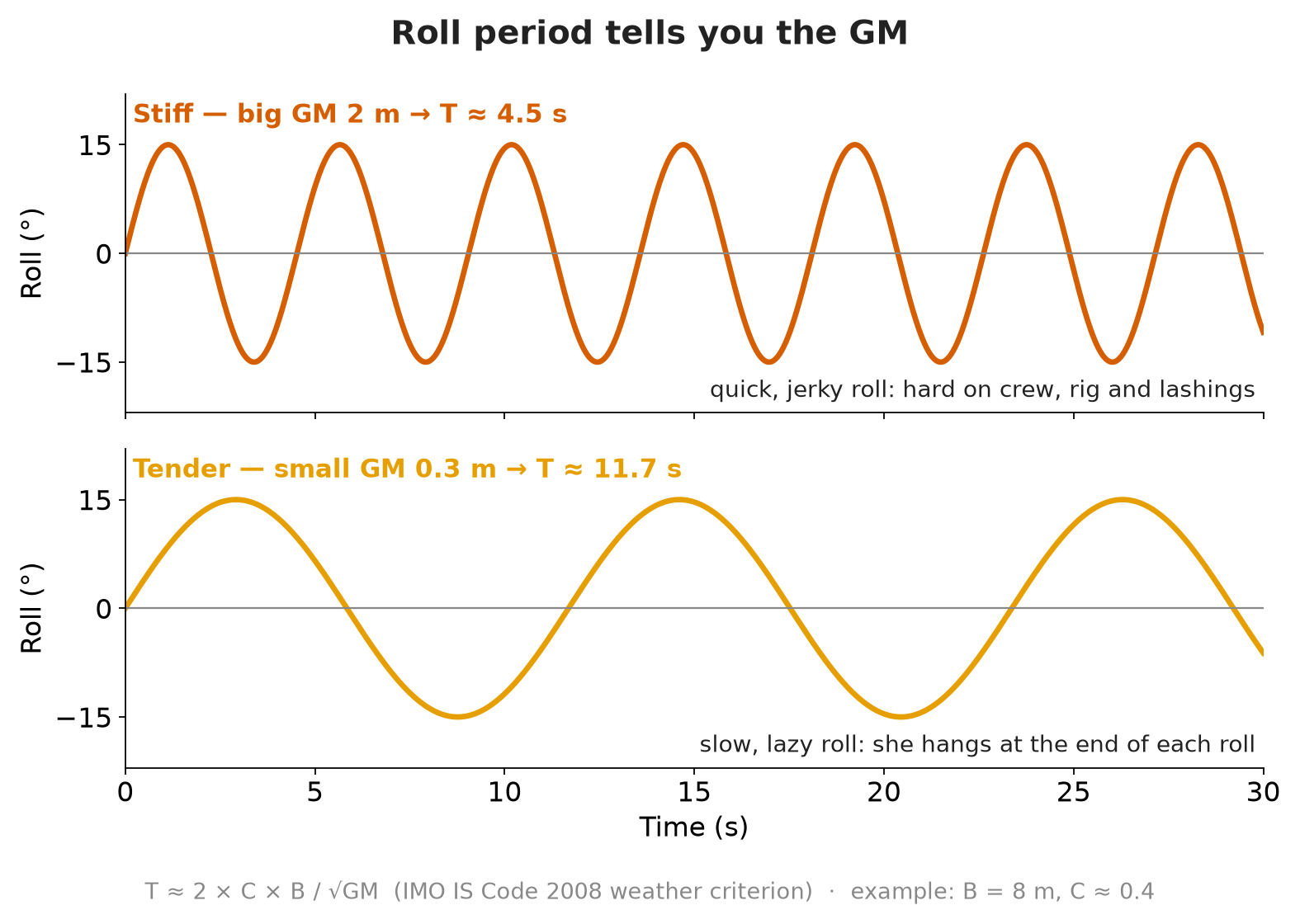
- Short, quick, jerky roll. In heavy weather the rolls can be violent.
- Warships are often given a large GM to survive damage: a classic stiff hull.
- Advantage: a big reserve against heeling forces (wind, turning, weight shifts).
- Disadvantages: uncomfortable and tiring for crew and guests; heavy loads on lashings, masts and fittings; cargo and loose gear can break free; people get hurt.
- The IS Code sets no maximum GM, but advises avoiding excessive GM because of the large acceleration forces (IS Code Part B, 5.1.6).
- On the bridge: if she is too stiff, raise G a little (for example, move weight higher or use the upper tanks), within the stability booklet.
The tender vessel
In short: a tender vessel has a small GM. She rolls slowly and gently, but her margin of stability is small.
- Small righting moment: she comes back upright slowly and without force.
- Long, slow, easy roll. Comfortable, which can hide the danger.
- The closer G gets to M, the more tender the motion becomes. At GM = 0 she has no initial stability at all.
- Advantage: comfortable motion, low stress on structure and lashings.
- Disadvantages: heels a lot to wind, turning and weight shifts; small reserve if G rises further (ice, water on deck, slack tanks, fuel used from low tanks).
Stiff vs tender at a glance
| Feature | Stiff | Tender |
|---|---|---|
| GM | Large | Small |
| Roll period | Short, quick | Long, slow |
| Righting moment | Strong | Weak |
| Comfort | Poor, violent motion | Good, easy motion |
| Main risk | Damage, injuries, shifting gear | Too little reserve; capsize if G rises |
- Roll period gets longer as GM gets smaller (the period depends on 1/√GM). Typical figures: about 12 s for a passenger ship built for comfort, 6–8 s for a tanker or cargo ship (Wikipedia, “Metacentric height”).
Warning signs of poor stability
In short: a ship losing stability tells you through the way she moves. Learn the signs and act early.
- Long, slow, lazy roll, longer than normal for that vessel.
- She hangs at the end of each roll before coming back.
- Heels more than usual to a gust, a small turn or a weight moved across the deck.
- A list that has no obvious cause, or a list that flops from one side to the other: a sign of angle of loll (GM negative; she floats at the angle where GZ = 0).
- A list that gets worse when you fill or empty a tank, or move fuel or water.
- Water staying on deck instead of draining away; ice building up on the upper works.
- On the bridge: if you see these signs, stop moving weight, check tank soundings and the loading condition, reduce free surface and lower G. Do not try to correct loll by moving weight across the ship.
Raising and lowering weights
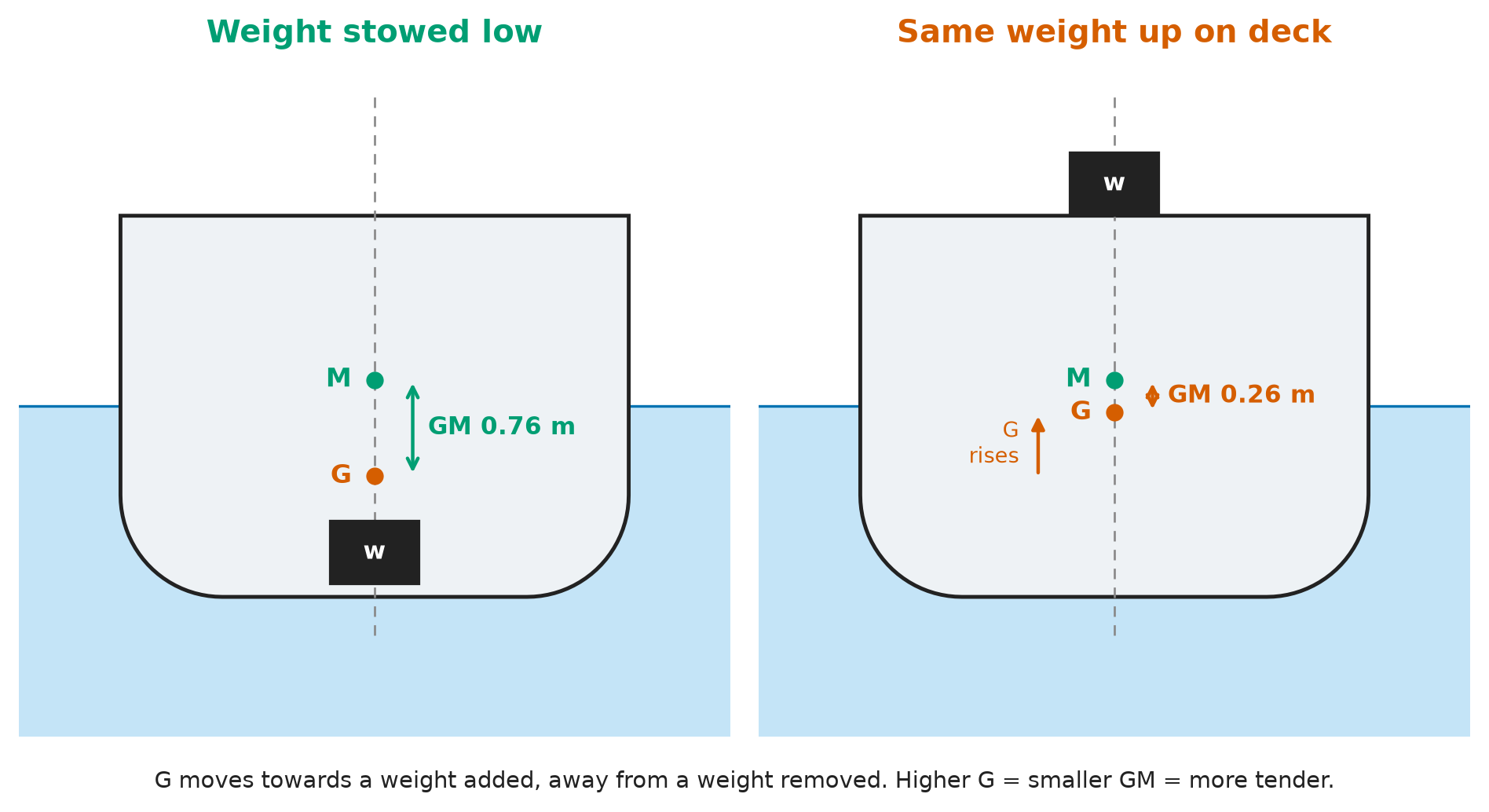
In short: G moves towards a weight that is added, away from a weight that is removed, and in the same direction as a weight that is moved.
- Raising a weight raises G: smaller GM, more tender.
- Lowering a weight lowers G: bigger GM, stiffer.
- How far G moves: GG₁ = (weight × distance moved) ÷ displacement.
- Suspended weights: a load on a crane or davit acts at the head of the crane the moment it leaves the deck. Lifting a tender or a jet ski can raise G a lot.
- Using fuel or water from low tanks removes weight from low down: G rises and the tanks become slack.
- Adding weight high up (ice, wet sails and covers, toys on the upper deck, water in a swimming pool) raises G.
- Transferring weight or fuel: think stability first. Check the effect on GM, list and free surface before you start.
Low freeboard
In short: less freeboard means less reserve buoyancy and a smaller range of stability.
- The deck edge goes under at a smaller angle of heel, so the GZ curve peaks earlier and falls away sooner.
- Openings (doors, vents, air pipes) reach the water sooner: the down-flooding angle gets smaller.
- More green water comes on deck, adding weight high up.
- Keep a seaworthy freeboard in all loading conditions (IS Code Part B, 5.3.1). Never load beyond the load line marks.
Blocked freeing ports and scuppers
In short: freeing ports and scuppers let water off the deck. If they are blocked, that water stays aboard as weight high up with a large free surface.
- Trapped water raises G and adds free surface: GM falls, sometimes fast.
- The water runs to the low side and makes the list worse; in the worst case this leads to capsize.
- The IS Code names water trapped on deck as an influence that reduces stability (IS Code Part A, 2.1.4).
- If freeing ports cannot drain a well deck, reduce speed, alter course, or both. Freeing ports with closing appliances must always work and must never be locked (IS Code Part B, 5.3.5).
- On the bridge: before heavy weather, check that scuppers and freeing ports are clear of mooring lines, fenders, deck gear and rubbish. See also Heavy Weather Preparation and Seaworthiness.
Slack tanks and free surface effect
In short: a partly filled (slack) tank lets the liquid shift when the ship heels. This acts as a virtual rise of G, so it reduces GM.
- The free surface effect grows with:
- the density of the liquid (denser liquid, bigger effect);
- the breadth of the free surface: the effect goes with breadth cubed (a wide tank is far worse than a long, narrow one);
- a smaller displacement (the effect is divided by the ship’s displacement).
- What matters is the size and shape of the free surface, not how high the tank sits in the ship. A tank nearly empty or nearly pressed up has a smaller free surface.
- How to reduce it:
- keep tanks empty or pressed up (full), never slack;
- keep the number of slack tanks to a minimum (IS Code Part B, 5.1.5);
- use longitudinal divisions: two baffles that split a tank into thirds cut the effect by a factor of nine (Wikipedia, “Metacentric height”);
- remember swimming pools and spa tanks: a filled pool has a large free surface (IS Code Part B, 5.1.5).
- Damage that lets water into a compartment creates a large free surface too; see Collision, Grounding, Flooding and Machinery Failure.
⚡ Flashcards
Test yourself, one card at a timeQ1What do GM and GZ tell you about stability?
AnswerBigger GM = more stable at small angles. Bigger GZ = more force to come back upright (righting moment = displacement × GZ).
Common trapTrap: GM alone does not describe large angles; you need the GZ curve.
Q2What are the minimum GM and GZ in the 2008 IS Code?
AnswerGM₀ ≥ 0.15 m; GZ ≥ 0.20 m at 30° or more; max GZ at not less than 25°. Areas: 0.055 m·rad to 30°, 0.09 to 40°, 0.03 between 30° and 40°.
Common trapTrap: meeting the criteria does not make the ship capsize-proof.
Q3Explain a stiff vessel.
AnswerLarge GM, strong righting moment, short quick roll. Big reserve, but violent motion, strain on lashings and fittings, injuries.
Common trapTrap: “stiff = safest”. The IS Code advises avoiding excessive GM.
Q4Explain a tender vessel.
AnswerSmall GM, weak righting moment, long slow roll. Comfortable but little reserve. The nearer G is to M, the more tender she gets.
Common trapTrap: a comfortable roll can hide a dangerously small GM.
Q5What are the warning signs of poor stability?
AnswerLong lazy roll, hanging at the end of each roll, big heel to small forces, list with no cause, list flopping side to side (loll), water or ice staying on deck.
Common trapTrap: correcting loll by moving weight across the ship.
Q6What is the effect of raising or lowering a weight?
AnswerRaise it: G rises, GM falls (more tender). Lower it: G falls, GM rises (stiffer). GG₁ = w × d ÷ displacement.
Common trapTrap: a weight on a crane acts at the crane head as soon as it is lifted.
Q7How does low freeboard affect stability?
AnswerLess reserve buoyancy, deck edge immerses sooner, smaller range of stability, down-flooding angle comes sooner, more water on deck.
Q8Why must freeing ports and scuppers be kept clear?
AnswerTrapped water = weight high up + large free surface = GM falls and list worsens. If the deck will not drain: reduce speed and/or alter course.
Common trapTrap: freeing ports with closing appliances must never be locked.
Q9What is free surface effect and how do you reduce it?
AnswerA virtual rise of G (loss of GM) from liquid moving in slack tanks. Grows with density and breadth cubed. Keep tanks full or empty, few slack tanks, longitudinal divisions.
Common trapTrap: it is the breadth of the free surface that counts, not how high the tank is.
📚 Resources
Videos
- NS301 - Comparison of Angle of List and Angle of Loll — DeckPrep (YouTube)
Books
- Ship Stability for Masters and Mates — Bryan Barrass and D. R. Derrett, 7th edition (Butterworth-Heinemann, 2012)
Regulations
- IMO MSC.267(85) — International Code on Intact Stability, 2008 (2008 IS Code): Part A 2.2 criteria, Part B chapter 5 precautions against capsizing
- MCA MSIS43 — Instructions for the guidance of surveyors on intact stability (full text of the 2008 IS Code with MCA notes)
Official sites
- GOV.UK — Officer of the Watch (yachts less than 3000 GT) oral examination syllabus — 3.2 Seaworthiness of the ship
- GOV.UK — General Ship Knowledge examination syllabus — motion of stiff and tender vessels, free surface
- Wikipedia — Metacentric height
Exam focus — MCA
Typical questions: “Explain a stiff vessel and a tender vessel.” · “How would you know your vessel has poor stability?” · “What happens to stability when you lift the tender with the crane?” · “Why do we keep freeing ports clear?” · “What is free surface effect and how do you reduce it?” What the examiner wants: link every answer to G and GM (G up = GM down); name the motion (short and violent vs long and lazy); give the practical signs (hanging at the end of the roll, unexplained list, loll); and say what you would do on watch: keep tanks full or empty, clear the freeing ports, lower G, check the stability booklet before moving weight or fuel.