Free Surface Effect
StabilityHow liquid moving in slack tanks, flooded spaces or water on deck acts as a virtual rise of G and cuts GM, what makes the effect bigger or smaller, and how to reduce it on board. A standard MCA oral question and a factor in many capsizes.
Last reviewed 1 Nov 2026 · From a professional captain's years of study notes · Organised with AI and checked against current regulations · How we write
On this page (9)
Read first: flotation, centres and metacentric height and good and poor stability. This topic builds on G, M and GM.
What free surface effect is
In short: liquid that can move in a partly filled tank behaves as if G were higher than it really is. This virtual rise of G means a loss of GM.
- A tank that is not full is a slack tank. A full tank is pressed up.
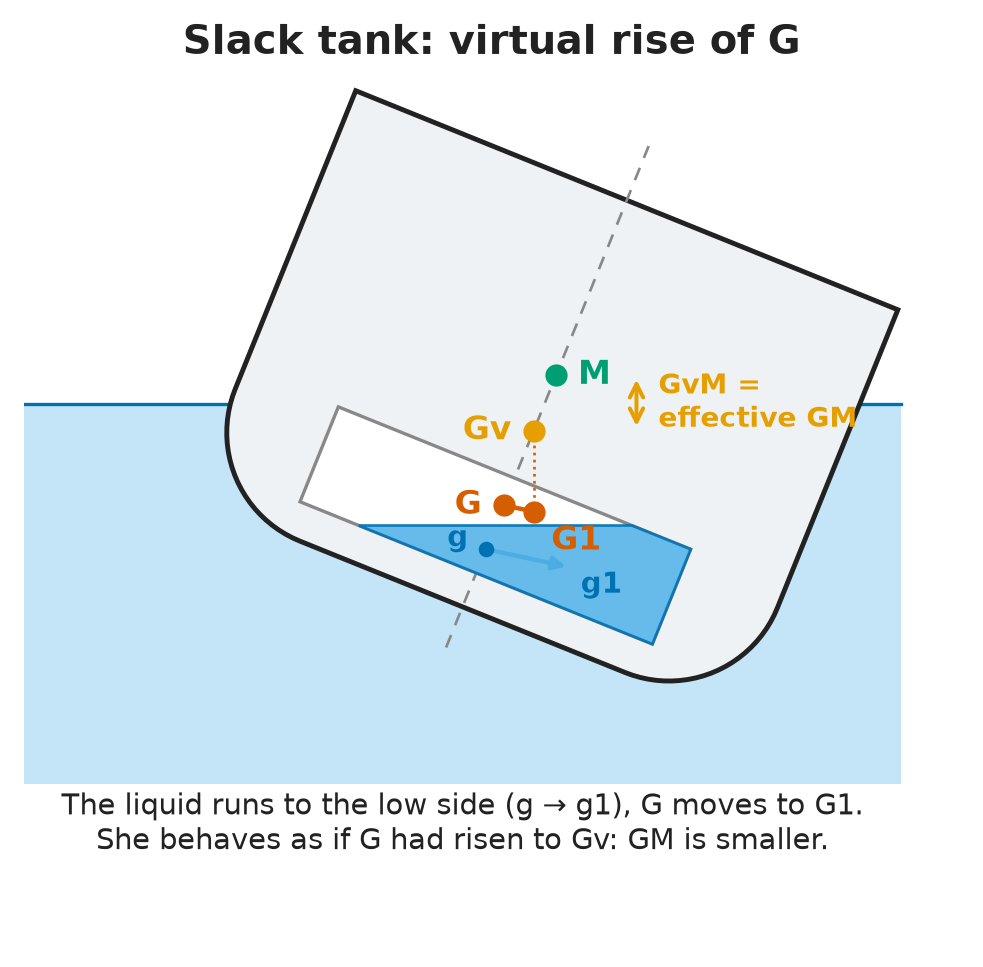
- When the ship heels, the surface of the liquid stays level. Liquid runs to the low side, so the weight in the tank moves towards the low side.
- That shift works against the righting lever: the ship comes back upright more slowly and with less force.
- We show this as if G had moved up from G to a virtual position Gv. The real G has not moved, but the ship behaves as if it had.
- GM fluid = GM solid − free surface correction (FSC). Always use GM fluid to judge the stability of the ship.
- The 2008 IS Code asks for the initial GM and the GZ curve to be corrected for free surfaces in every loading condition (IS Code Part B, 3.1.1).
- On the bridge: a ship with large slack tanks feels more tender than her solid GM suggests. She rolls slower and heels more to small forces.
How big it is: the free surface correction
In short: the loss of GM = free surface moment ÷ displacement.
- Free surface moment (FSM) = density of the liquid × i, in t·m.
- i = the transverse moment of inertia of the liquid surface. For a rectangular tank: i = length × breadth³ ÷ 12 (m⁴).
- FSC (m) = FSM ÷ displacement (t). The IS Code uses the same ratio, free surface moment ÷ displacement, to decide which small tanks can be left out (IS Code Part B, 3.1.12).
- Several slack tanks: add up all the FSMs, then divide by the displacement.
- The stability booklet and the loading computer list the FSM of each tank. A stability instrument must show the free surfaces of each loading condition (IS Code Part B, 4.1.4.1).
Worked example: a yacht fuel tank
- Tank 6 m long, 4 m wide, half full of diesel (density 0.85 t/m³). Displacement 500 t.
- i = 6 × 4³ ÷ 12 = 32 m⁴. FSM = 0.85 × 32 = 27.2 t·m. FSC = 27.2 ÷ 500 = 0.054 m.
- If GM solid is 0.20 m, GM fluid is only about 0.15 m: right at the IS Code minimum GM of 0.15 m (IS Code Part A, 2.2). One slack tank used up a quarter of the margin.
What makes it bigger or smaller
In short: free surface effect grows with the density of the liquid and the breadth cubed of the tank. It falls as displacement grows.
- Density: denser liquid = bigger effect. Sea water (about 1.025 t/m³) gives more than diesel (about 0.85 t/m³).
- Breadth of the free surface: cubed. Double the breadth and the effect is 8 times bigger. This is the factor that matters most.
- Length of the tank: the effect grows only in proportion to length. A long, narrow tank is far better than a short, wide one.
- Displacement: the same tank matters less in a big ship and more in a small one, because the moment is divided by displacement. Free surface is a big issue on yachts and small craft.
- How full the tank is: in a box-shaped tank the effect is the same at 20% or 80% full, because the surface has the same breadth. It only changes when the surface itself changes size: in shaped tanks near the top or bottom, or when the liquid touches the tank top or bottom as she heels.
- Height of the tank in the ship: no effect. A slack tank in the double bottom costs as much GM as the same tank high up.
Reducing free surface in tanks
In short: have as few slack tanks as possible. Keep tanks pressed up or empty, and keep the free surface narrow.
- Press up (fill completely) or drain empty. A full or empty tank has no free surface.
- Keep the number of slack tanks to a minimum (IS Code Part B, 5.1.5).
- Use tanks one at a time: run one tank down to empty before you start the next, instead of several half-empty tanks.
- Transfer liquid to narrower tanks, or to tanks split by longitudinal bulkheads or baffles. A division only helps if the liquid cannot flow freely across it.
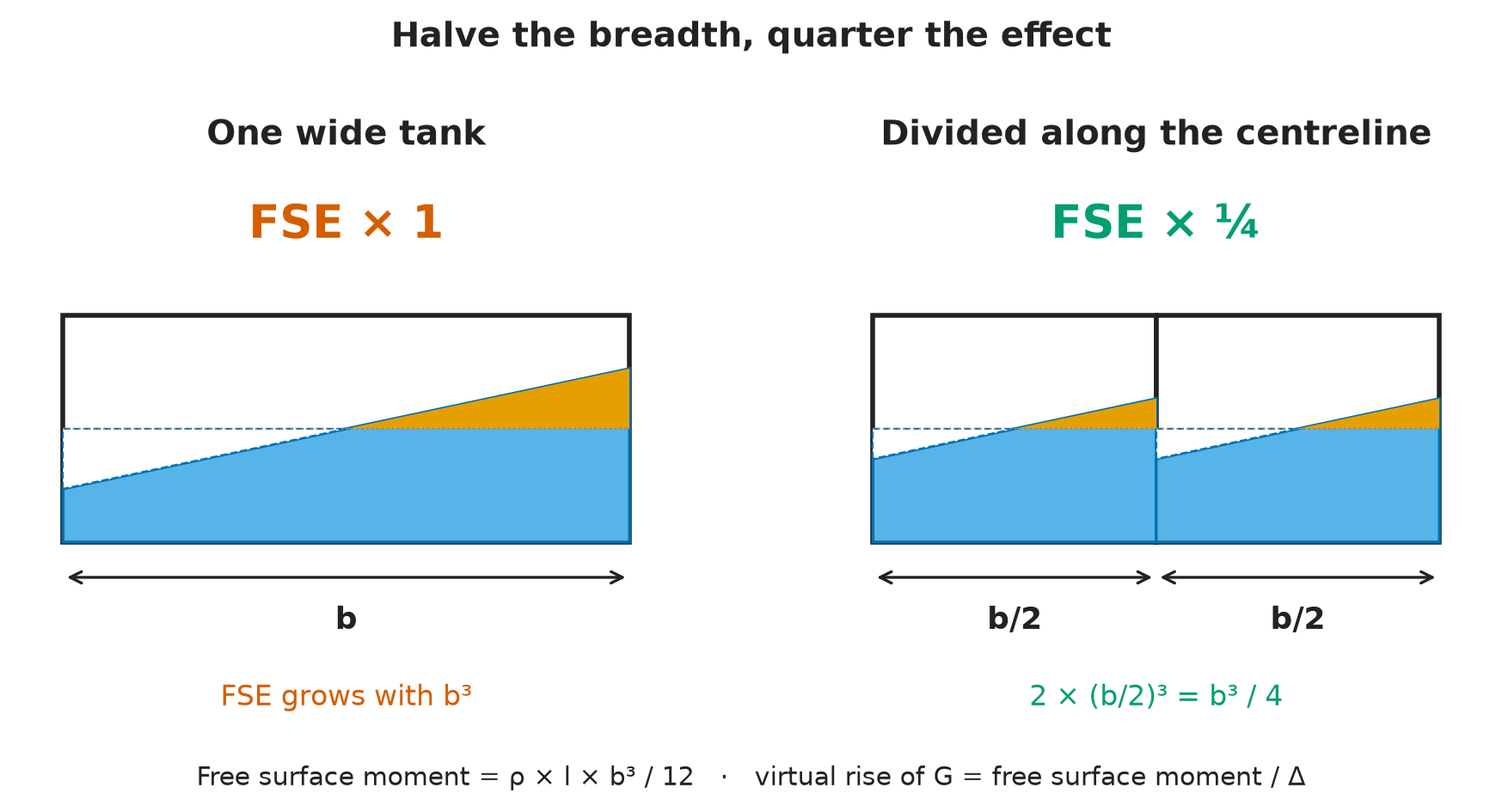
- Divide tanks longitudinally. Because the effect goes with breadth cubed:
- one centreline bulkhead (two halves) cuts the effect to ¼;
- two bulkheads (three parts) cut it to 1/9 (Wikipedia, “Metacentric height”).
- In the worked example above, a centreline bulkhead brings the FSC down from 0.054 m to about 0.014 m.
- Keep cross-connection valves between port and starboard tanks shut, so the tanks act as two narrow tanks, not one wide one.
- Remember swimming pools and spa tanks: a filled pool has a large free surface (IS Code Part B, 5.1.5).
- The one exception: slack tanks may, in exceptional cases, be used to reduce an excessive GM on a very stiff ship, with care for sloshing (IS Code Part B, 5.1.6).
Free surface from outside the tanks
In short: any water that can move inside or on top of the ship has a free surface: hull damage, water on deck and fire-fighting water.
- Hull damage: a flooded compartment that is open to the sea or only part full adds a large free surface as well as weight. See flooding after a collision or grounding.
- Water on deck in heavy weather: green water trapped on deck adds weight high up plus a wide free surface. Avoid water trapping in deck wells. If the freeing ports cannot drain it, reduce speed, alter course, or both. Freeing ports with closing appliances must work and must never be locked (IS Code Part B, 5.3.5). More in heavy weather preparation.
- Fire-fighting water: tonnes of water from hoses collect on decks above the waterline. The SS Normandie (New York, 1942) and the MS al-Salam Boccaccio 98 (Red Sea, 2006) capsized as fire-fighting water built up (Wikipedia, “Free surface effect”). When fighting a fire on board, use only the water you need, keep the drains clear and watch the list.
- Vehicle decks: the Herald of Free Enterprise (Zeebrugge, 1987) capsized with water spread across an open vehicle deck (Wikipedia, “Free surface effect”).
- How to reduce it:
- clear freeing ports and scuppers: check them before heavy weather;
- fore-and-aft barriers or divisions, so water cannot run right across the ship;
- at the design stage: deck camber and sheer help water run off to the freeing ports.
Free surface and loll
In short: free surface can create or worsen an angle of loll. If the loss of GM makes GM fluid negative, the ship lolls.
- A ship with negative GM has no stability upright. She heels until the shape of the waterplane gives back a little GZ, and floats there: the angle of loll (GZ = 0). She can flop from one side to the other.
- A small solid GM plus large slack tanks can be enough: the ship is positive “on paper” but negative in real life.
- What to do:
- first make sure it is loll, not list: a list has positive GM and G off the centreline; loll flops side to side;
- never move weight across the ship to correct loll: she may flop over to the other side, further;
- cut the free surface you already have and remove top weight;
- lower G by filling low tanks (double bottom), one small tank at a time, starting on the low side. A tank that is being filled is slack until it is full: it adds free surface first, so GM gets worse before it gets better.
⚡ Flashcards
Test yourself, one card at a timeQ1What is free surface effect?
AnswerLiquid moving in a slack tank acts as a virtual rise of G (G to Gv), so a loss of GM. GM fluid = GM solid − FSC.
Common trapTrap: the real G does not move; the ship only behaves as if it had.
Q2How do you calculate the free surface correction?
AnswerFSC = FSM ÷ displacement. FSM = density × i; rectangular tank i = L × B³ ÷ 12. Several tanks: add the FSMs.
Common trapTrap: dividing by the tank’s weight, not the ship’s displacement.
Q3Which factors affect free surface effect?
AnswerGrows with density and with breadth cubed (length only in proportion). Falls with displacement.
Common trapTrap: “the more fluid the liquid, the bigger the effect”. It is the denser liquid that gives the bigger effect.
Q4Does free surface effect depend on how full the tank is or how high it sits?
AnswerNo. A box-shaped tank costs the same GM at 20% or 80% full, and in the double bottom or high up. Only the size of the free surface counts.
Common trapTrap: “a low tank is harmless”.
Q5How do you reduce free surface effect in tanks?
AnswerFew slack tanks (IS Code B 5.1.5). Press up or drain empty; use one tank at a time; transfer to narrower or divided tanks; keep cross-connections shut.
Common trapTrap: forgetting swimming pools and spa tanks.
Q6What does a centreline bulkhead do to free surface effect?
AnswerCuts it to ¼ (two halves, breadth cubed). Two bulkheads (thirds) cut it to 1/9.
Common trapTrap: “halving the tank halves the effect”.
Q7Where else can free surface come from, and how do you reduce it?
AnswerHull damage, water on deck in heavy weather, fire-fighting water. Clear freeing ports, fore-and-aft barriers, deck camber and sheer (design); if the deck will not drain, reduce speed and/or alter course.
Common trapTrap: freeing ports with closing appliances must never be locked.
Q8How can free surface lead to loll, and what do you do?
AnswerLoss of GM makes GM fluid negative: she lolls. Confirm loll, cut free surface, remove top weight, fill low tanks one at a time, low side first.
Common trapTrap: moving weight across the ship, or forgetting that a tank being filled adds free surface first.
📚 Resources
Videos
- Stability Part 9. Free Surface Effect — Waterborne Marine Publication and Education (YouTube)
- Ship Stability _Free Surface Effect (FSE) — SAILORSTUBE (YouTube)
Books
- Ship Stability for Masters and Mates — Bryan Barrass and D. R. Derrett, 7th edition (Butterworth-Heinemann, 2012)
Regulations
- IMO MSC.267(85) — International Code on Intact Stability, 2008 (2008 IS Code): Part B 3.1 effect of free surfaces of liquids in tanks; Part B 5.1.5–5.1.6 slack tanks; Part B 5.3.5 water trapped on deck
- MCA MSIS43 — Instructions for the guidance of surveyors on intact stability (full text of the 2008 IS Code with MCA notes)
Official sites
- GOV.UK — General Ship Knowledge examination syllabus — 2.2.2: free surface as a reduction in GM or a rise in KG
- Wikipedia — Free surface effect
Exam focus — MCA
Typical questions: “What is free surface effect?” · “What factors affect it?” · “How would you reduce free surface on board?” · “Why does a centreline bulkhead help so much?” · “Your vessel has a list that flops from side to side: what is happening and what do you do?” What the examiner wants: the words “virtual rise of G” and “loss of GM”; density and breadth cubed, divided by displacement; that it does not depend on how full or how high the tank is; practical answers (press up or empty, few slack tanks, longitudinal division, clear freeing ports, watch fire-fighting water); and the link to loll, with the safe way to correct it.