Flotation, Centres and Metacentric Height
StabilityWhy a ship floats (density, Archimedes, the law of flotation, draught), the four points of stability K, B, G and M, and how GM = KM − KG tells you if she is stable, neutral or unstable. Every stability question at sea and in the MCA oral starts here.
Last reviewed 1 Nov 2026 · From a professional captain's years of study notes · Organised with AI and checked against current regulations · How we write
On this page (10)
How a ship floats: mass, volume and density
In short: This is the first Stability topic: start here. Every stability sum uses three quantities — mass, volume and density — and one ratio, relative density (RD).
- Mass: how much matter there is. On board we work in tonnes (t).
- Volume: the space something takes up, in cubic metres (m³).
- Density: mass per unit volume. Density = mass ÷ volume, in t/m³. So mass = volume × density.
- Typical values: fresh water 1.000 t/m³, sea water 1.025 t/m³. Dock and river water lies in between.
- Relative density (RD): the density of a substance ÷ the density of fresh water. It has no units. Sea water: RD 1.025. An oil with RD 0.85 floats on water.
- On the bridge: a tank of 50 m³ filled with sea water holds 50 × 1.025 = 51.25 t; the same tank filled with fuel of RD 0.85 holds 42.5 t.
Archimedes and the law of flotation
In short: A body in a fluid is pushed up by the weight of the fluid it displaces (Archimedes). A floating ship sinks until she displaces her own weight of water (law of flotation).
- Archimedes’ principle: a body wholly or partly immersed in a fluid feels an upthrust equal to the weight of fluid displaced.
- Law of flotation: a floating body displaces a weight of liquid equal to its own weight. That weight is the ship’s displacement (Δ).
- Displacement = underwater volume × density of the water.
- Weight acts down through G, buoyancy acts up through B. Floating upright and at rest, the two forces are equal and on the same vertical line.
- On the bridge: going from the sea into a fresh-water river, the weight does not change but the water is less dense. She must displace a bigger volume, so she sinks deeper (bigger draught).
Draught and form coefficients
In short: The draught is how deep the keel is below the waterline. Form coefficients compare the real hull with a box of the same length, breadth and draught: they describe how “fine” or “full” she is.
- Draught: vertical distance from the keel to the waterline, read on the draught marks forward, aft and (on bigger ships) amidships.
- Waterplane area coefficient (Cw) = waterplane area ÷ (L × B).
- Block coefficient (Cb) = underwater volume ÷ (L × B × draught).
- Midship section area coefficient (Cm) = immersed midship area ÷ (B × draught).
- All three are less than 1. A box barge is close to 1; a fast, fine yacht hull is much lower.
- They matter because they link the draught to volume and area: the underwater volume gives the displacement, the waterplane area gives TPC (tonnes per centimetre immersion).
The four points of stability: K, B, G and M
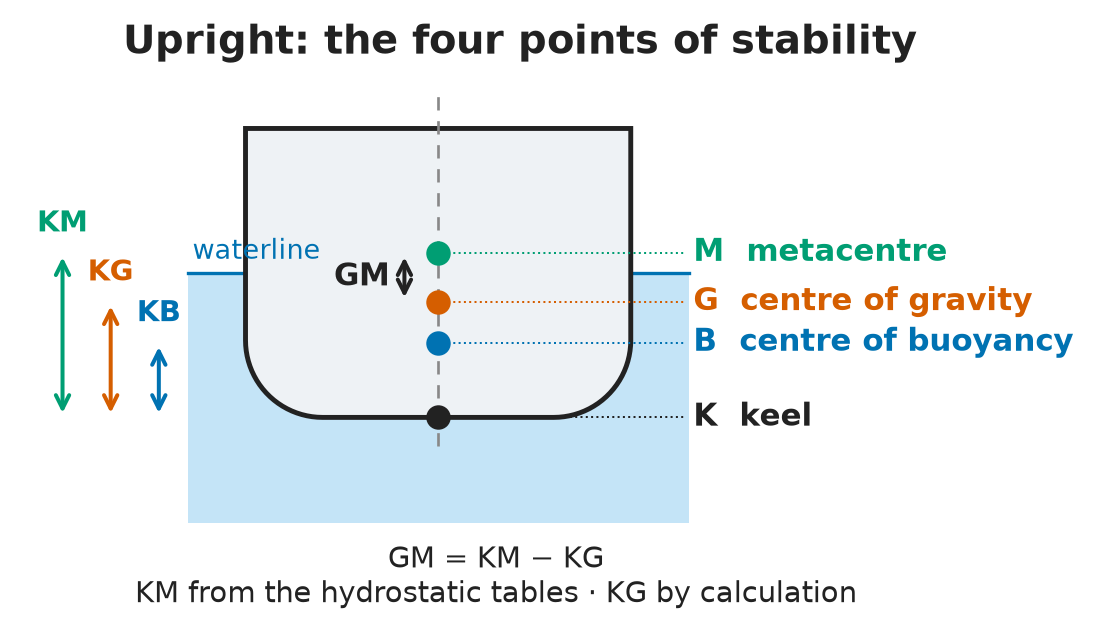
In short: Four points on the centreline do all the work: K (keel), B (centre of buoyancy), G (centre of gravity) and M (metacentre). All heights are measured up from K.
K — the keel
- The reference point at the bottom. KB, KG and KM are heights above the keel.
B — centre of buoyancy
- The centre of the underwater volume (the geometric centre of the immersed hull). Buoyancy acts up through B.
- B moves whenever the underwater shape changes: it rises as the draught increases and moves towards the low side when she heels.
G — centre of gravity
- The point through which the whole weight of the ship acts downwards.
- G moves only when weight is added, removed or shifted on board. Heeling alone does not move G.
- The lightship weight and KG come from the inclining experiment, done in lightship condition (REG YC 11.9(1)). For each loading condition, KG is then calculated by moments (see below).
M — the metacentre
- For small angles of heel (textbooks usually say up to about 10–15°), M is the point where the vertical through the new B cuts the centreline.
- In this range M stays practically fixed, so GM is a good measure of initial stability.
- KM = KB + BM. BM (the metacentric radius) depends on the shape of the waterplane, so KM changes with draught.
GM = KM − KG and the hydrostatic tables
In short: GM = KM − KG. KM comes from the hydrostatic tables in the stability booklet at the present draught; KG comes from your own calculation. GM is always calculated — no table gives it to you.
- KM: enter the hydrostatic tables (part of the approved Stability Information Booklet, REG YC 11.10) with the mean draught or displacement and read KM.
- KG: start from lightship weight and KG, add every weight on board (fuel, water, stores, tenders, people) with its own height. KG = sum of (weight × height) ÷ total weight.
- GM = KM − KG, then correct for free surface to get the effective (fluid) GM.
- Example: KM 6.20 m, KG 5.60 m → GM 0.60 m (before free surface correction).
- Hydrostatic tables give, for each draught: displacement, TPC, KMT (transverse KM), KML (longitudinal KM), KB and LCB (longitudinal centre of buoyancy). They describe the hull shape, so they never give GM: GM depends on how you have loaded her.
- For large commercial yachts, the GM after free surface correction must be at least 0.15 m (REG YC 11.2(1)(a)(v)).
Three states of equilibrium
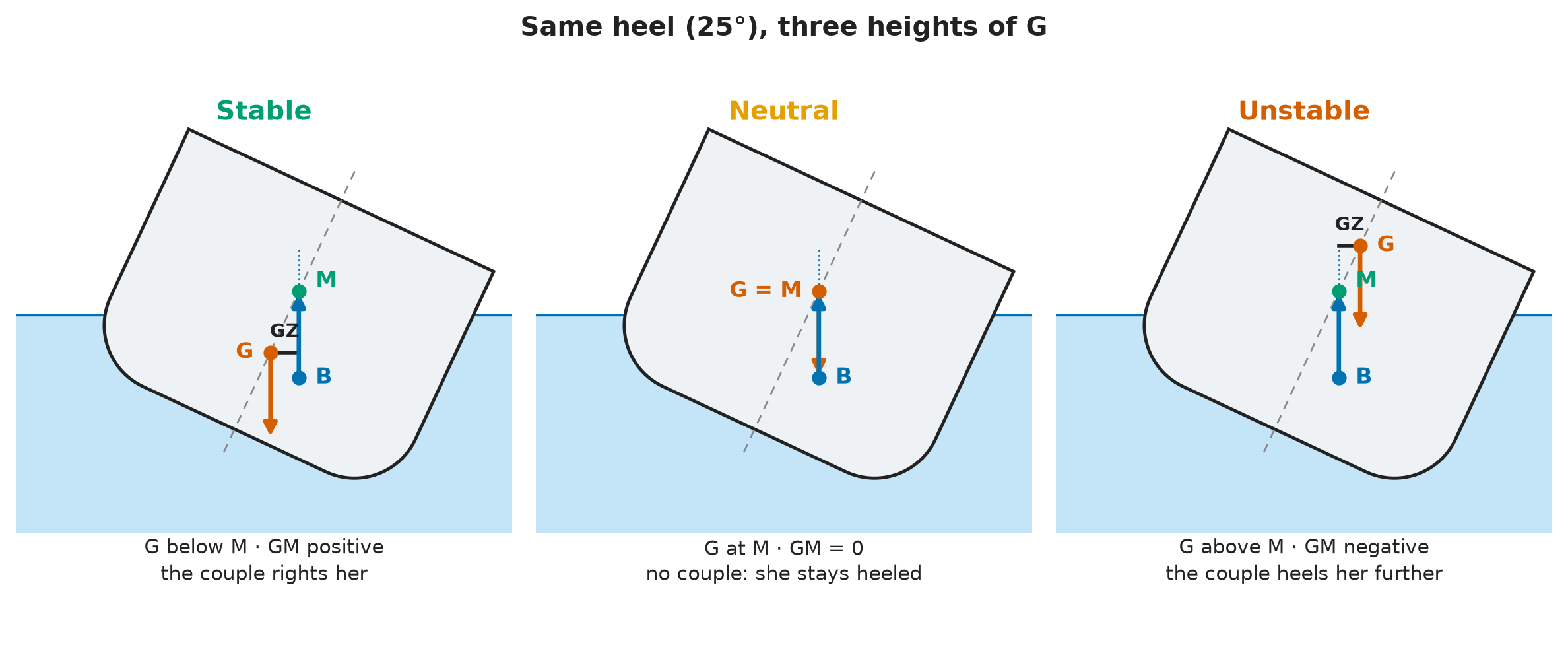
In short: Heel her a little and see what G and B do. G below M → stable (GM positive). G at M → neutral (GM = 0). G above M → unstable (GM negative).
- Stable (positive GM): G is below M. When she heels, B moves to the low side and the buoyancy pushes up outboard of G. The righting couple brings her back upright.
- Neutral (GM = 0): G is at M. Weight and buoyancy act on the same vertical line at any small heel: no couple, so she stays at whatever angle she is pushed to.
- Unstable (negative GM): G is above M. The couple acts the wrong way and heels her further.
- GZ (righting lever) = the horizontal distance between G and the vertical through B. Righting moment = Δ × GZ. At small angles GZ ≈ GM × sin θ.
- The bigger the GM, the more stable she is at small angles. The bigger the GZ, the more force she has to come back upright.
- But more is not always better: a very large GM gives a short, jerky roll that is hard on people, gear and lashings.
Adding and removing weight
In short: G moves towards a weight you add and away from a weight you remove — along the line joining G and that weight’s centre of gravity.
- Load a weight → G moves towards it. Discharge a weight → G moves away from it. Shift a weight on board → G moves parallel to the shift.
- Size of the shift: GG1 = (w × d) ÷ (Δ + w) when loading, ÷ (Δ − w) when discharging (w = weight, d = distance from G to the weight).
- Weight added high (above G) raises G and reduces GM. Weight added low (double-bottom tanks) lowers G and increases GM. Removing weight from low down (using fuel from double bottoms) raises G.
- Adding or removing weight also changes the draught, so KM changes too: always re-read KM before working out the new GM.
- A weight lifted by a crane acts at the crane head as soon as it leaves the deck: G jumps up at once.
- On the bridge: Δ 1,000 t, you lift a 20 t tender onto a deck 4 m above G. GG1 = 20 × 4 ÷ 1,020 = 0.08 m: G rises 0.08 m and GM falls by about the same.
- The same logic explains why you ballast low tanks before heavy weather, why fire-fighting water left on board is a danger when fighting a fire, and why flooding after a collision or grounding can capsize a ship.
⚡ Flashcards
Test yourself, one card at a timeQ1What is density, and what is relative density?
AnswerDensity = mass ÷ volume (t/m³): fresh water 1.000, sea water 1.025. RD = density ÷ fresh-water density.
Common trapRD has no units.
Q2State Archimedes' principle.
AnswerA body wholly or partly immersed in a fluid feels an upthrust equal to the weight of fluid it displaces.
Q3State the law of flotation. What happens when she sails from the sea into a fresh-water river?
AnswerA floating body displaces its own weight of water. In fresh water (less dense) she must displace more volume: she sinks deeper.
Common trapHer weight does not change.
Q4What is the draught, and name three form coefficients.
AnswerDraught = keel to waterline. Cw = waterplane area ÷ (L × B) · Cb = underwater volume ÷ (L × B × d) · Cm = midship area ÷ (B × d). All less than 1.
Q5What is the centre of buoyancy (B), and does it move?
AnswerThe centre of the underwater volume. It moves with draught (rises as she sinks deeper) and moves to the low side when she heels.
Q6What is the centre of gravity (G), and how is it found?
AnswerThe point through which the whole weight acts down. Lightship KG from the inclining experiment; for each loading condition KG is calculated by moments.
Common trapHeeling alone does not move G.
Q7What is the metacentre (M)?
AnswerFor small angles, the point where the vertical through the new B cuts the centreline. KM = KB + BM, read from the hydrostatic tables for the draught.
Q8How do you find GM on board?
AnswerGM = KM − KG: KM from the hydrostatic tables at the present draught, KG by calculation; then correct for free surface.
Common trapGM is never read from a table.
Q9What do the hydrostatic tables give you for a draught?
AnswerDisplacement · TPC · KMT · KML · KB · LCB.
Common trapNot GM: it depends on the loading (KG).
Q10What are the three states of equilibrium?
AnswerStable: G below M, GM positive · Neutral: G at M, GM = 0 · Unstable: G above M, GM negative.
Common trapNeutral is GM = 0, not “equal GM”.
Q11What do a bigger GM and a bigger GZ tell you?
AnswerBigger GM = more initial stability. Bigger GZ = more force to bring her back upright (righting moment = Δ × GZ).
Common trapToo much GM = short, jerky roll.
Q12You load or discharge a weight. What does G do?
AnswerLoading: G moves towards the weight. Discharging: G moves away from it. GG1 = w × d ÷ (Δ ± w). Weight high = G up = GM down.
📚 Resources
Video
- Metacentre & Stability of a Ship — Capt. S.S. Chaudhari
Books
- Ship Stability for Masters and Mates — Bryan Barrass and Capt. D.R. Derrett, 7th edition (Elsevier, 2012)
Regulations
- REG Yacht Code Part A, July 2024 edition — Red Ensign Group: chapter 11 Stability (11.2 intact criteria, 11.9 inclining experiment, 11.10 stability documents)
- MSN 1895 (M): The Red Ensign Group (REG) Yacht Code Part A — MCA (2025): the legal background of the Yacht Code for UK yachts
- IMO MSC.267(85) — International Code on Intact Stability, 2008 (2008 IS Code)
Official sites
- Large commercial yachts: inclining test guidance notes — MCA
- UK Ship Register large yacht services: stability information — MCA: model stability information for motor and sailing yachts
Exam focus — MCA
Typical questions • “Define B, G and M.” → B = centre of the underwater volume, moves with draught and heel; G = where the whole weight acts, moves only when weight moves; M = for small angles, where the vertical through B cuts the centreline. • “How do you find the GM of your yacht today?” → KM from the hydrostatic tables at the present draught, KG by moments from the lightship KG, GM = KM − KG, then the free surface correction. • “Where in the stability booklet do you find GM?” → trick question: nowhere in the hydrostatic tables; they give displacement, TPC, KMT, KML, KB, LCB. GM is calculated for each loading condition. • “What are the three states of equilibrium?” → stable, neutral, unstable, with where G is compared with M and the sign of GM. • “You lift the tender onto the upper deck. What happens?” → G moves towards the added weight, rises, GM falls; KM changes with the new draught. How to answer: draw K, B, G and M on a sketch of the hull as you talk, give the formula GM = KM − KG, and say where each number comes from (tables or calculation).