Weather Instruments and Observations
MeteorologyThe weather instruments on a ship (aneroid barometer, barograph, precision aneroid, marine screen with wet and dry bulb, sea thermometer and anemometer) and how to correct, read and report them. Good readings give you the pressure tendency and dew point you forecast from, and examiners expect you to know each instrument and its errors.
Last reviewed 1 Nov 2026 · From a professional captain's years of study notes · Organised with AI and checked against current regulations · How we write
On this page (11)
Aneroid barometers on board
In short: every ship measures pressure with an aneroid barometer. There are three kinds, each with its own job.
Read first: Pressure, Wind and the Coriolis Effect (topic 1), Humidity, Dew Point and Fog (topic 2) and Depressions, Fronts and Synoptic Charts (topic 3). This is topic 4 of Meteorology. Next: Weather Forecasts and Information at Sea.
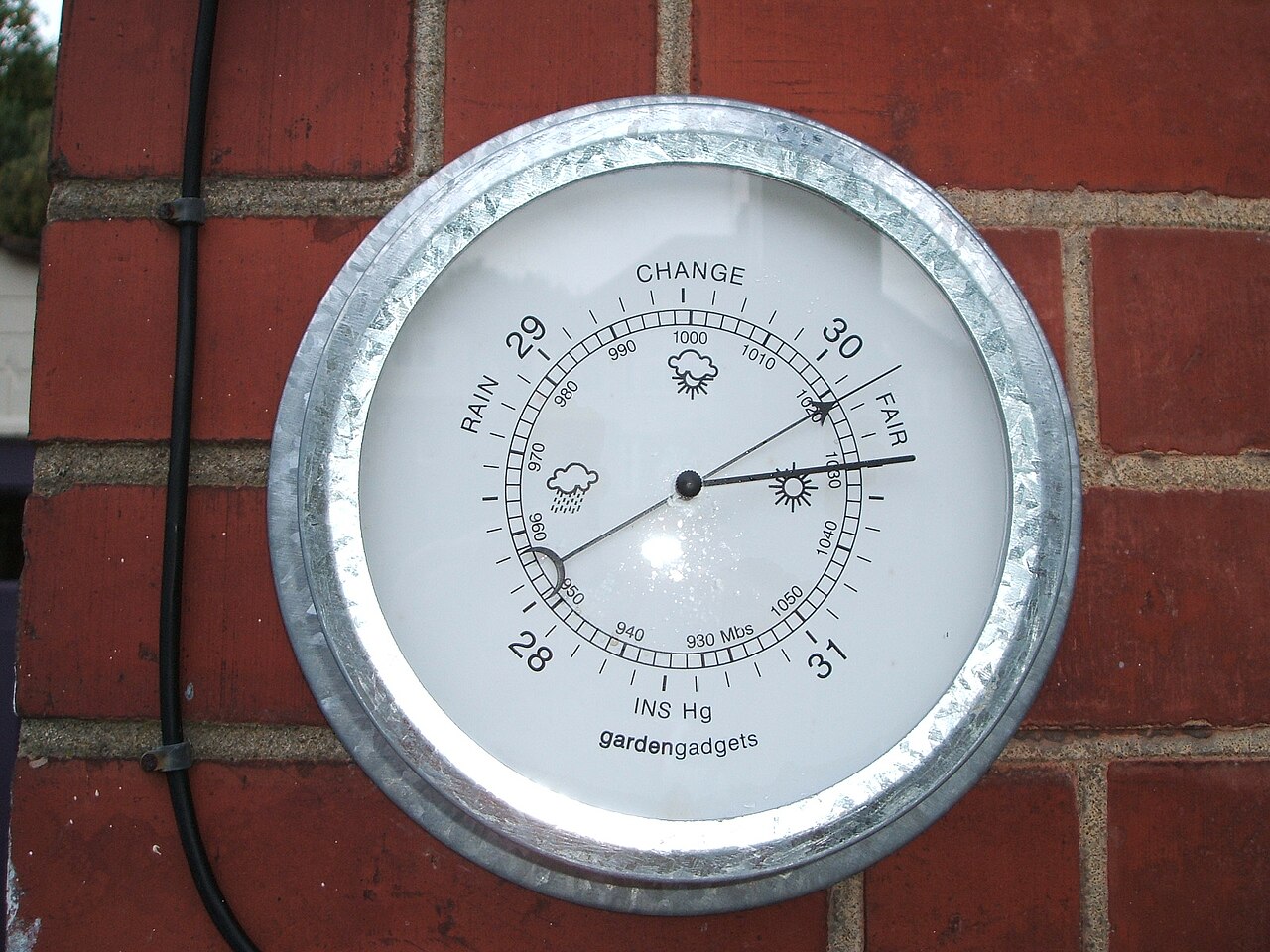
- Aneroid = “without liquid”. Inside is a sealed metal capsule (cell) with most of the air pumped out. When pressure rises, the capsule is squeezed; when it falls, the capsule swells. Levers turn that small movement into a needle on a dial.
- Units: millibars (mb). 1 mb = 1 hPa (hectopascal).
- The barometer is part of the bridge’s basic weather equipment on every vessel.
The three types
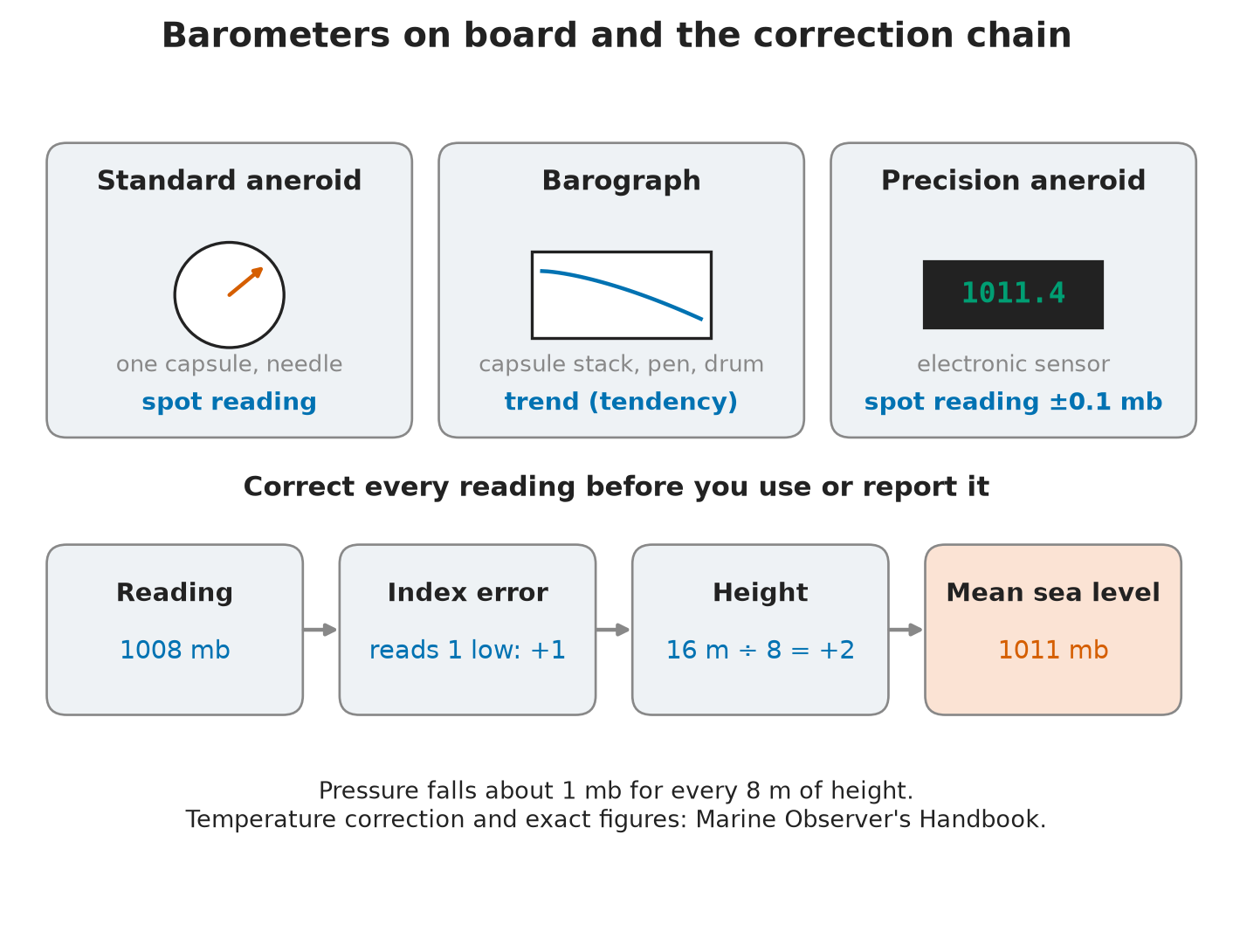
| Type | How it is built | What it gives you | Accuracy |
|---|---|---|---|
| Standard aneroid | One capsule, needle and dial | A spot reading of the pressure now | Good, after corrections |
| Barograph | A stack of capsules moves a pen on a paper chart wrapped round a turning drum | A continuous trace: the tendency | Less accurate than a barometer |
| Precision aneroid | Electronic sensor with a digital display | An accurate spot reading | ±0.1 mb |
- On the bridge: read the value from the barometer (or precision aneroid) and the trend from the barograph.
Barometer errors and corrections
In short: a raw reading is not the sea-level pressure. Correct it for the instrument’s own error, for temperature and for height before you use or report it.
- Instrument (index) error: every barometer reads a little high or low. Find the error by comparing it with a known correct reading, for example from the harbour master in port. Note it, and apply it to every reading.
- Temperature: heat changes the metal parts and the reading. Correct for it: all three types are corrected for temperature and height (Marine Observer’s Handbook).
- Height (reduction to mean sea level): pressure falls about 1 mb for every 8 m you climb. The barometer on the bridge is above the sea, so it reads low. Add the height correction.
- The full correction table (height and temperature) is in the Marine Observer’s Handbook.
- Why it matters: weather charts, forecasts and other ships all use mean sea level pressure. An uncorrected reading cannot be compared with them.
Worked example
- Barometer reading on the bridge: 1008 mb.
- Instrument error from the last check: reads 1 mb low → +1 mb → 1009 mb.
- Height of the barometer: 16 m → 16 ÷ 8 = +2 mb → 1011 mb at mean sea level.
- For a precise figure, take height and temperature corrections from the table in the Marine Observer’s Handbook.
Barograph and pressure tendency
In short: one reading tells you where you are. The tendency (the change over 3 hours) tells you where the weather is going.
- Pressure tendency = the change in pressure over the previous 3 hours: rising, falling or steady, and by how many mb.
- The barograph draws the tendency for you. One glance at the trace shows a steady fall, a sudden drop or a rise after a front.
- Barograph care:
- Use oil-based ink in the pen.
- Use chart paper matched to the drum speed, so the time scale is right.
- The barograph is less accurate than the barometer: use the two together. Barometer for the value, barograph for the trend.
- Example: 1012 mb at 0900, 1006 mb at 1200 → falling 6 mb in 3 h. A fall of more than 2 mb in 3 h is already significant, and this one is much steeper (see Pressure, Wind and the Coriolis Effect). Tell the Master.
The Stevenson (marine) screen
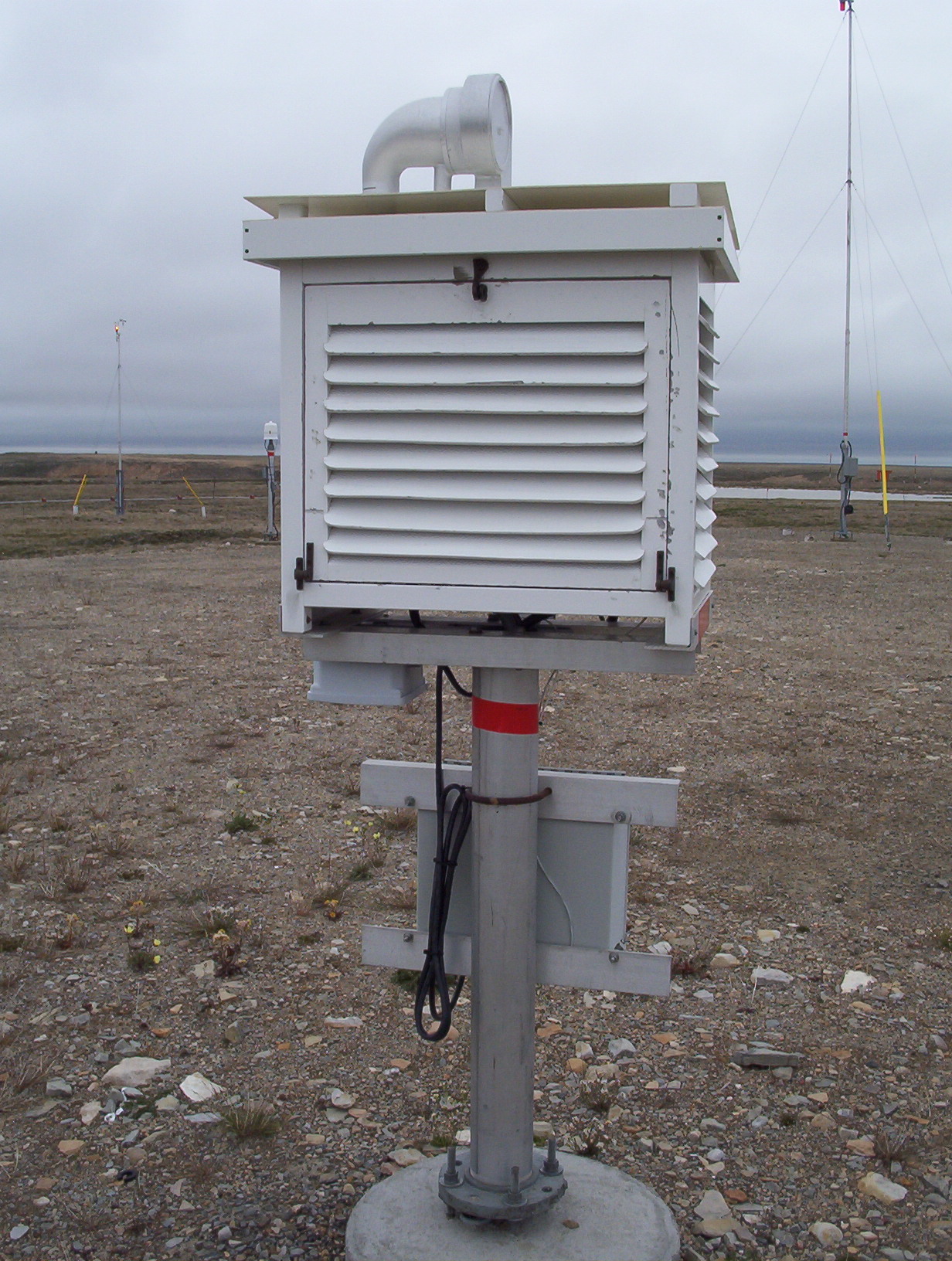
In short: a white, louvred box that shades the thermometers so they read the true air temperature.
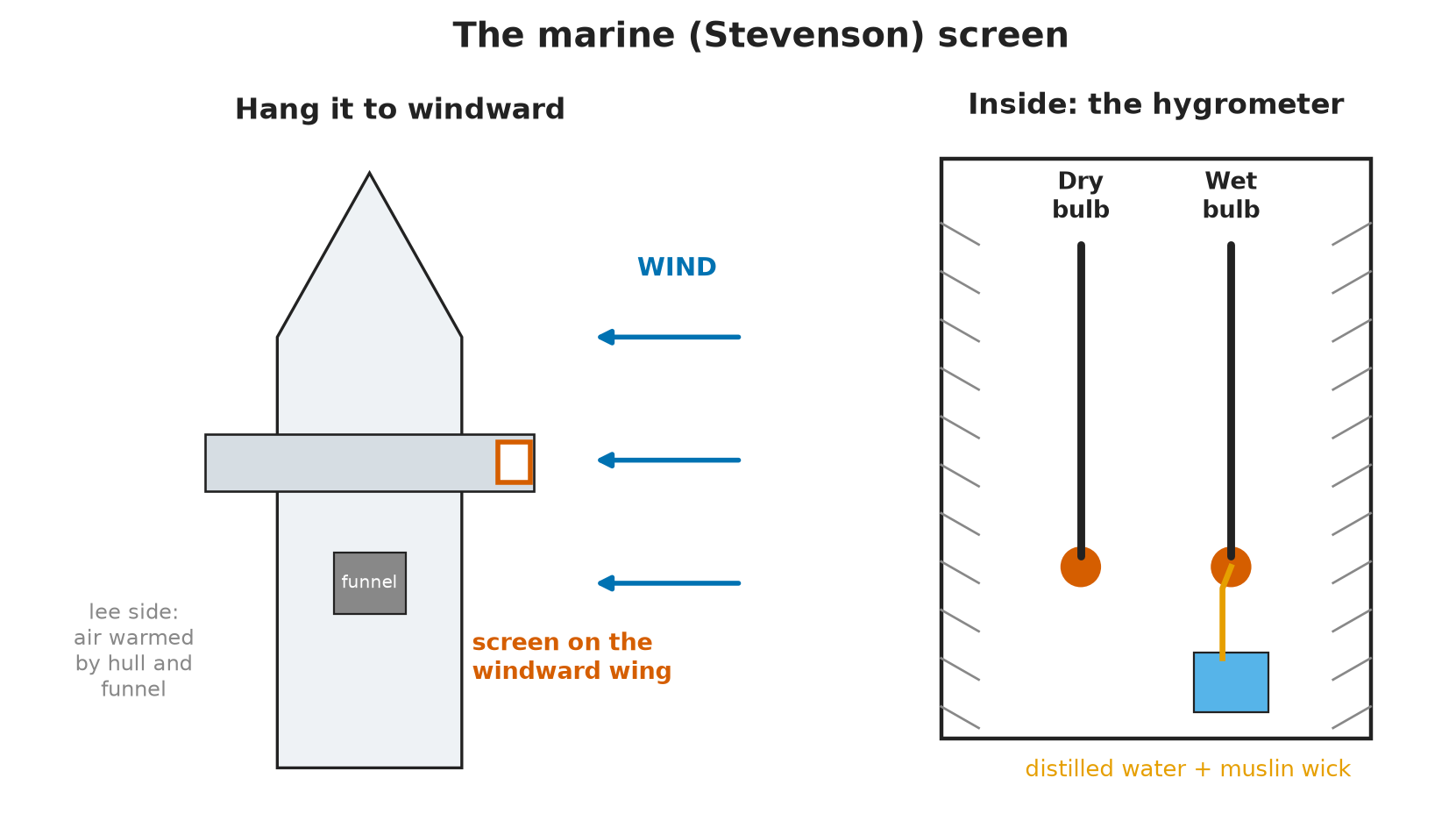
- White to reflect the sun. Louvred sides let air flow through while keeping off direct sun, rain and spray.
- It holds the dry bulb and wet bulb thermometers: the hygrometer.
- Where: hung on the windward side, usually on the bridge wing, so the air reaching it comes straight off the sea.
- Why windward: on the lee side the air has passed over the warm hull, funnel and accommodation. It reads too warm and too dry.
- On the bridge: when the ship alters course and the wind changes side, move the screen (or use the one on the other wing).
The wet and dry bulb hygrometer
In short: two thermometers side by side. The gap between them tells you how much water vapour the air holds.
- Also called a psychrometer.
- Dry bulb: an ordinary thermometer. It gives the air temperature.
- Wet bulb: its bulb is covered by a muslin wick that dips into a small reservoir of distilled water. Water evaporates from the wick and cools the bulb.
- Use distilled water only: salt or tap water leaves deposits on the muslin and spoils the reading. Keep the muslin clean.
- The dry bulb reads higher than the wet bulb (or the same, in saturated air).
- More water vapour in the air → less evaporation → the wet bulb reads higher, closer to the dry bulb. So the wet bulb shows the moisture in the air.
- Bigger difference between the two → drier air.
- Depression (wet-bulb depression) = dry bulb minus wet bulb.
- Enter the table in NP100 or the Marine Observer’s Handbook with the dry bulb and the depression → dew point and relative humidity. How to use them for fog is in Humidity, Dew Point and Fog.
- Readings close together = air near saturation = fog likely, especially over a cold sea.
Sea temperature
In short: the sea temperature is measured with a sea bucket. Compared with the dew point, it tells you if sea fog is coming.
- Sea bucket: lower the bucket over the side, haul up a surface sample and read the thermometer in it straight away, out of the sun and wind, before the water warms or cools.
- Take the sample well clear of the ship’s own discharges.
- Use: sea temperature at or below the dew point → sea fog likely (NP100). See Humidity, Dew Point and Fog.
The anemometer: apparent and true wind
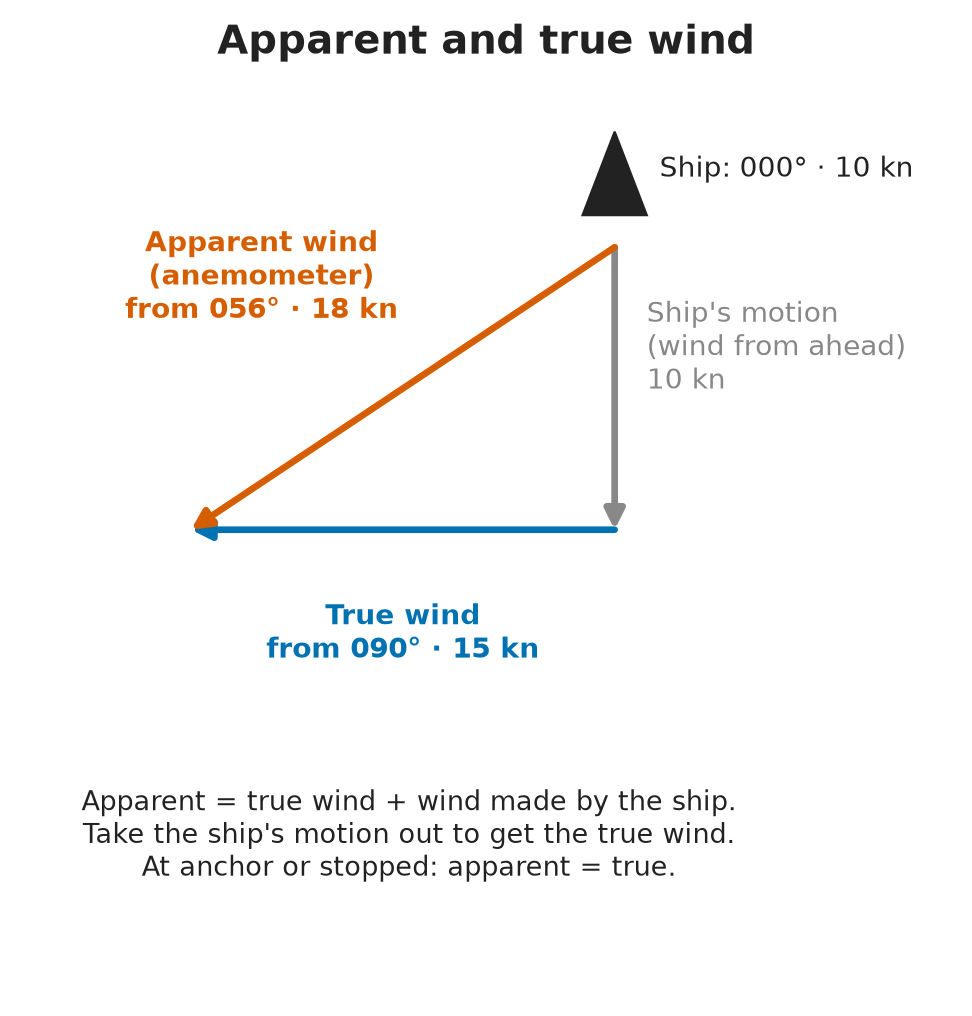
In short: the anemometer measures the wind across the moving ship. To know the real wind you must take the ship’s own motion out.
- The anemometer (cups or propeller, with a wind vane) sits high on the mast. It gives wind speed and direction.
- It measures the apparent (relative) wind: the true wind combined with the wind made by the ship’s own course and speed.
- True wind = apparent wind with the ship’s motion taken out. Work it out with a vector triangle (ship’s course and speed + apparent wind), or read it from an instrument that takes heading and speed inputs.
- Check: at anchor or stopped, apparent wind = true wind.
- Back-up: estimate the true wind from the sea state with the Beaufort table (NP100). See Pressure, Wind and the Coriolis Effect.
- Sailing yachts also carry an inclinometer (angle of heel) next to the anemometer.
Recording and reporting observations
In short: your readings go in the log, feed your own forecast and, when the weather is dangerous, must be reported to other ships and the authorities.
- Log book: record corrected pressure, tendency, air and sea temperature, wet and dry bulb, wind and weather at the times set by the Master’s standing orders.
- Danger messages (SOLAS V/31–32): a ship that meets a tropical storm, or winds of Beaufort Force 10 or more with no warning received, must report it. The report includes:
- the barometric pressure, corrected if practicable, the unit, and whether it is corrected or uncorrected;
- the tendency: the change over the past 3 hours;
- true wind direction and Beaufort force, sea state, swell, ship’s position, date and time.
- Example: “BAROMETER CORRECTED 994 MILLIBARS, TENDENCY DOWN 6 MILLIBARS”.
- Voluntary Observing Ships (VOS): under SOLAS V/5, governments encourage the use of accurate meteorological instruments and ship weather reports. The MCA strongly encourages UK companies to volunteer their ships (MGN 610 (M+F), section 8). VOS crews report every 3–6 hours at sea, sent by satellite (Met Office).
⚡ Flashcards
Test yourself, one card at a timeQ1Which three types of aneroid barometer may you find on board?
AnswerStandard aneroid (one capsule, spot reading) · barograph (stack of capsules, pen on a drum, shows the tendency) · precision aneroid (electronic, ±0.1 mb).
Common trapThe barograph is the least accurate of the three: do not read the pressure value from it.
Q2Which corrections do you apply to a barometer reading?
AnswerInstrument (index) error, temperature, and height to reduce it to mean sea level. Table in the Marine Observer’s Handbook. Height rule: pressure falls about 1 mb per 8 m of height.
Q3Your barometer is 16 m above the sea and reads 1008 mb. What is the sea-level pressure?
Answer16 m ÷ 8 = +2 mb → about 1010 mb (then apply the instrument error).
Common trapDo not subtract: the bridge is higher than the sea, so it reads low. You add the height correction.
Q4How do you check that the ship's barometer is accurate?
AnswerCompare it with a known correct reading ashore, e.g. from the harbour master, and note the difference as the instrument error. Apply that error to every reading.
Q5What is the pressure tendency and why does it matter?
AnswerThe change in pressure over the last 3 hours (rising, falling, steady, and by how much). It tells you what is coming better than one reading does. A fast fall = deteriorating weather.
Q6Barograph or barometer: which do you trust?
AnswerBoth, together: the barometer for the exact value, the barograph for the trend. Barograph: oil-based ink, chart paper matched to the drum speed.
Q7What is a Stevenson (marine) screen and where is it fitted?
AnswerA white, louvred box holding the dry and wet bulb thermometers. Hung on the windward side, usually the bridge wing.
Common trapOn the lee side the air has passed over the warm ship and reads too high.
Q8How does the wet and dry bulb hygrometer work?
AnswerDry bulb = air temperature. Wet bulb = covered by a muslin wick fed with distilled water; evaporation cools it, so it reads lower. Dry minus wet = depression → table → dew point and humidity.
Q9The wet and dry bulb are far apart. And close together?
AnswerFar apart (big depression) = dry air. Close together = moist air, near saturation: fog risk.
Q10How do you measure the sea temperature?
AnswerWith a sea bucket: haul a sample from the surface and read the thermometer in it straight away. You need it to predict sea fog (sea temperature vs dew point).
Q11Your anemometer shows 20 kn. Is that the true wind?
AnswerNo: it is the apparent (relative) wind. Take out the ship’s own course and speed to get the true wind.
Common trapSteaming at 15 kn in a flat calm, the anemometer still shows 15 kn from right ahead.
Q12Which barometer data goes in a tropical storm danger message?
AnswerThe pressure (say corrected or uncorrected, and the unit) and the tendency over the past 3 hours (SOLAS V/31–32). e.g. “BAROMETER CORRECTED 994 MILLIBARS, TENDENCY DOWN 6 MILLIBARS”.
📚 Resources
Videos
- How To Read / Set / Use An Aneroid Barometer — The Weather Store
- The Stevenson Screen — Learning Factory
Books
- Marine Observer’s Handbook — Met Office, 11th edition (1995): barometer height and temperature corrections, wet and dry bulb tables
- Admiralty Mariner’s Handbook (NP100) — UK Hydrographic Office, current edition: hygrometric table, Beaufort table
- Guide to Instruments and Methods of Observation (WMO-No. 8) — World Meteorological Organization, 2024 edition: Vol. I Ch. 3 (pressure), Ch. 4 (humidity); Vol. III Ch. 4 (marine observation)
Regulations
- MGN 610 (M+F) Amendment 1 — MCA guidance on SOLAS V: regulation 5 (meteorological instruments, VOS) and regulations 31–32 (danger messages)
- Danger Message Reporting, Notice A10B — Canadian Coast Guard Notices to Mariners: SOLAS V/31–32 report contents, with barometer and tendency examples
Official sites
- Marine observations: underpinning forecasts and climate understanding — Met Office (Voluntary Observing Ships)
Exam focus — MCA
Typical questions • “What barometers do you have on board, and how do they differ?” → standard aneroid (one capsule, spot reading), barograph (stack of capsules, pen on drum, tendency, less accurate), precision aneroid (electronic, ±0.1 mb); use barometer and barograph together. • “How do you correct a barometer reading?” → instrument error (checked against the harbour master), temperature, height to mean sea level: about 1 mb per 8 m, table in the Marine Observer’s Handbook. • “What is pressure tendency?” → the change over the last 3 hours; it goes in a danger message with the corrected pressure (SOLAS V/31–32). • “Describe the Stevenson screen and the wet and dry bulb.” → white louvred box hung to windward; wet bulb with muslin wick and distilled water; depression → table → dew point; close readings = fog risk. • “Is the anemometer reading the true wind?” → no, apparent wind; remove own course and speed. What examiners look for: the three aneroid types with the ±0.1 mb figure, the 1 mb per 8 m height rule applied the right way (add), screen to windward with distilled water, and the 3-hour tendency.