Isolated Danger, Safe Water and Special Marks
NavigationThe isolated danger, safe water and special marks of the IALA system: what each one tells you, and its colour, shape, topmark and light. They are the same in Regions A and B, show you hazards, open water and special areas, and come up regularly in the MCA oral.
Last reviewed 1 Nov 2026 · From a professional captain's years of study notes · Organised with AI and checked against current regulations · How we write
On this page (7)
Isolated danger marks
In short: a black-and-red mark sitting on a small danger. There is good water all round it, but not close to it.
Read first: IALA Buoyage System and Light Characters (light abbreviations), then Lateral Marks and Preferred Channel, then Cardinal Marks. This is the fourth topic of the Buoyage area; Emergency Wreck Marking Buoy comes next.
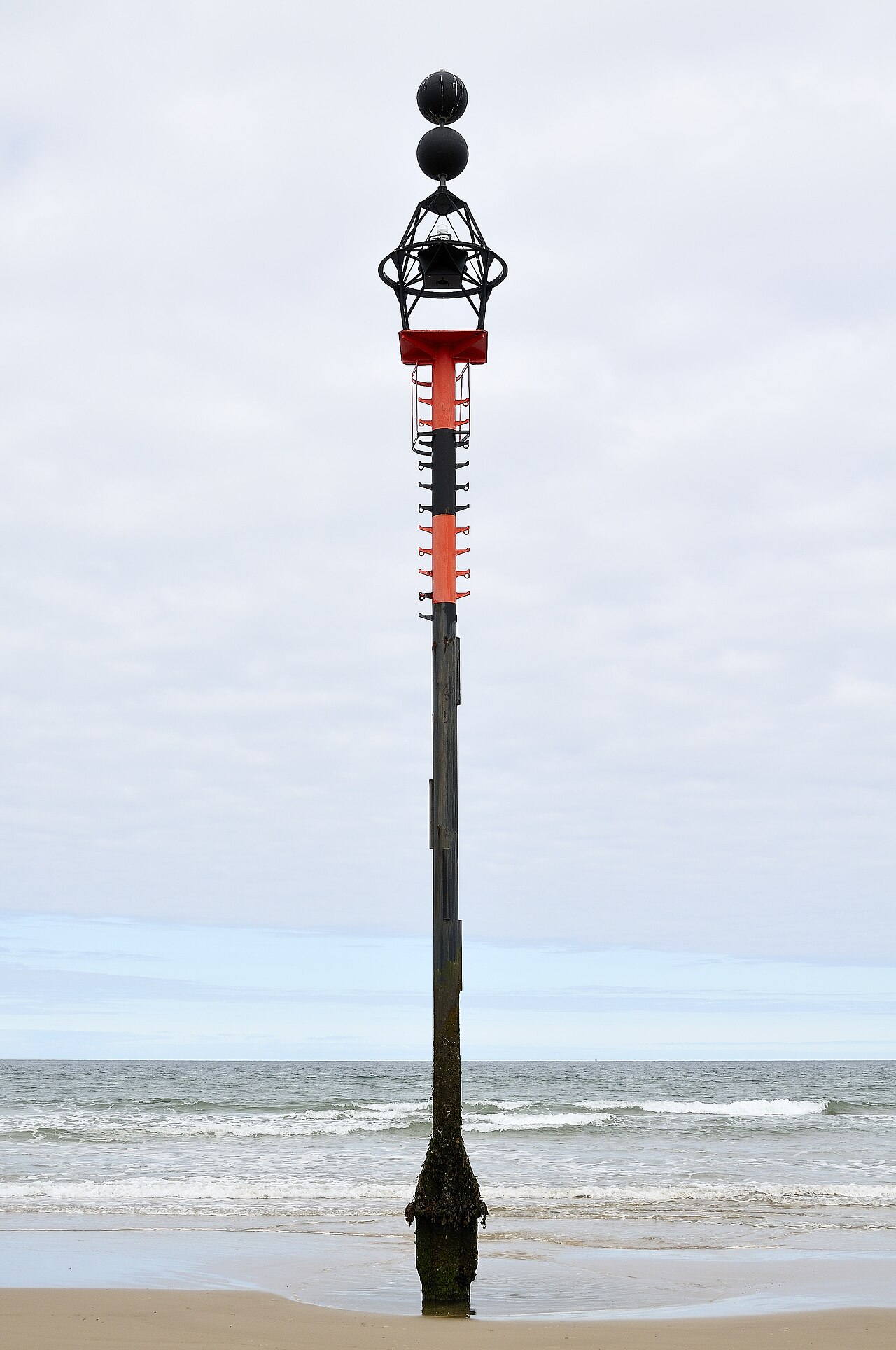
- Purpose: marks an isolated danger of limited extent — a rock, a shoal, a small wreck — that has navigable water all around it.
- The mark is placed on or above the danger. Unlike a cardinal mark, it does not point you to a safe side.
- Topmark: two black spheres, one above the other. This is the most important day feature.
- Colour: black with one or more broad red horizontal bands. Chart letters: BRB.
- Shape: usually pillar or spar. The shape carries no meaning.
- Light: white, flashing in groups of two: Fl(2).
- Memory hook: two spheres, two flashes.
- On the bridge: plan a clearing distance from the charted danger, not from the buoy. A buoy swings round its mooring and can drag off station.
Safe water marks
In short: a red-and-white striped mark that says “the water is good all round here”. It is a welcome sign, not a warning.
- Purpose: shows safe, navigable water all around the mark.
- Typical uses: mid-channel or channel centreline marks, landfall buoys at the seaward start of a buoyed channel, and the best point of passage under a fixed bridge.
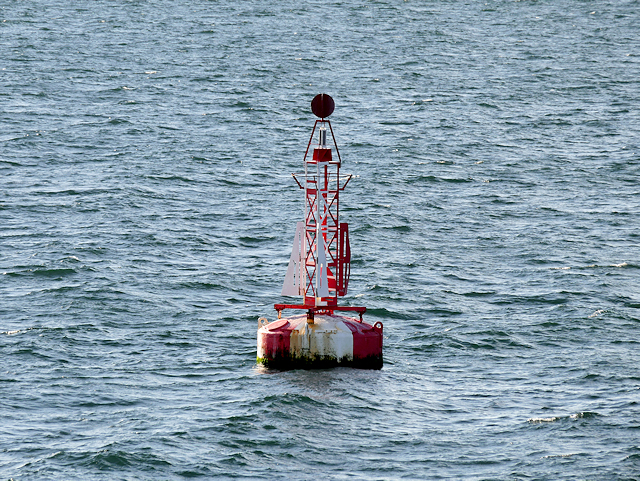
- Colour: red and white vertical stripes — the only IALA mark with vertical stripes. Chart letters: RW.
- Shape: spherical, pillar or spar.
- Topmark (if fitted): a single red sphere.
- Light: always white, one of: Iso (isophase, equal light and dark), Oc (occulting, light longer than dark), LFl 10s (one long flash of at least 2 s every 10 s) or Mo(A) (Morse “A”: short–long, · —).
- Memory hook: one sphere, one long flash.
- On the bridge: a landfall buoy is often the first mark you meet when approaching a port. Use it to confirm your position before you enter the channel.
Sources differ on the light. Older revision flashcards gave only LFl 10s. Other study guides give white Morse A, isophase or occulting. Each is right but incomplete: IALA R1001 allows all four — Iso, Oc, LFl 10s and Mo(A). Learn all four.
Special marks
In short: yellow means “something special here”. Look it up on the chart before you go near it.
- Purpose: not mainly an aid to navigation. It shows a special area or feature.
- Examples: pipelines and cables (including outfall pipes), recreation zones, no-anchoring areas, data buoys (ODAS), spoil grounds, military exercise areas, and traffic separation where normal channel marks could confuse.
- What exactly it marks: check the chart, the sailing directions or the Notices to Mariners.
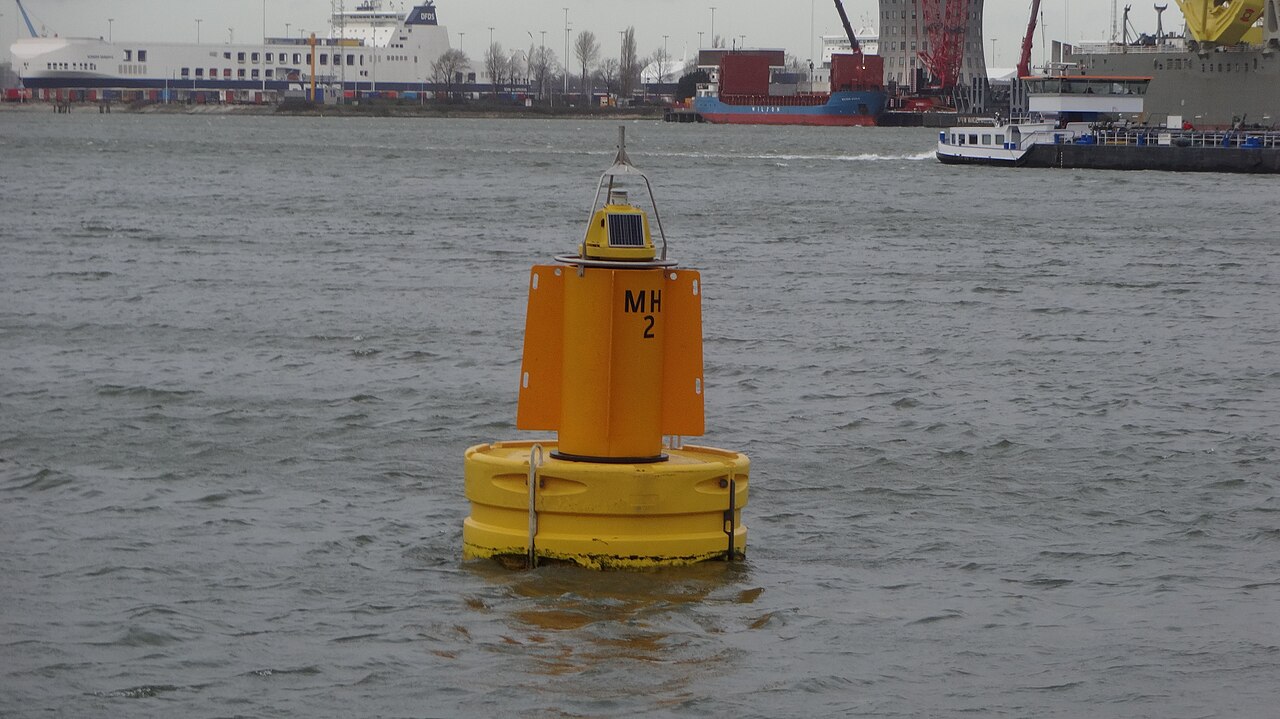
- Colour: yellow. Chart letter: Y.
- Shape: optional, but it must not conflict with navigational marks.
- Topmark (if fitted): a single yellow X (St Andrew’s cross).
- Light (if fitted): yellow, with any rhythm other than those used for white lights of navigational marks — so it cannot be mistaken for a cardinal, isolated danger or safe water light.
- On the bridge: a special mark near a pipeline or cable often means do not anchor and do not trawl. Check the chart before letting go.
Telling them apart
In short: read the topmark first by day, the colour of the light first by night.
| Mark | Topmark | Colour | Light | Meaning |
|---|---|---|---|---|
| Isolated danger | Two black spheres | Black, red band(s) — BRB | White Fl(2) | Small danger here, water all round |
| Safe water | One red sphere (if any) | Red and white vertical stripes — RW | White Iso, Oc, LFl 10s or Mo(A) | Safe water all round |
| Special | Yellow X (if any) | Yellow — Y | Yellow, any rhythm not used for white lights | Special area or feature |
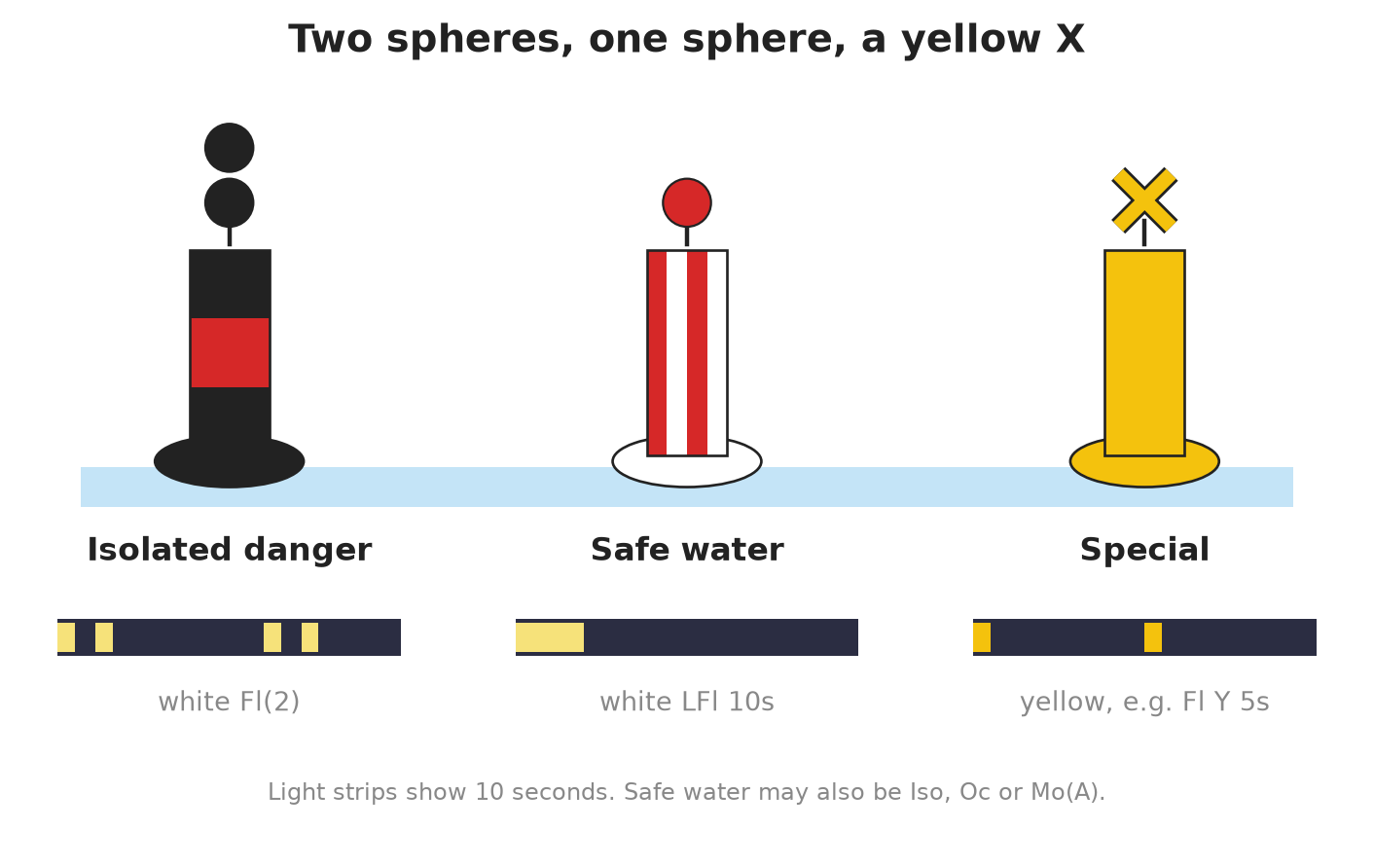
- By night: yellow light → special mark. White light → count it: two flashes in a group = isolated danger; long flash, isophase, occulting or Morse A = safe water; quick or very quick = cardinal.
- Both IALA regions: all three marks are the same in Region A and Region B.
- On the chart: symbols are in INT 1 / Chart 1, Section Q. On ECDIS, pick the object with the cursor to read its full light.
⚡ Flashcards
Test yourself, one card at a timeQ1What does an isolated danger mark tell you?
AnswerThere is a danger of limited extent right under or next to the mark, with navigable water all round it.
Common trapIt does not tell you which side to pass. Keep a wide berth all round.
Q2Describe an isolated danger mark by day.
AnswerTopmark: two black spheres, one above the other. Body: black with one or more red horizontal bands (chart letters BRB). Usually a pillar or spar.
Q3What light does an isolated danger mark show?
AnswerWhite, Fl(2): flashes in groups of two. Hook: two balls, two flashes.
Common trapIt is never red, even though the body has red bands.
Q4What does a safe water mark tell you?
AnswerSafe, navigable water all round the mark: mid-channel, a channel centreline, a landfall, or the best passage under a fixed bridge.
Common trapIt does not mark a danger.
Q5Describe a safe water mark by day.
AnswerRed and white vertical stripes (the only IALA mark with vertical stripes, chart letters RW). Spherical, pillar or spar. Topmark, if fitted: one red sphere.
Q6Give the possible lights of a safe water mark.
AnswerAlways white, one of four: Iso, Oc, LFl 10s or Morse “A” (IALA R1001).
Common trapLearning only one of them. Different revision sources each list only part of the set.
Q7What is a special mark for? Give examples.
AnswerNot mainly for navigation: it shows a special area or feature such as pipelines and cables, recreation zones, no-anchoring areas, data buoys (ODAS), spoil grounds, military exercise areas. The chart or a Notice to Mariners says what it marks.
Q8Describe a special mark and its light.
AnswerYellow body, shape optional. Topmark, if fitted: a yellow X. Light: yellow, any rhythm not used for white lights.
Common trapA white light is never a special mark.
Q9At night you see a white Fl(2). Which mark is it, and what do you do?
AnswerAn isolated danger mark. Find it on the chart, give it a wide berth and do not pass close on any side.
Q10Are these three marks different in IALA Region B?
AnswerNo. Isolated danger, safe water and special marks are the same in both regions. Only lateral mark colours change.
📚 Resources
Books
- NP735 IALA Maritime Buoyage System — UK Hydrographic Office (ADMIRALTY), 8th edition (2018)
Regulations
- IALA Recommendation R1001 — The IALA Maritime Buoyage System — Edition 2.0 (revised June 2023)
- SOLAS V/13 — establishment and operation of aids to navigation
Official sites
- Isolated danger marks — Trinity House
- Safe water marks — Trinity House
- Special marks — Trinity House
- Canadian Chart 1 — Section Q, IALA buoyage — Canadian Hydrographic Service (chart symbols for all three marks)
Exam focus — MCA
Typical questions • “Describe an isolated danger mark” → two black spheres, black with red band(s), white Fl(2), danger of limited extent with water all round. • “Give the light of a safe water mark” → white: Iso, Oc, LFl 10s or Morse A — name all four. • “Where would you find a safe water mark?” → mid-channel, centreline, landfall, best passage under a fixed bridge. • “What is a yellow buoy for?” → special mark: pipelines, cables, recreation zones, no-anchoring areas, data buoys; check the chart or Notices to Mariners. • “Describe the light sequence for every buoy” → these three sit beside the lateral and cardinal marks in that answer. What examiners look for: the same fixed order every time — topmark, colour, light, meaning — and the action you would take on the bridge. Never call a white light a special mark.